.svg)

Best AI proposal writer for public sector sellers in 2026

If you sell into state and local government, K–12, and higher education, an AI proposal writer can be the difference between chasing every RFP and winning the right ones faster.
This article evaluates five tools across five capability areas that matter when you’re selling into government and education.
What to look for in an AI proposal writer
These five capabilities are the criteria that separate a tool that only drafts responses from one that builds pipeline and carries a deal to a signed contract in government and education.
- Identifying pre-RFP opportunities. Board meetings, budget releases, grant awards, and leadership changes produce buying signals months before a solicitation is published. Government and education buyers are rarely experts in the solution they need, so they consult vendors early to learn what is possible. The vendor that monitors these sources and educates the buyer often shapes the evaluation criteria before competitors know the opportunity exists.
- Contact and account data quality. The data source behind your contact records decides whether outreach reaches the right person or bounces. Decision-makers in state and local government, K–12, and higher education rarely maintain current LinkedIn profiles. Tools that draw heavily from commercial web data see high bounce rates that waste rep time and hurt deliverability in a finite market where sender reputation matters.
- Visibility into what agencies and institutions are already buying. Knowing the incumbent vendor, contract value, and expiration date changes how a rep positions in a discovery call. A purchase order shows a line item and a price, but a full contract reveals opt-out clauses, implementation fees, and renewal timelines. That context is what lets a rep walk in already knowing how to compete.
- Finding and responding to RFPs efficiently. A centralized, scored feed of bid portals saves hours of portal-hopping across thousands of state, local, and education procurement sites. AI-assisted drafting then compresses response time from days to hours. A team that spends less time on setup and formatting can respond to more best-fit opportunities without adding headcount.
- Contract vehicle access that removes procurement friction. Above a buyer's sole-source threshold, a deal either routes through an existing cooperative contract or triggers a full competitive solicitation that adds months. A cooperative contract is a pre-competed purchasing agreement that agencies can buy through without running their own RFP. Vendors who can transact through vehicles like NASPO, OMNIA, Sourcewell, and TIPS give procurement offices a faster, compliant path to purchase.
No capability works to its full potential alone. An early buying indicator is only useful with an accurate contact to act on it. That contact only converts with enough account context for a relevant conversation, and that conversation only becomes a proposal if the team finds the RFP in time.
A won proposal then becomes revenue faster when the buyer has a contract vehicle to purchase through without triggering a months-long process. No single capability outranks the others, and together they form one motion from buying signal to closed deal. The platforms in this article differ in how much of that motion they cover end-to-end versus how much they leave teams to stitch together across research, enrichment, outreach, and procurement.
1. Starbridge
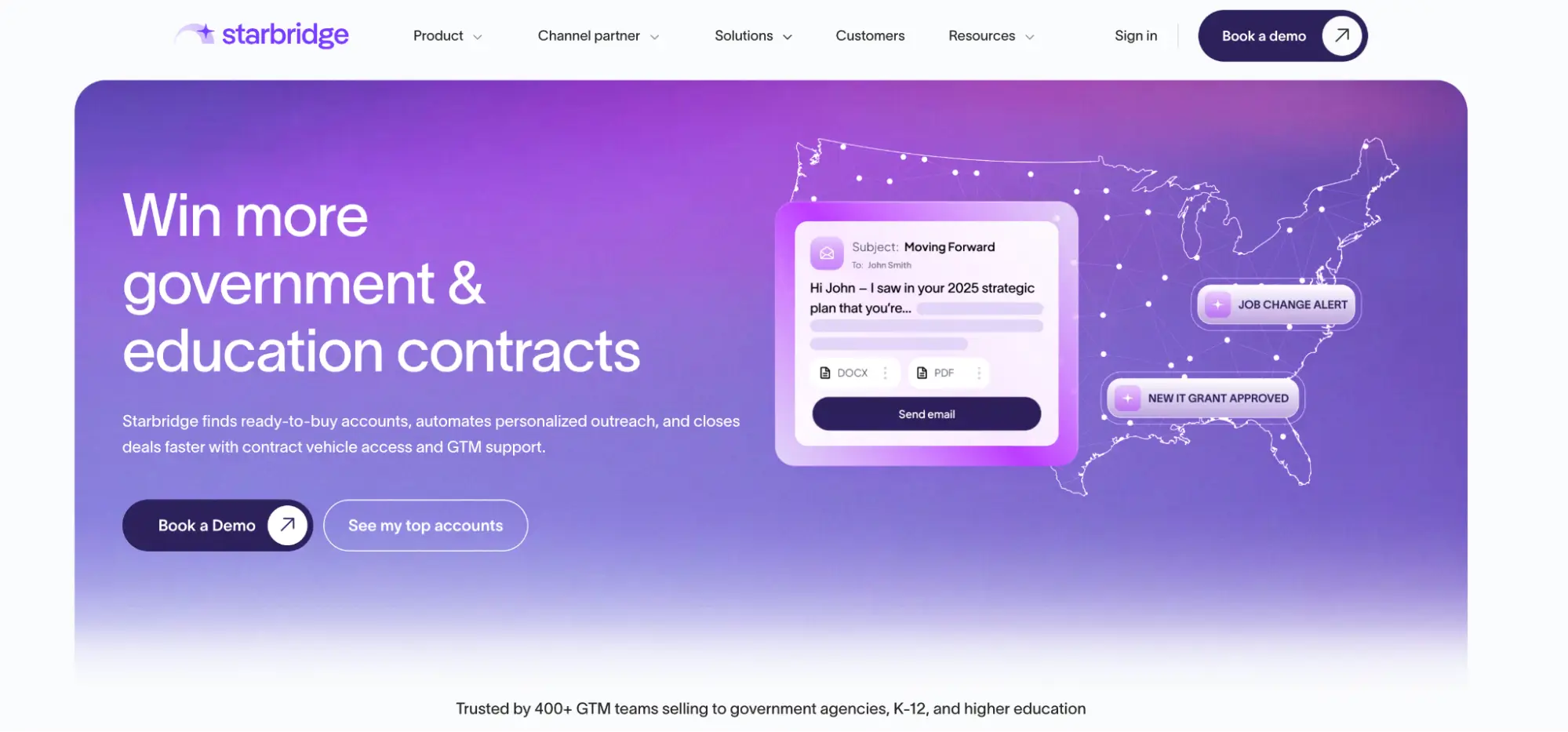
Starbridge is the AI sales intelligence platform built for companies selling to state and local government, K–12, and higher education. It goes beyond drafting a proposal, carrying a deal from the earliest buying indicator through outreach, RFP response, and procurement to a signed contract. Trusted by more than 450 GTM teams, it’s a strong candidate for the best AI proposal writer for public sector sellers who want more than a drafting tool.
What Starbridge does well
Starbridge is built around five capabilities that cover the full government and education sales workflow.
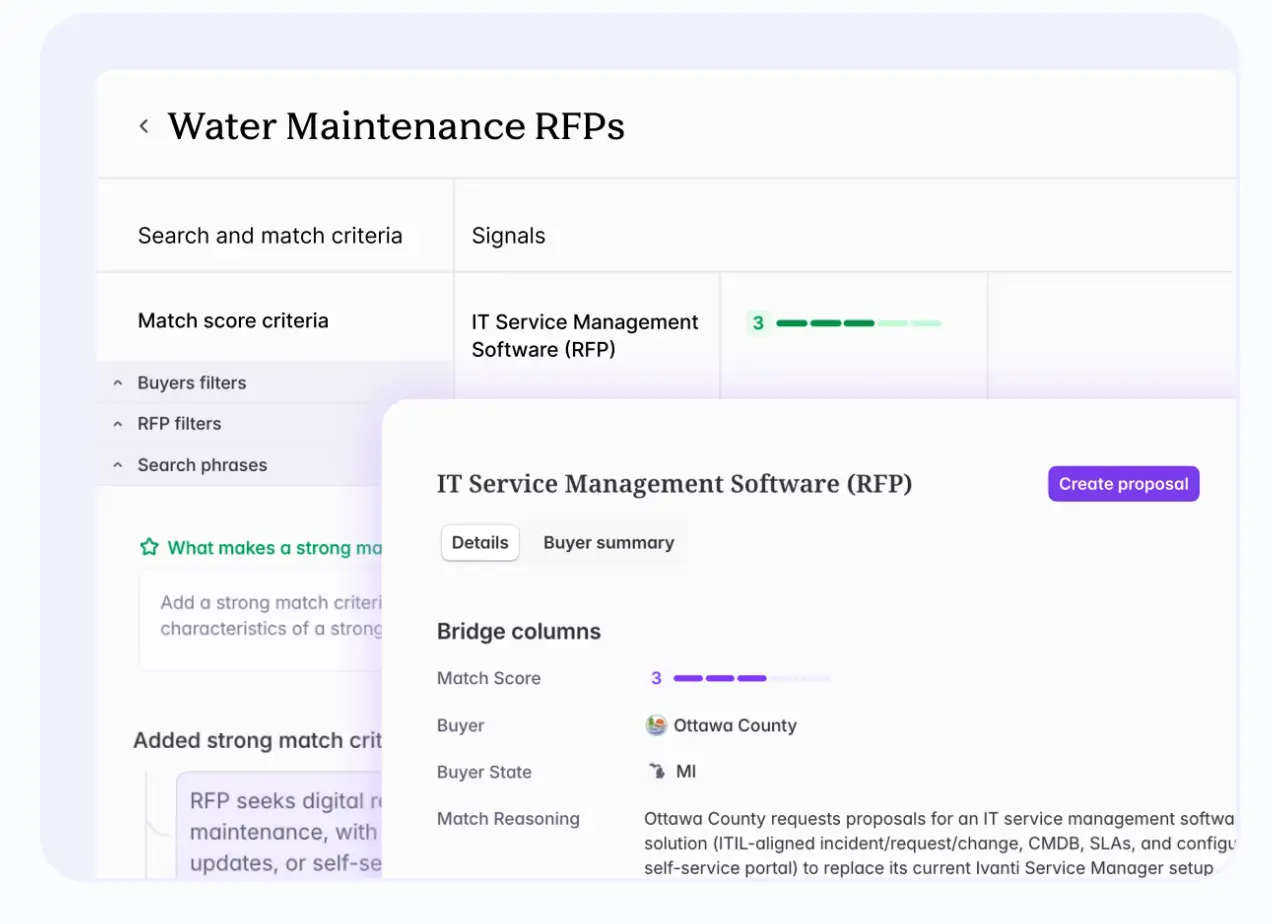
The AI RFP Finder & Proposal Writer is the on-keyword capability, and it starts by centralizing thousands of state, local, and education bid portals into one personalized feed. Starbridge then scores each RFP by product fit, region, and win likelihood so reps chase the right pursuits, and it flags RFPs that already name a competitor so teams do not waste time on wired deals. The AI proposal writer drafts from the team's product knowledge base, cutting response time by up to 50% and saving 8 to 10 hours per RFP. That means a lean team responds to more best-fit opportunities without adding staff.
Feeding that RFP work is the Buying Signal Monitor, which surfaces demand before a solicitation ever appears. A buying signal is an early sign that a district, university, or state or local agency is planning to spend, such as a new grant, a budget line item, or a contract about to expire. Starbridge monitors 320K+ entities for board minutes, budgets, grants, leadership changes, and contract expirations, then delivers a warm lead with a verified contact, the reason timing is right, and AI-generated outreach pushed into Salesforce, HubSpot, Apollo, and Outreach. GovWell shows what that looks like in practice, sourcing 15% of its total qualified pipeline from Starbridge and turning it into a repeatable channel rather than a one-time lift.
Every warm lead is only as good as the contact attached to it, which is where Contacts & Company Data comes in. Starbridge sources verified names, emails, and phone numbers for decision-makers across 320K+ entities using proprietary web-agent crawls of .gov and .edu domains, waterfall enrichment, and continuous bounce-checking. That approach hits 98% email accuracy over a 14,000-email test, well above the 60 to 70% typical of databases that draw heavily from LinkedIn and commercial sources. Native Salesforce and HubSpot integrations then sync, clean, and enrich contact records bi-directionally, so the data reps act on stays current. ClearGov consolidated several data providers into Starbridge and enriched 65,000 accounts with 47,000 net-new verified contacts at 98% deliverability, which gave its reps a book of business built on records that actually reach someone.
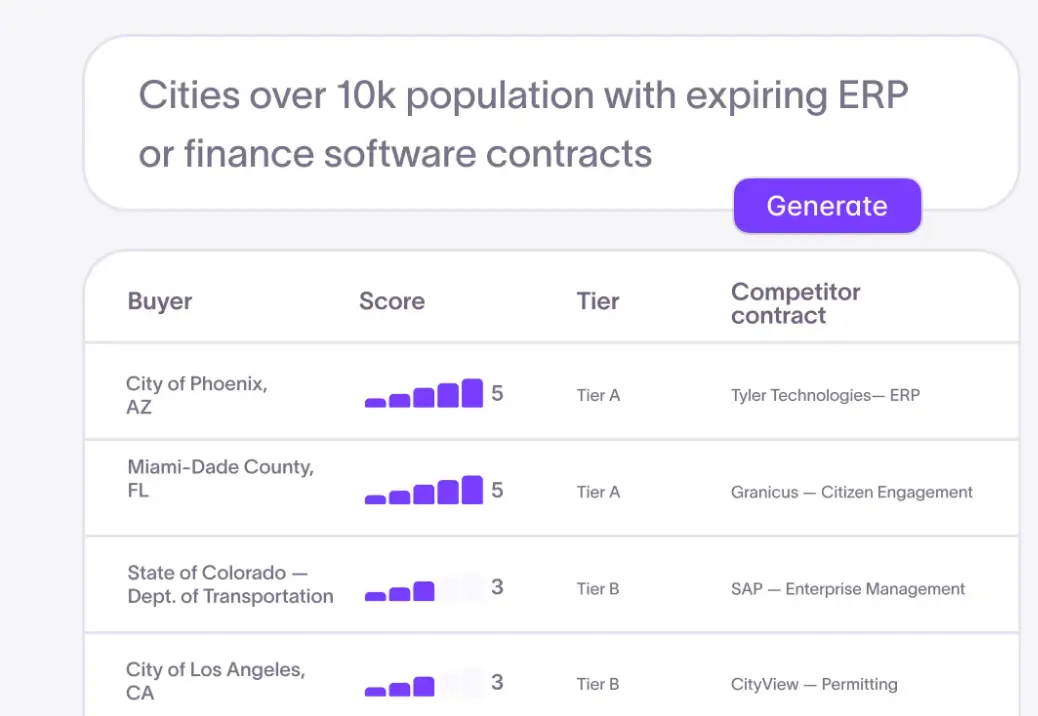
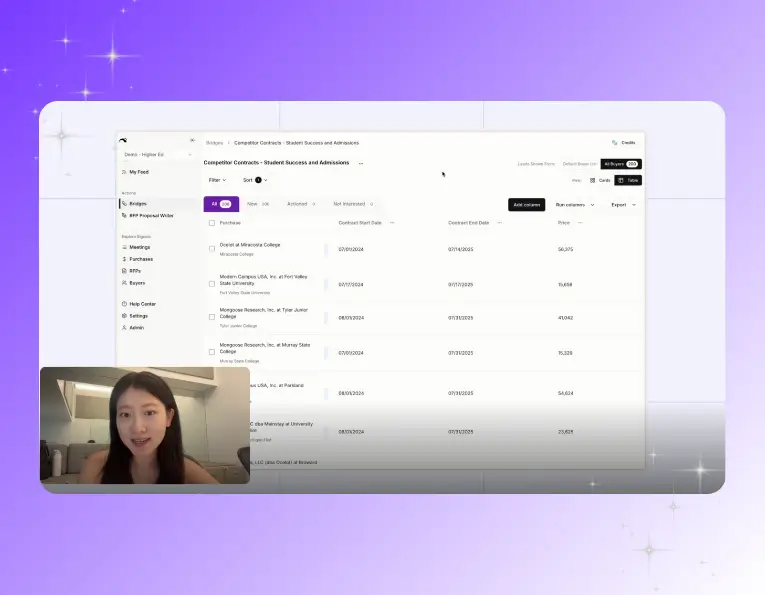
Complementing that contact layer is Public Spend Intelligence, which tells reps what an account is already buying and from whom. Starbridge surfaces full competitor contracts with pricing, opt-out clauses, and expiration dates through FOIA automation, plus purchase order data for 77% of state and local government, K–12, and higher education institutions out of the box. Frontline Education put this to work and cut research time by 90%, so its reps walk into meetings already knowing account priorities, competitive context, and spend history. The conversation starts at the problem instead of the introduction.
The fifth capability, Contract Vehicle & Reseller Access, carries a won deal across the finish line. Starbridge provides contract vehicle access directly as part of the platform, so a won deal turns into a signed purchase order in weeks instead of months. Vendors onboard once, then get approved across NASPO ValuePoint, OMNIA Partners, Sourcewell, and TIPS, and Starbridge handles the compliance, paperwork, and renewals. That closes the procurement gap that usually stalls a deal after the buyer has already said yes.
Where Starbridge falls short
Starbridge delivers deeper sales intelligence for state and local government and education than it does for federal contracting. Teams whose core market is federal defense or civilian agencies will find platforms tuned specifically to that motion, and Starbridge is the strongest fit when state and local government and education is the primary market.
Best for
Starbridge is best for enterprise and mid-market revenue teams whose core motion is selling to state and local government, K–12, and higher education. It fits teams that want an AI proposal writer sitting inside a full signal-to-signed-contract motion rather than a standalone drafting tool, and that are ready to consolidate research, enrichment, RFP response, and procurement into one platform.
2. Loopio
Loopio is RFP and proposal response software for teams handling a high volume of RFPs, RFIs, security questionnaires, and due diligence questionnaires. It centralizes approved content into a library and uses AI to speed up responses. Loopio is most widely used in SaaS, financial services, healthcare, and business services.
What Loopio does well
Loopio's connected content library and response intelligence let teams reuse vetted, approved answers across any project. Its AI is grounded in more than a decade of response data, so reps and proposal managers pull answers instantly instead of rebuilding them each time.
The collaboration and workflow layer keeps complex responses on track. Automated workflows, multi-step reviews, and SME assignments coordinate contributors across teams, while strategic-oversight views surface win and loss trends across projects.
Loopio also connects to the tools teams already run. Enterprise integrations span Salesforce, HubSpot, Microsoft Dynamics, Slack, Highspot, Seismic, and the Microsoft suite.
Where Loopio falls short
Loopio is a horizontal response-management tool tuned to regulated commercial industries like SaaS, financial services, and healthcare, where security questionnaires and DDQs are common. Its content and workflows are organized around those response types rather than the board-minutes, budget, and procurement patterns that drive state and local government, K–12, and higher education sales. Teams selling into that market may find the fit stronger for questionnaire volume than for public-sector pursuit strategy.
Contract vehicle access is not part of the offering as of July 2026.
Best for
Loopio is best for enterprise proposal and bid teams responding to a high volume of RFPs, security questionnaires, and DDQs across commercial industries. It fits teams that need a shared content library and a structured collaboration workflow more than they need pre-RFP intelligence.
3. GovDash
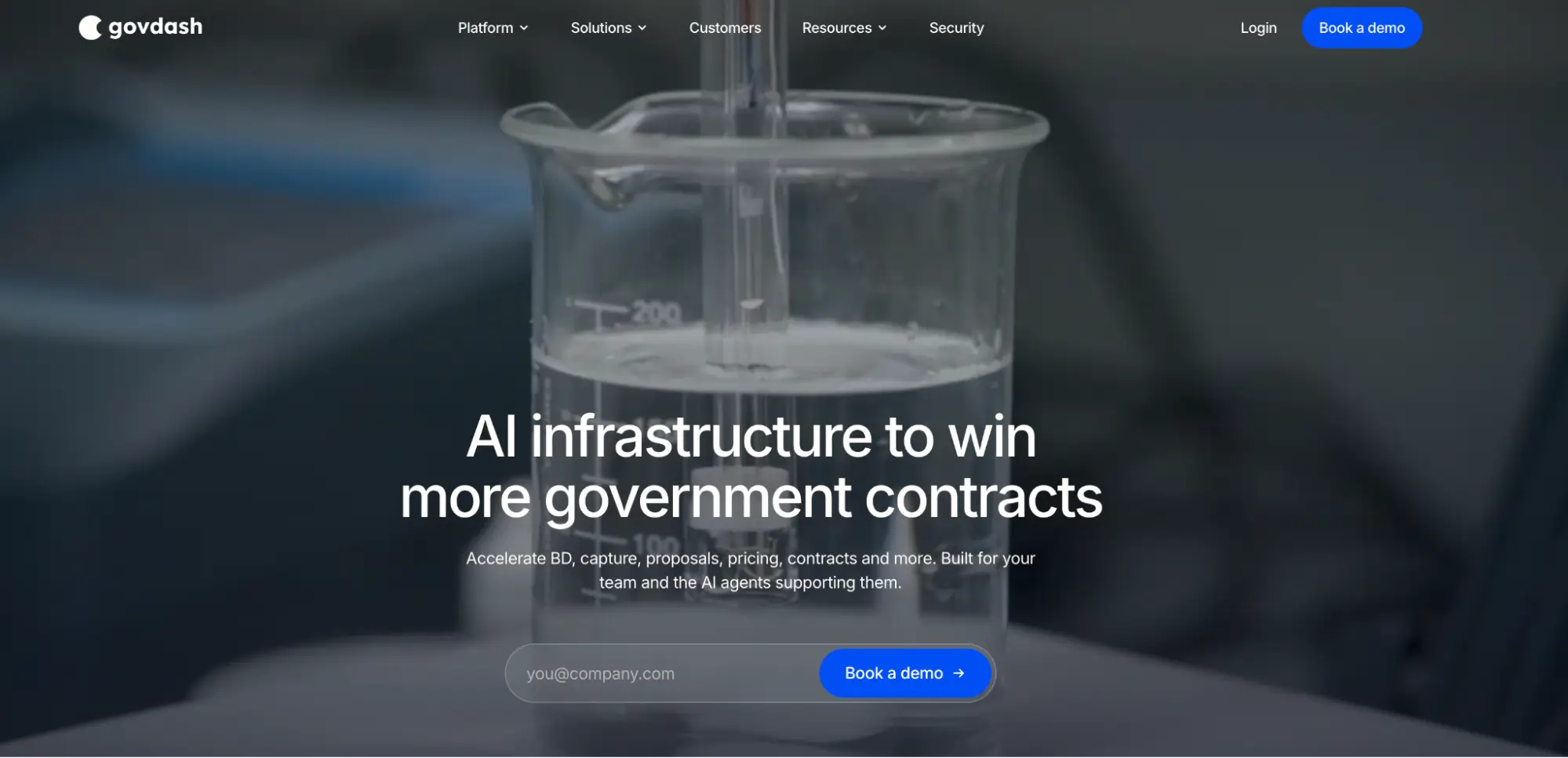
GovDash is a government contracting platform spanning discovery, capture, pricing, proposal, and contract management, with an AI agent called Dash. It leans towards government contracting and serves defense, federal civilian, health, and state and local government contractors.
What GovDash does well
GovDash automates the path from solicitation to draft. It reads the full solicitation, builds a compliance matrix, surfaces relevant past performance, and lets teams draft inside Microsoft Word with citations.
The platform unifies the GovCon lifecycle in one place. Discovery spans SAM.gov, GSA eBuy, and more, capture adds structured gate reviews and pricing templates, and contract management tracks modifications and feeds past performance back into the next bid.
GovDash also carries a strong compliance and security posture for federal work. That includes FedRAMP Moderate equivalency, CUI protection aligned to DFARS, US-based personnel, and a self-hosted deployment option.
Where GovDash falls short
Contract vehicle access is not part of the offering as of July 2026. GovDash's GSA eBuy connection surfaces opportunities to pursue, which is distinct from getting a vendor onto a vehicle and transacting through it.
Best for
GovDash is best for federal and defense contractors, including small businesses that want to compete like a prime. It fits teams that need an integrated capture-through-contract workflow with a strong compliance posture.
4. pWin.ai
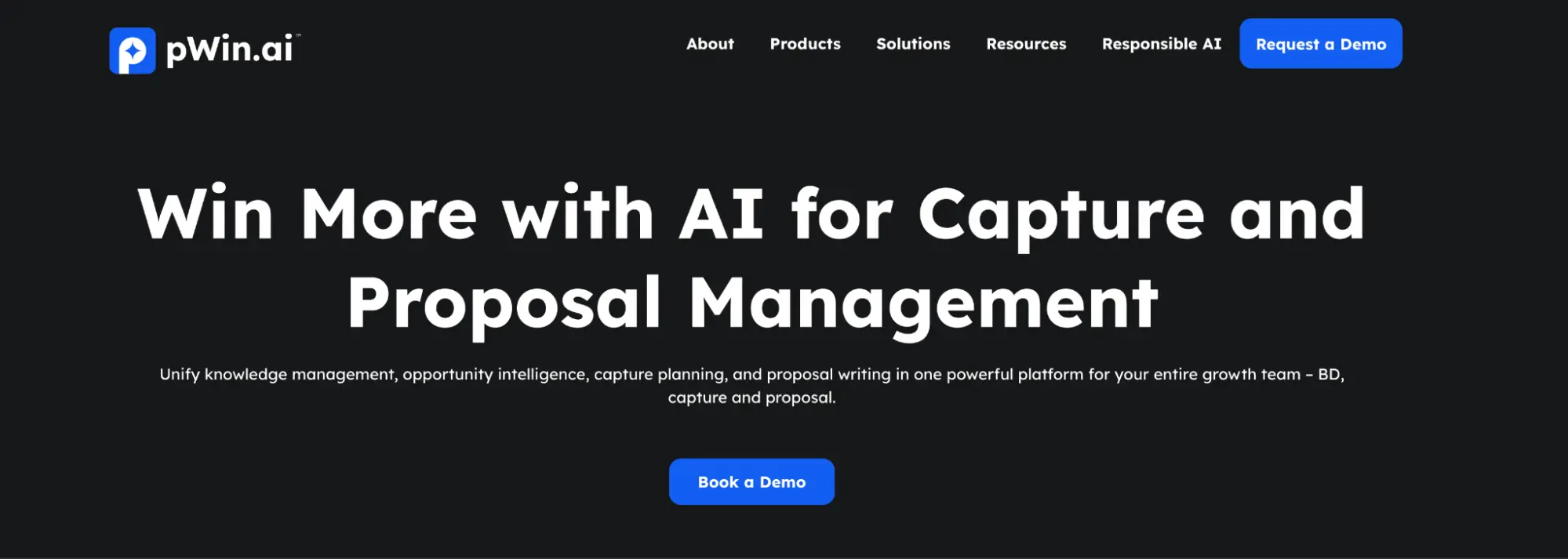
pWin.ai is an AI capture and proposal platform for government contractors that unifies knowledge management, opportunity intelligence, capture planning, and proposal writing for BD, capture, and proposal teams. It’s co-developed with Shipley and carries FedRAMP Moderate equivalency for handling CUI.
What pWin.ai does well
pWin.ai generates proposals grounded in Shipley methodology. Its response process reads the solicitation, builds an annotated outline, maps requirements to sections, and drafts a full response using official templates.
The platform connects capture planning to knowledge management. It extracts win themes, customer pain points, and competitor positioning from capture artifacts. It also retrieves stored content through its Knowledge Repository, and uses a Readiness Report to flag capability gaps and teaming needs before a solicitation drops.
pWin.ai adds integrates market intelligence and contracts platforms such as TechnoMile, connects to CRM, and generates RFI and questionnaire responses from stored content.
Where pWin.ai falls short
pWin.ai leans towards federal GovCon proposal operations grounded in FAR-driven solicitations and Shipley methodology. Its opportunity intelligence flows from federal market and contracts data rather than the K–12 board discussions and municipal budget cycles that drive state and local outreach.
Contract vehicle access is not part of the offering as of July 2026.
Best for
pWin.ai is best for federal contractors, capture, and proposal teams that want Shipley-quality AI drafting and structured capture planning unified in a single platform.
5. GovSignals
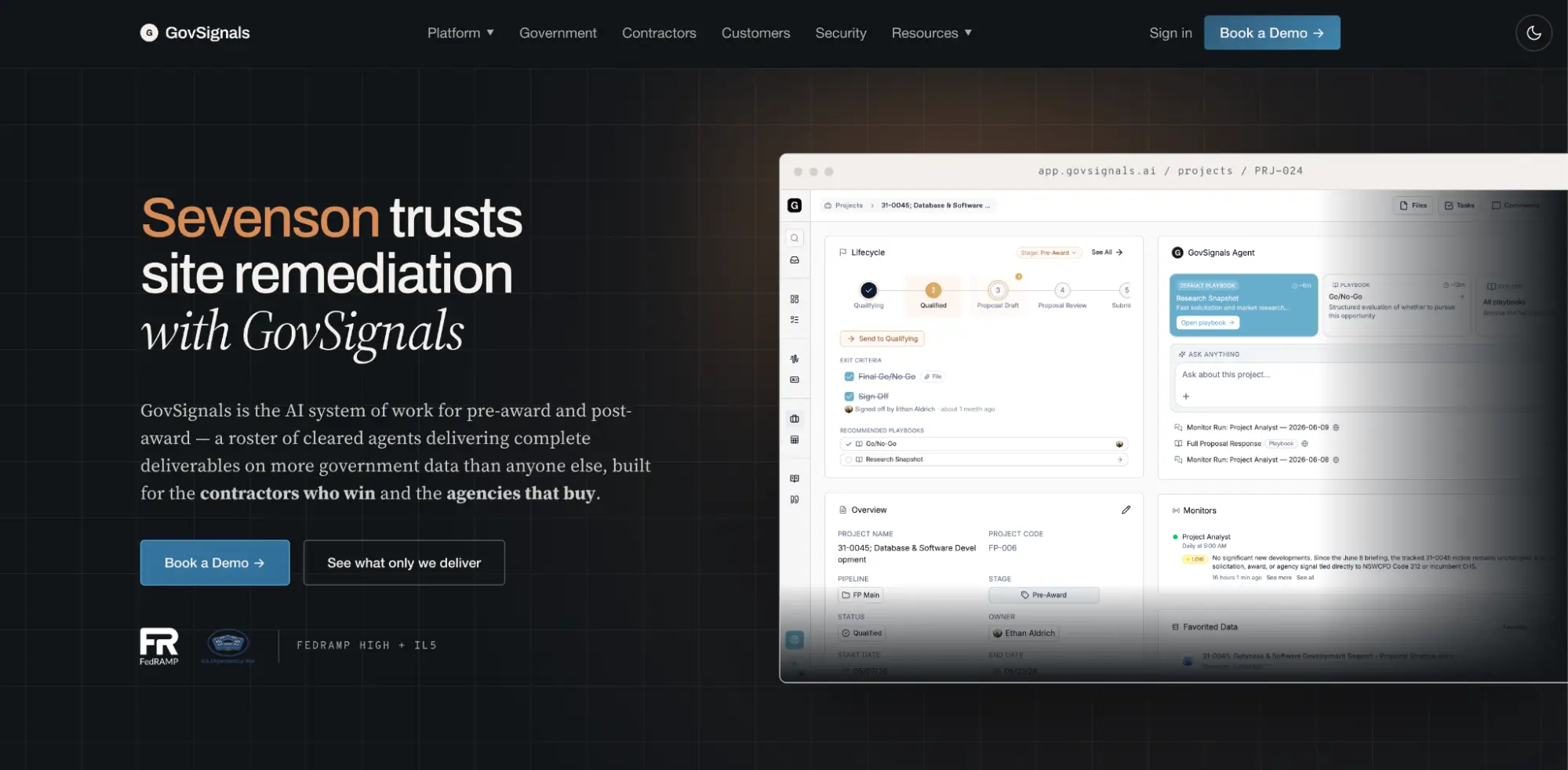
GovSignals is as an AI system of work for GovCon, spanning market intelligence, capture, proposals, pricing evidence, post-award, and contract lifecycle management. It uses source-cited AI agents across federal, state, and local government data and carries a high security posture.
What GovSignals does well
GovSignals produces source-cited work products across the proposal workflow. It generates a cited market brief, a bid or no-bid memo, a compliance matrix, a proposal outline, and a first-draft response plan, with every output traceable back to the notices, awards, budgets, or documents that support it.
The platform carries a high security posture for sensitive work. It’s FedRAMP High authorized, IL5-ready, SOC 2 Type II certified, and ITAR-aligned, which fits teams handling CUI and defense-adjacent data.
GovSignals also covers the full lifecycle from pre-award to post-award. It ties data signals to capture, proposal, pricing evidence, post-award oversight, and consortium management in one system.
Where GovSignals falls short
GovSignals is more oriented to federal GovCon teams operating in high-security, CUI-heavy environments. Teams selling to school districts and city departments may pay for a large surface area they will never open.
Best for
GovSignals is best for federal GovCon teams, especially in defense and CUI-heavy environments, that need a security-cleared, source-cited system of record from pre-award through post-award.
Which AI proposal writer is right for you?
If you respond to a high volume of commercial RFPs, security questionnaires, and DDQs and mostly need a content library and collaboration workflow, Loopio may be enough for your team. Its library and workflow focus on that response-heavy motion.
If your core market is federal or defense contracting and you need a compliance-heavy, capture-to-contract workflow, GovDash, pWin.ai, and GovSignals are each worth a look. The right pick among them depends on how much security posture and lifecycle coverage your programs require, from FAR-driven drafting to FedRAMP High and IL5 environments.
If you sell to state and local government, K–12, and higher education and want an AI proposal writer that sits inside a full motion, Starbridge is the clear choice. It carries a deal from an early buying signal through verified contacts, spend intelligence, RFP response, and contract vehicle access, so your team works one connected workflow.
Book a Starbridge demo to see how the platform helps your revenue team close more deals in government and education, from the first buying signal to a signed contract.
Frequently asked questions
Starbridge is the best AI proposal writer for public sector sellers whose market is state and local government, K–12, and higher education. That’s because its proposal writer sits inside a full signal-to-contract motion. Loopio fits teams responding to a high volume of commercial RFPs, security questionnaires, and DDQs. GovDash, pWin.ai, and GovSignals each fit federal and defense contractors that need capture-to-contract workflows and high-security postures. The best choice depends on your primary market and how much of the motion you want in one platform.
Look for a platform that covers the full sales motion rather than one stage of it. The strongest tools connect pre-RFP opportunity detection with verified contact data and vendor spend visibility. They then cover RFP discovery and drafting alongside contract vehicle access, so a won deal reaches a signed contract faster. A platform that covers only one or two areas leaves your team stitching the rest together by hand, from research and enrichment through outreach and procurement.
Starbridge offers the most accurate contact data in this group for government and education buyers, at 98% email accuracy over a 14,000-email test. Rather than drawing heavily from LinkedIn and commercial sources, it runs proprietary web-agent crawls across .gov and .edu domains, then waterfall enriches and continuously bounce-checks the results. Decision-makers in state and local government, K–12, and higher education rarely keep current LinkedIn profiles, so that sourcing difference shows up in deliverability. If contact accuracy is your deciding factor, test Starbridge's data against your current provider on a sample of your own accounts.
Starbridge surfaces buying intent before an RFP is published, which is where public-sector deals are often won or lost. Its Buying Signal Monitor tracks board minutes, budget releases, and contract expirations across 320K+ entities, then delivers a warm lead with a verified contact and a reason to reach out. Because government buyers consult vendors early to learn what is possible, engaging months before a solicitation lets a team shape the evaluation criteria. Loopio, GovDash, pWin.ai, and GovSignals center on opportunities that are already posted or forecasted.
Starbridge is the tool in this group built to shorten the time from a qualified buyer to a signed contract, not just to surface opportunities. When a deal stalls in procurement after the buyer says yes, its contract vehicle access gives them a pre-approved path to purchase through vehicles like OMNIA Partners, TIPS, and Sourcewell. Starbridge provides this access as part of the platform and handles the compliance, paperwork, and renewals itself. The other four tools do not publicly state contract-vehicle sell-through as a capability as of August 2026.
Starbridge is priced as a premium platform scoped for enterprise and mid-market revenue teams, so the earliest-stage companies should weigh that against their budget. A founder-led team doing light outbound can still get value, but the platform is built for teams with a funded, ongoing government and education motion. It’s also stronger for state and local government and education than for federal work. Teams that need only a single point tool for one job may find a narrower product a better fit.
Explore our use case library
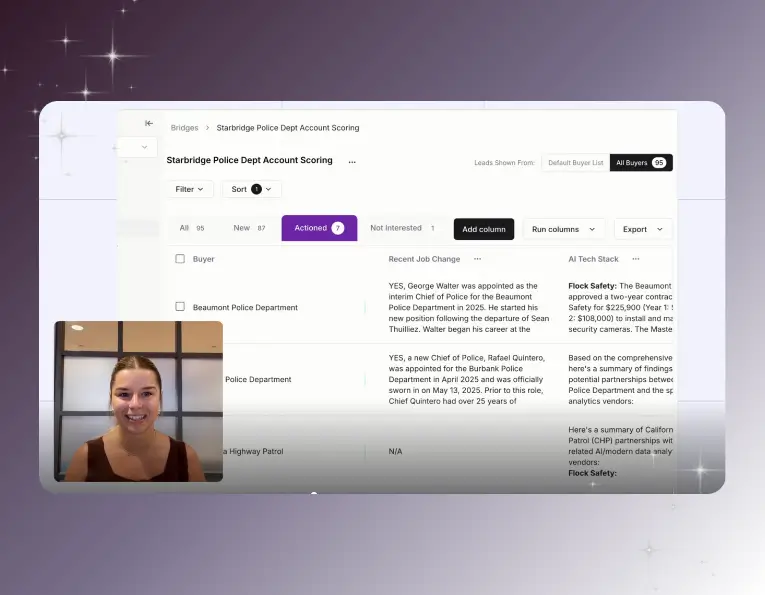
Ready to give your SLED team real leverage?
Let’s talk about how Starbridge can build a qualified pipeline for your current team — without adding headcount.