.svg)

BidNet Direct alternatives: 4 tools for government and education sales intelligence in 2026

If you sell to state and local government, K–12, and higher education, you may already use BidNet Direct to catch and respond to published bids across those markets. However, many teams reach a point where they want to grow faster, or build a more complete picture of their buyers.
This guide evaluates four BidNet Direct alternatives across five capability areas that matter for government and education sales intelligence.
What to look for in a government and education sales intelligence tool
The five capability areas below work as the evaluation criteria for any tool in this category:
- Identifying opportunities before they go to RFP. Board discussions, budget releases, and grants produce buying indicators months before a formal solicitation appears. So do leadership changes and expiring contracts. Buyers are rarely experts in the solution they need, so they consult vendors early to learn what is possible. The vendor who engages first helps shape the requirements that end up in the RFP.
- Contact and account data quality. The data source decides whether outreach reaches the right decision-maker or a stale record. Decision-makers in state and local government, K–12, and higher education rarely maintain active LinkedIn profiles. Tools that draw heavily from commercial web data reach this market poorly.
- Visibility into what agencies and institutions are already buying. Knowing the incumbent vendor, contract value, and expiration date changes how a rep positions in a discovery call. Procurement records are public, yet they sit fragmented across thousands of agencies and portals. Pulling them together by hand takes hours a rep does not have.
- Finding and responding to RFPs efficiently. Response windows are short, and a centralized, scored feed cuts the portal-hopping that eats a rep's day. AI-assisted drafting then compresses proposal time from days to hours. Teams that centralize discovery and response move faster than teams juggling a dozen portals.
- Contract vehicle access that removes procurement friction. After a buyer says yes, procurement can still add months before a contract is signed. Access to the cooperative or federal vehicle a buyer already uses lets a won deal skip a full RFP and move to a signed purchase order. That shortens the gap between a verbal commitment and signed paperwork.
All of the above capabilities work together as one motion. That motion carries a deal from the first buying indicator through outreach and procurement to a signed contract. No single capability outranks the others, since a gap in any one stalls the deal.
The platforms in this guide differ in how much of that motion they cover end-to-end versus how much they leave teams to put together manually across research, enrichment, outreach, and procurement.
1. Starbridge
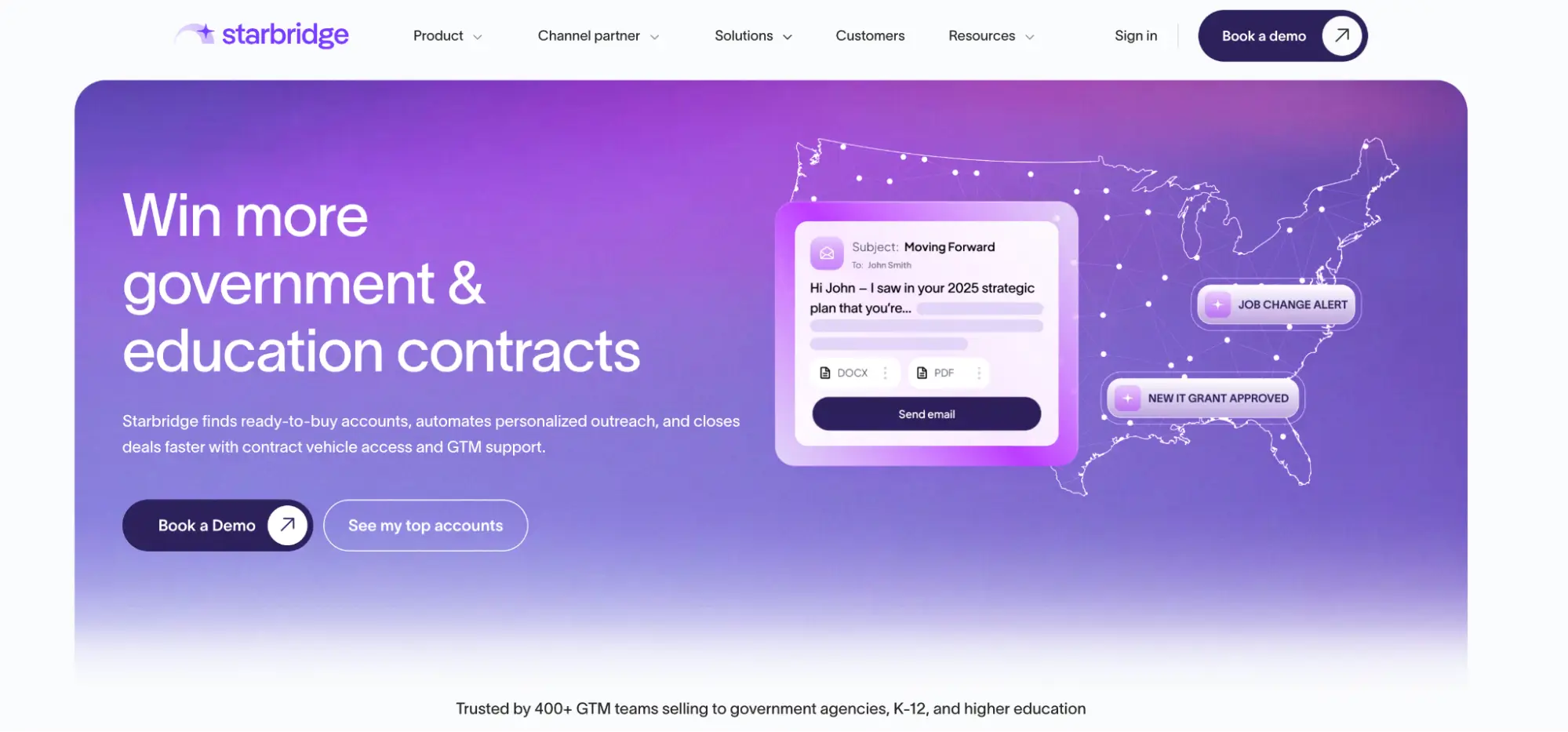
Starbridge is the AI sales intelligence platform built for companies selling to state and local government, K–12, and higher education. More than 400 GTM teams use it to surface buying intent before competitors know the opportunity exists. The platform connects that intelligence straight to the tools reps already work in. Starbridge earns the top spot here because it covers the full motion from buying indicator to signed contract in one place.
What Starbridge does well
Starbridge is built around five capabilities that cover the full government and education sales workflow.
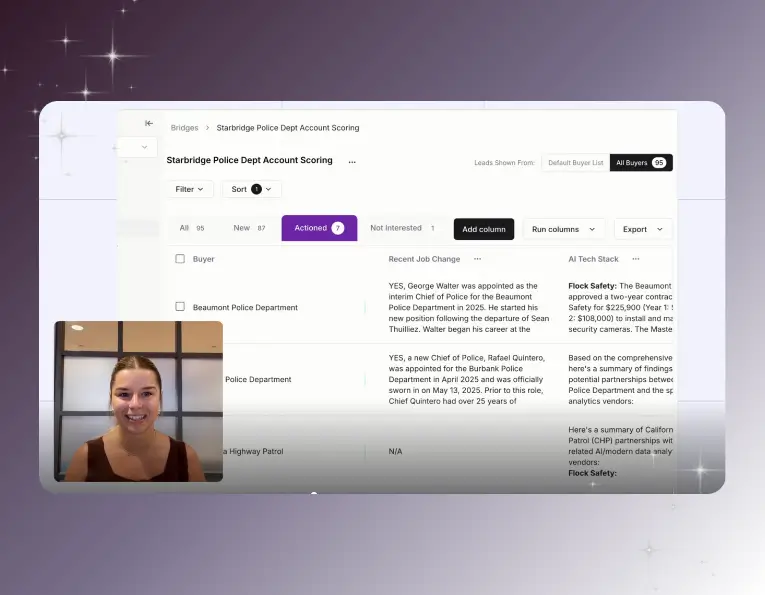
The workflow starts with Starbridge's Buying Signal Monitor, which watches 320K+ government and education entities for early buying indicators. The signal monitor reads board minutes, budgets, grants, leadership changes, and contract expirations, with bids weighted last. Every indicator fires with a verified contact, a reason to reach out, and AI-drafted copy pushed into Salesforce, HubSpot, Apollo, and Outreach. GovWell, for one, sources 15% of its total qualified pipeline from Starbridge.
From there, Starbridge's Contacts & Company Data turns each signal into reachable people. Purpose-built web-agent technology pulls verified contacts from .gov and .edu domains, backed by waterfall enrichment and continuous bounce-checking. That approach delivers 98% email accuracy, so reps reach verified, deliverable contacts instead of chasing dead ends. Bi-directional Salesforce and HubSpot integrations then sync, clean, and enrich every record automatically.
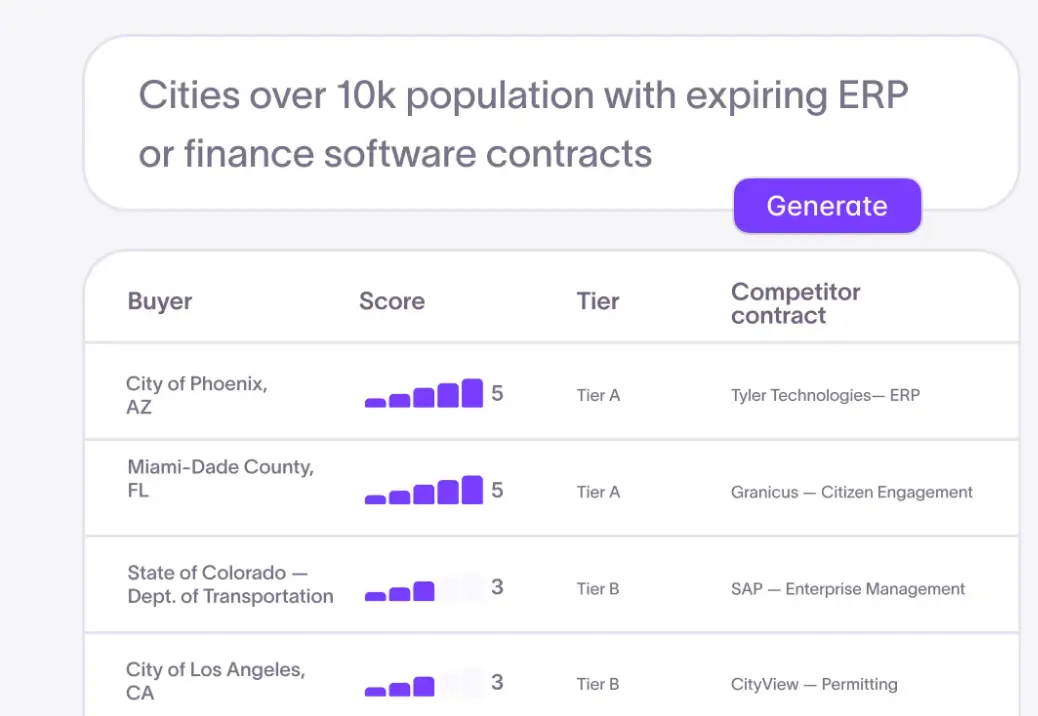
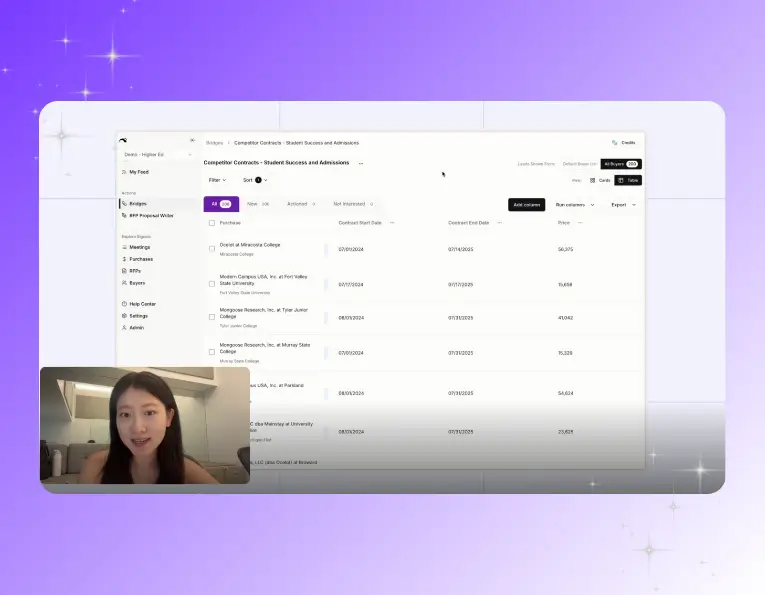
Once outreach starts, Starbridge's Public Spend Intelligence tells a rep what an account already buys. FOIA automation at scale surfaces full competitor contracts, unredacted proposals, opt-out clauses, and expiration dates, not just line items. Out of the box, Starbridge has the purchase order data for 77% of state/local government, K12, and Higher Ed institutions. Frontline Education cut its account research time by 90% after putting that context in front of reps.
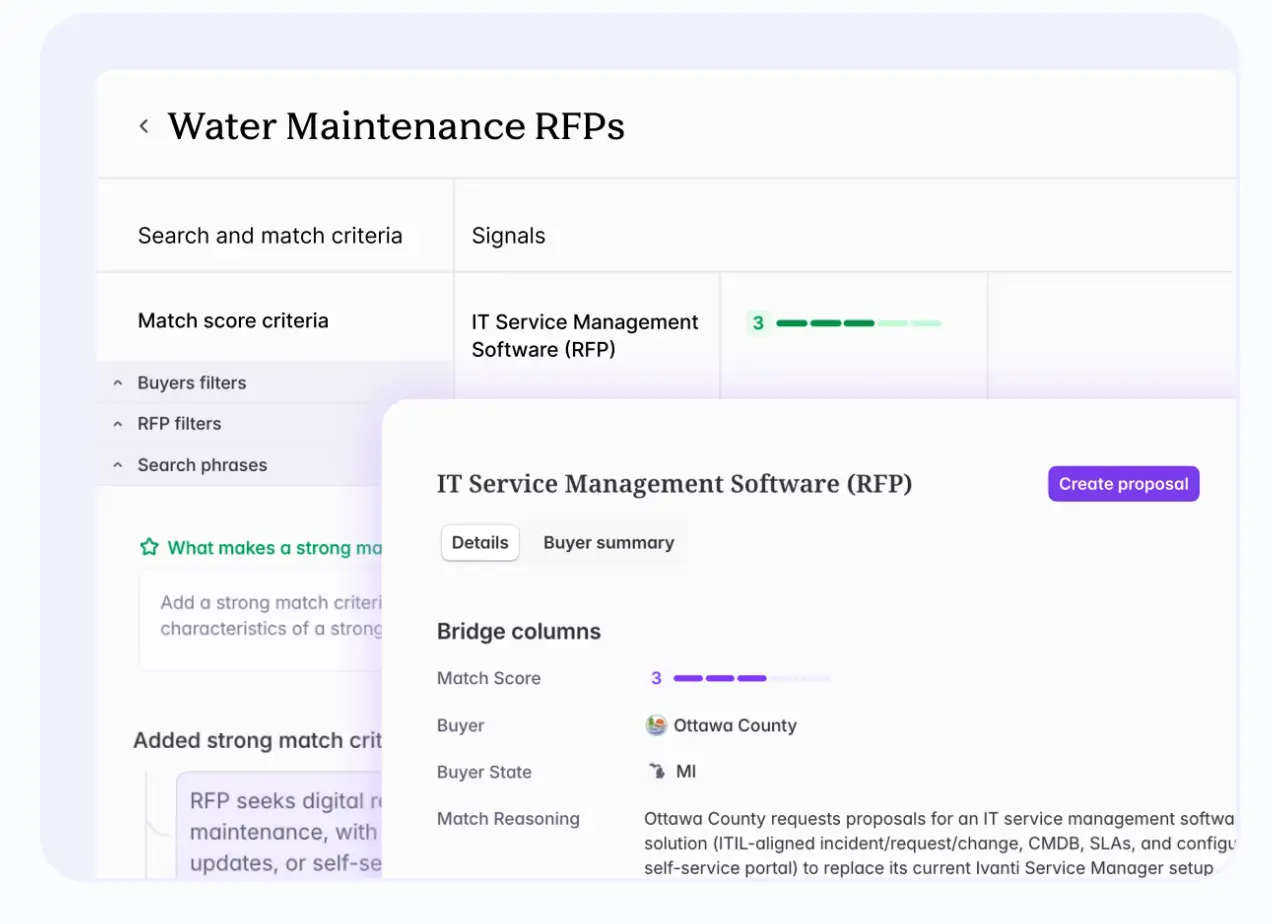
When a solicitation does post, Starbridge's AI RFP Finder & Proposal Writer centralizes thousands of bid portals into one personalized feed. Each RFP is scored by product fit, region, and win likelihood, and the feed flags any that name a competitor. The AI proposal writer then drafts responses from the team's knowledge base, with a compliance matrix builder to keep submissions in line. An RFP is the last buying indicator, not the first, so a team already engaged upstream treats it as confirmation rather than a starting gun.
Contract Vehicle & Reseller Access closes the loop, and Starbridge provides it directly while handling the compliance, paperwork, and renewals. Teams onboard once across NASPO ValuePoint, OMNIA Partners, Sourcewell, TIPS, and GSA, then use the right vehicle on every deal. Navigate Procurement surfaces that vehicle on each buyer's page inside the platform. A won deal then reaches a signed purchase order without triggering a full RFP.
Where Starbridge falls short
Starbridge's sales intelligence runs deeper for state and local government and education than for federal work. Teams whose primary motion is federal will find more coverage from a federal-first tool.
The RFP proposal writer is lightweight. It speeds up drafting, but it will not replace a dedicated RFP hire on complex, high-stakes bids.
Pricing is premium, which fits resourced enterprise revenue teams better than early-stage companies. Contact data accuracy and the breadth of buying signals come at a higher price point, so buyers are paying for quality.
Best for
Starbridge fits resourced enterprise revenue teams running outbound into state and local government, K–12, and higher education. These are teams that want one platform from buying indicator to closed deal, with verified contacts, competitive contract context, and CRM workflows built in.
2. GovSpend
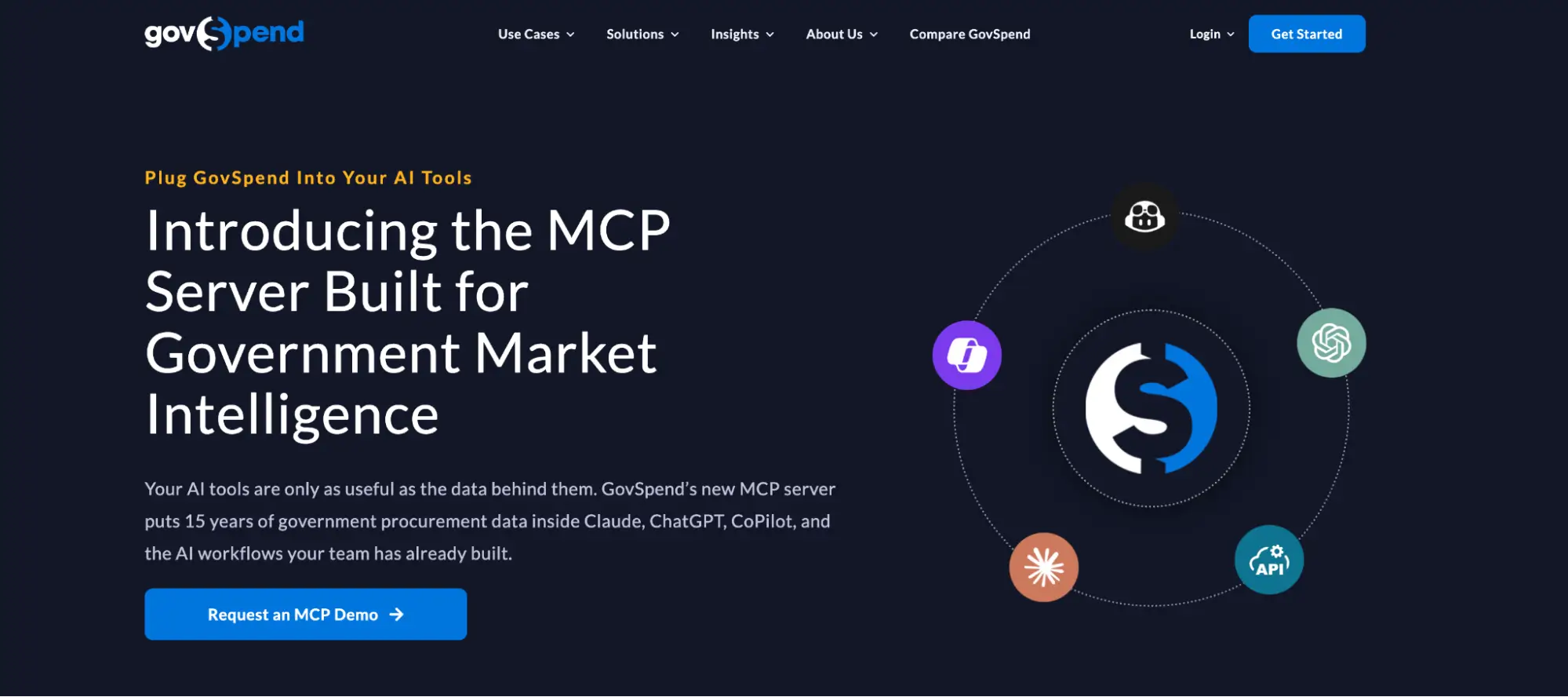
GovSpend is a procurement intelligence platform founded in 2011 and now owned by private equity. The platform centers on historical purchase order data, spanning state and local and federal markets. GovSpend serves vendors, agencies, and consultants who need visibility into government purchasing.
What GovSpend does well
GovSpend offers a comprehensive line-item purchase order library in the state and local market. Teams can see what an agency bought, from which vendor, and at what price. Records include contract end dates, which support recompete research. That data comes from a mix of agency relationships and public records requests.
The Opportunities module combines GovSpend data, the public web, and a company profile to rank leads by fit. AI Search runs queries across those data sources, while AI Notebook gives teams a workspace to score and analyze saved searches.
Searchable meeting transcripts let companies track budget and technology discussions across agencies. Bid alerts also notify teams when a new or updated solicitation matches their criteria.
Where GovSpend falls short
Data freshness is a common theme in user reviews. As one G2 reviewer put it, "sometimes data is missing or not entered correctly or is out of date." For teams prospecting a finite market, out-of-date records mean wasted rep time and lower sequence performance.
Detail also varies by data source. Another G2 reviewer observed, "data cleanliness varies by state. Some agencies provide deep detail. Others provide vague line descriptions." Reps working across several states may find they enrich records unevenly as a result.
The search quality and data freshness flags that current users bring up trace back to the same issue. Govspend's value comes from a historical record of what agencies have already bought. So when an alert finally surfaces an opportunity, competitors also running that search see it in the same window.
RFP proposal drafting is delivered through a third-party partner, Iris. Teams that prefer a single workflow from bid discovery through submitted proposal may find the hand-off between tools adds friction.
Seeing what an agency purchased through a contract vehicle is a different thing from getting a vendor added to one. GovSpend supplies the spend and contract records. The onboarding step, the one that lets a ready buyer purchase through a cooperative contract vehicle without running a full solicitation, sits outside the platform as of July 2026.
Best for
GovSpend fits teams whose primary workflow centers on procurement research, historical spend analysis, and bid monitoring across state and local government.
3. GovWin
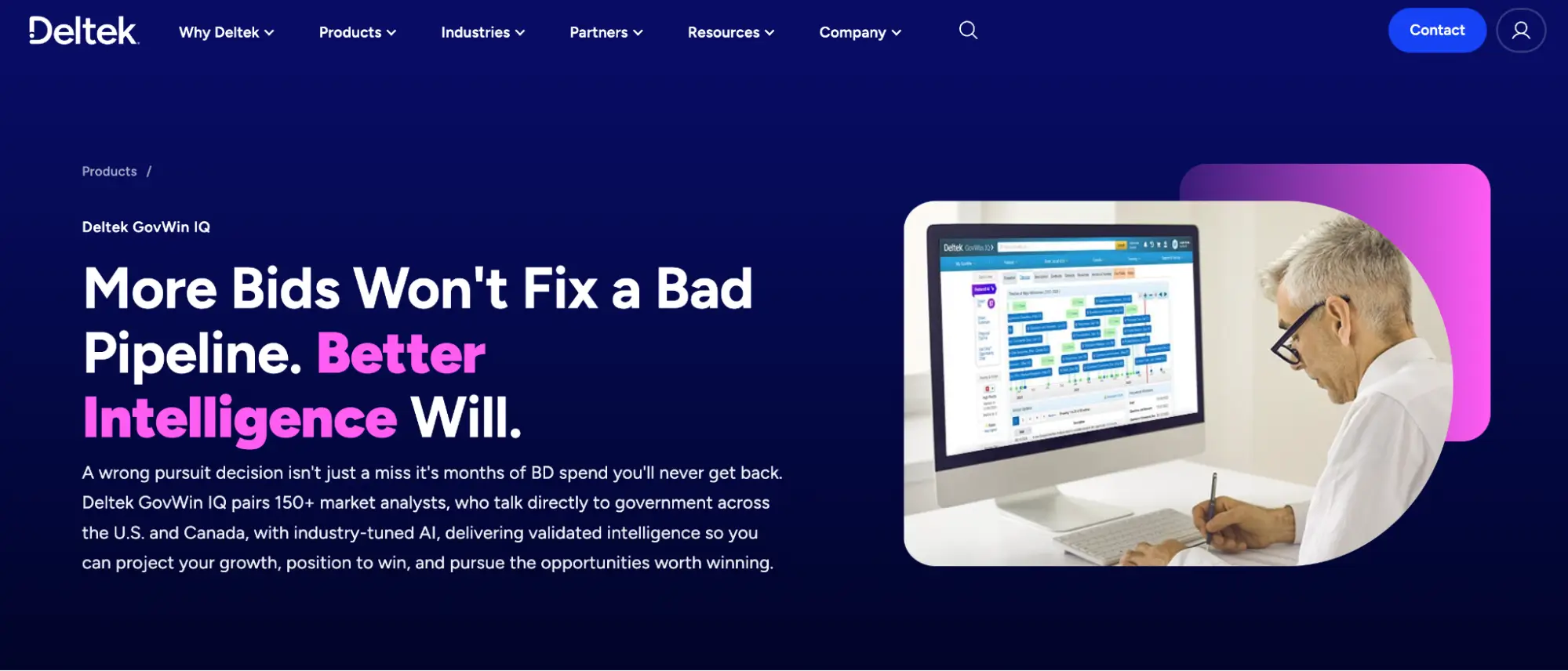
GovWin is a market intelligence platform owned by Deltek and focused primarily on federal government contractors. Market analysts back the platform, sourcing intelligence directly from procurement activity. More recently, GovWin has expanded into state and local government and education.
What GovWin does well
GovWin's analysts source leads, track recompetes, and forecast federal opportunities years before an RFP posts. This analyst-backed forecasting is the platform’s main draw.
GovWin also runs a broad government bid database. The platform tracks contract awards, spending analysis, and agency org charts. Folder management and prioritization help teams work through high volumes of solicitations.
For federal pursuits, GovWin adds labor rate analysis, competitor identification, and teaming partner recommendations. Ask Dela, its AI assistant, summarizes procurement documents to speed research. Native Deltek Costpoint and Vantagepoint integrations connect the platform to existing finance and project systems.
Where GovWin falls short
State and local, K–12, and higher education coverage is a more recent addition to GovWin. The platform's depth and most frequently updated data remain oriented toward federal procurement. Its intelligence leans toward macro market trends rather than the account-level indicators that drive daily outbound in state and local and education markets.
Search and filtering can create friction. As one G2 reviewer described it, "searching outside of my saved searches is challenging. The filters are not user-friendly and can be difficult to find what I'm looking for. Lately postings have been missing attachments or have wrong dates." That kind of friction slows teams that search broadly rather than within saved queries.
Best for
GovWin fits federal contractors and teams with a primary federal motion. These teams need analyst-backed opportunity intelligence, recompete tracking, and pricing analysis, and they want some visibility into state and local solicitations from the same platform.
4. Agile Education Marketing
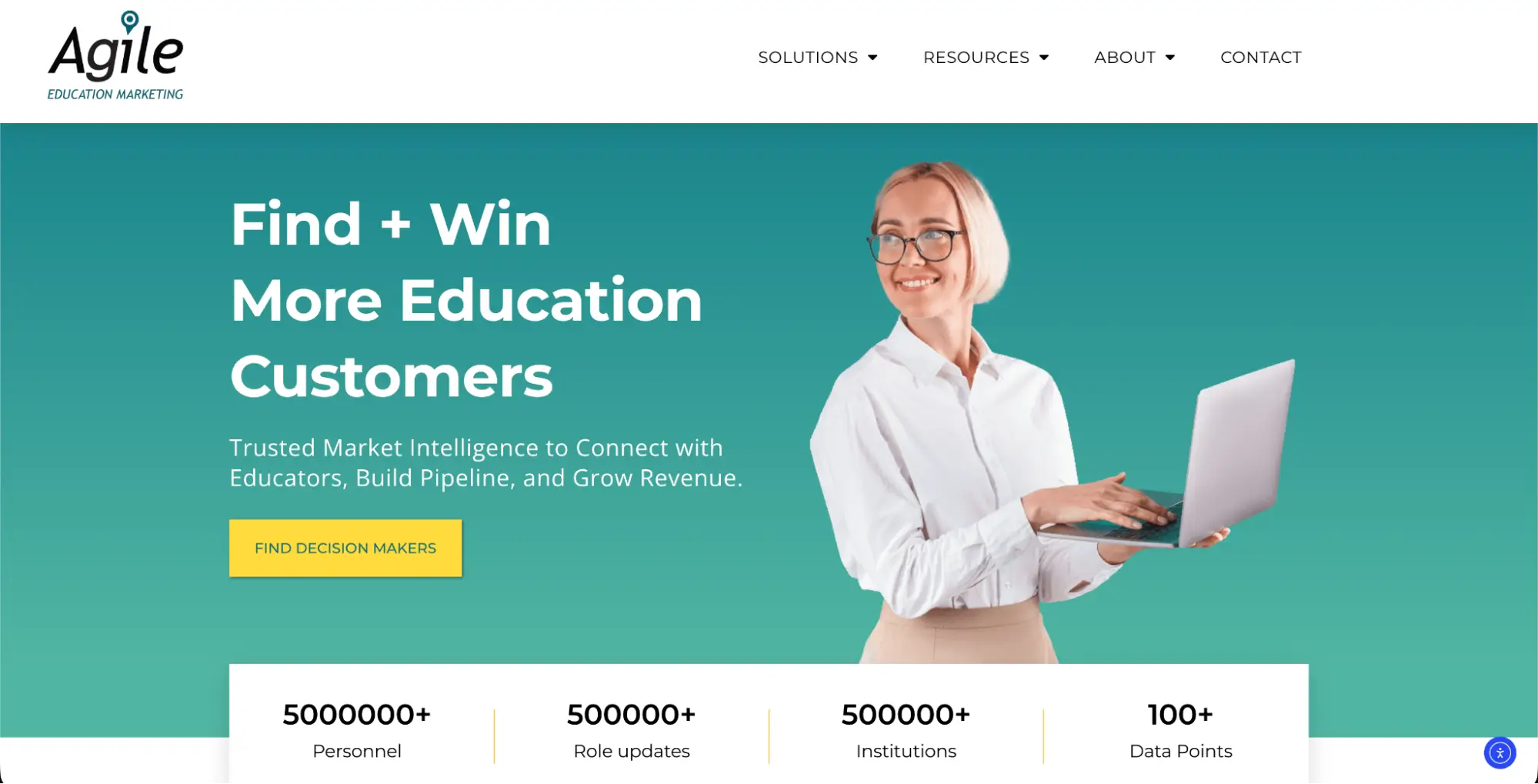
Agile Education Marketing is an education marketing data provider focused on K–12 and higher education contact data. Alongside its data, the company offers engagement services spanning email, social, paid ads, and consulting. It licenses an educator contact database plus an EdIntel market-listening add-on.
What Agile Education Marketing does well
Agile Education Marketing maintains a deep, human-verified educator contact database. Coverage spans K–12, higher education, early childhood, and public libraries. The company refreshes records year-round from federal and state files, web research, and phone verification.
The product line is flexible. Self-serve Prospector supports on-demand list building, Data Explorer handles segmentation, and Custom Data License allows full integration. CRM integrations cover Salesforce, HubSpot, and Marketo. The EdIntel add-on surfaces state-specific programming and investment data at the district level.
Agile Education Marketing also executes marketing campaigns. Services span omnichannel email, social, and paid advertising, along with strategic consulting. Dedicated one-to-one account management supports clients through execution.
Where Agile Education Marketing falls short
Coverage concentrates on education. Teams that also sell to cities, counties, and state agencies would keep a complementary source for the non-education part of the business.
The model partially focuses on licensed lists and campaign execution, refreshed on a batch cycle rather than continuously. That approach points teams to who to contact. The timing and the reason a contact is likely to buy tend to come from other sources.
Data is licensed for defined terms. Buyers weighing long-term data ownership against subscription access should understand how the licensing model affects what stays in the CRM after a contract ends.
What Agile provides is contacts and campaigns. What it does not provide is a purchasing pathway. Cooperative contract vehicles like Sourcewell or TIPS, the ones that let an education buyer avoid a full solicitation, fall outside its data-and-services model as of July 2026, so teams need a separate provider to handle that final step.
Best for
Agile Education Marketing fits education-focused marketing teams that need accurate K–12 and higher education contact data for list-based outreach, territory planning, and campaigns. Teams that value hands-on account management and consulting support get the most from it.
Which BidNet Direct alternative is right for you?
GovSpend is a strong fit when your priority is historical procurement data and spend research across state and local agencies. Its deep line-item purchase order data, meeting intelligence, and AI-powered research support that workflow.
GovWin suits teams selling primarily to federal agencies. It offers analyst-backed intelligence on recompetes, pricing, and teaming partners.
Agile Education Marketing works well when you need accurate K–12 and higher education contact lists for marketing campaigns and list-based outreach.
Starbridge is built for teams selling technology or services to state and local government, K–12, and higher education. It surfaces buying indicators months before the RFP, delivers 98% accurate contacts, and adds full competitive contract context through FOIA automation with purchase order data for 77% of institutions. Starbridge also scores and drafts RFP responses with AI and provides contract vehicle access to close faster without a full RFP.
Book a demo to see how Starbridge helps your team win more deals in government and education.
Frequently asked questions
Starbridge is the best BidNet Direct alternative for teams whose primary market is state and local government, K–12, and higher education. Starbridge connects pre-RFP buying indicators with verified contacts in one workflow. Spend intelligence and contract vehicle access then carry that early buying signal to a closed deal without switching tools. GovSpend is best for teams that want deep historical line-item purchase order data for spend analysis and recompete research. GovWin is best when the primary motion is federal, with analyst-backed opportunity forecasts and recompete tracking. Agile Education Marketing is best for education-focused teams that need human-verified K–12 and higher education contact lists for campaigns.
Yes. Starbridge is the AI sales intelligence platform built for enterprise teams selling to state and local government, K–12, and higher education. Starbridge turns early buying indicators into closed deals rather than waiting for a bid to publish in BidNet Direct. Starbridge monitors more than 320,000 government and education entities for board minutes, budget releases, grant awards, leadership changes, and contract expirations, then delivers each buying signal with a verified contact and a reason the timing is right. Zencity's enterprise sales team sources 50% of its cold meetings from Starbridge. From there, the same connected workflow carries those accounts through outreach and procurement to a closed deal.
By the time a bid reaches a portal, the requirements are locked and a frontrunner has usually emerged, so alerting on published bids means engaging too late. BidNet Direct does one thing well: it aggregates published solicitations across state and local government, K–12, and higher education through regional purchasing groups. Starbridge works the window before that. Starbridge reads board minutes, budget releases, grant awards, and contract expirations across more than 320,000 government and education entities to surface buying intent months before a solicitation exists. Engaging that early lets a rep help shape requirements, then carry the account through outreach and procurement to a signed contract instead of competing in a bid everyone saw at the same moment.
BidNet Direct centers on published bid discovery, so a rep still needs verified contacts, spend context, and a procurement path elsewhere to act on what appears. Starbridge carries the whole motion. Proprietary web-agent technology pulls verified .gov and .edu contacts at 98% email accuracy with a 2% bounce rate across a 14,000-email test, well below the 15 to 25% bounce rate typical of the general contact databases reps otherwise rely on. FOIA automation then surfaces what an account already buys, including incumbent contracts, pricing, and expiration dates, with purchase order data for 77% of state and local government, K–12, and higher education institutions. That context turns a bid into a scored opportunity a rep can close.
Starbridge does, through contract vehicle access available as part of the platform. After a buyer commits, procurement can still add months, and a full solicitation restarts the clock. Starbridge provides direct access to major cooperative and government contract vehicles, including NASPO ValuePoint, OMNIA Partners, Sourcewell, TIPS, and GSA, and handles the compliance, paperwork, and renewals. A committed buyer can purchase through a vehicle they already use, so a won deal reaches a signed purchase order without a full RFP. Among the alternatives here, GovWin tracks vehicles such as GWACs and IDIQs but does not onboard vendors onto them, and contract vehicle access is not part of the GovSpend or Agile Education Marketing offering, both as of July 2026, so that final step still happens elsewhere.
Starbridge runs deepest for state and local government, K–12, and higher education, so a team whose primary motion is federal will find broader coverage in a federal-first tool such as GovWin. Where Starbridge wins is the state, local, and education motion end to end. Starbridge surfaces pre-RFP buying indicators and delivers verified .gov and .edu contacts. Starbridge also adds the spend context reps use to position against incumbents. For teams selling mostly into state and local government and education, that connected motion closes more deals than a broad federal database. Kaizen Labs lifted rep quota attainment by 10 to 20% with Starbridge.
Explore our use case library
Ready to give your SLED team real leverage?
Let’s talk about how Starbridge can build a qualified pipeline for your current team — without adding headcount.