.svg)

GovWin alternatives: 4 tools for government and education sales intelligence in 2026

GovWin, a Deltek product, is known for federal procurement data and RFP notifications, backed by market analysts and a database covering a large portion of publicly reported government spending.
That strength comes with a trade-off its own users point out. One G2 reviewer noted the platform can run "24 or 48 hours slower" than other tools they use to track the same opportunities, a lag that compounds well before procurement reaches the RFP stage.
GovWin's core workflow notifies teams once an opportunity has already been posted. By the time that notification lands, the buying window is largely closed. A competitor has typically already shaped the requirements, built the relationship, and positioned itself as the frontrunner long before the solicitation goes public.
That's the gap driving teams to look at GovWin alternatives. This article evaluates four such tools across the five capability areas that carry the most weight when selling to local government, K–12, and higher education. The comparison table below offers a quick look at how each platform stacks up before we dig into the details.
What to evaluate in a government and education sales platform
When evaluating tools for selling to state and local government, K-12, and higher education, five capabilities separate platforms that generate pipeline from those that generate reports.
- Identifying opportunities pre-RFP. Board meetings, budget releases, grant awards, leadership changes, and contract expirations produce buying signals months before a formal solicitation appears. Teams that monitor these sources can engage decision-makers while they are still defining requirements, rather than competing against an incumbent who helped write the evaluation criteria.
- Contact and account data quality. The accuracy of your contact data determines whether outreach reaches the right person or bounces. In state and local government, K-12, and higher education, decision-makers rarely maintain LinkedIn profiles, so platforms that depend heavily on commercial web sources can see bounce rates of 15-25%. Verified contacts sourced from official .gov and .edu domains, agency directories, and board meeting records produce fundamentally different outreach results.
- Visibility into what agencies and institutions are already buying. Knowledge of the incumbent vendor, contract value, and expiration date changes how a rep positions in a discovery call. Purchase order data shows what an account spent last year, but full competitor contracts with pricing, opt-out clauses, and implementation details tell a rep how to win the next deal.
- Finding and responding to RFPs efficiently. A centralized, scored RFP feed saves hours of portal-hopping across thousands of state, local, and education bid sites. AI-assisted proposal drafting compresses response time from days to hours, letting teams respond to more best-fit opportunities without burning headcount on manual drafting.
- Contract vehicle access that removes procurement friction. Above a buyer's sole-source threshold, a deal either routes through an existing cooperative contract or triggers a full competitive solicitation that can add months. Vendors who can transact through vehicles like NASPO ValuePoint, OMNIA, Sourcewell, or TIPS give procurement offices a faster path to purchase. Teams without vehicle access watch won opportunities stall in procurement.
The above capabilities work in tandem as a single pipeline-building motion. Available solutions differ in how much of this motion they cover end-to-end versus how much they leave teams to put together manually across disconnected tools and spreadsheets.
The tools that cover the full workflow in one platform tend to produce more pipeline per rep, because intelligence flows directly into action without the friction of tool-switching, manual data entry, and stale handoffs.
1. Starbridge
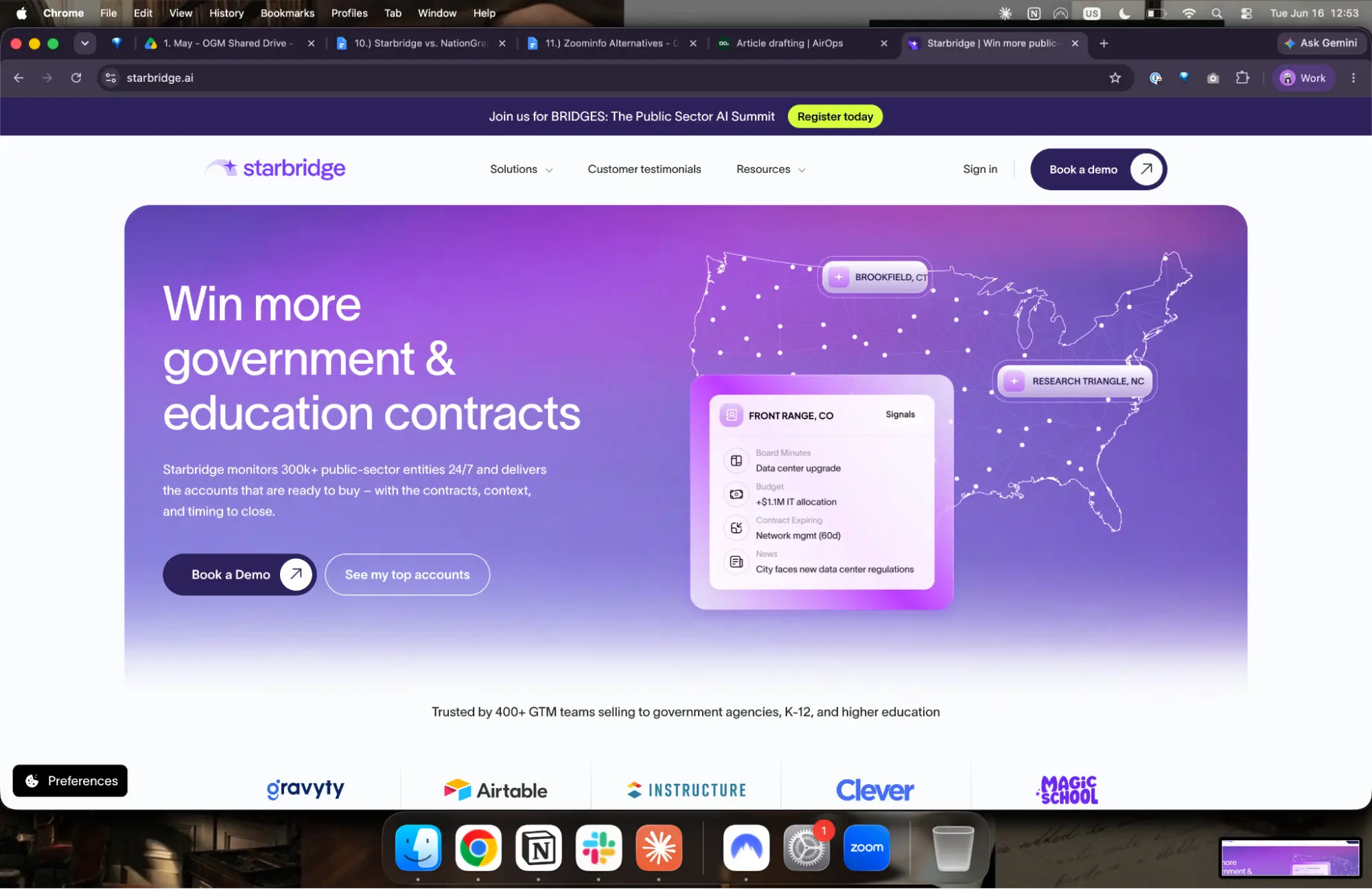
Starbridge is the AI sales intelligence platform built specifically with companies selling to state and local government, K-12, and higher education in mind. More than 400 GTM teams use Starbridge to surface buying intent before competitors know the opportunity exists, then turn that intelligence into outreach, proposals, and booked meetings from a single platform. The platform covers all five capability areas evaluated in this article:
What Starbridge does well
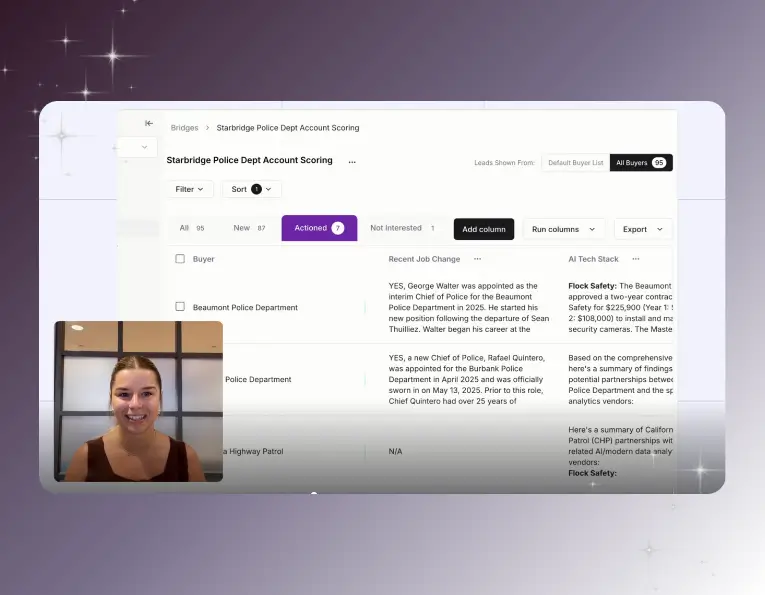
The window to influence a government or education deal opens months before a formal opportunity appears. Starbridge’s Buying Signal Monitor continuously tracks 320K+ entities for pre-RFP indicators across board meeting minutes, strategic plans, budget releases, grant awards, job postings, and contract expirations.
Each buying signal fires with a verified contact, a reason to reach out, and AI-generated outreach copy. A vector database handles context, so a signal like "budget shortfalls" surfaces even when those exact words never appear in the source document. GovWell, for example, booked five meetings from buying signals in their first week and now sources 15% of total qualified pipeline through Starbridge.
Early timing only matters if you can reach the right person. Contacts & Company Data uses proprietary web-agent technology that continuously crawls government department sites, school district portals, university websites, and board minutes rather than relying on commercial web sources that barely cover this market. Four levels of waterfall enrichment and ongoing bounce-checking produce 98% email accuracy validated across 14,000 emails, compared to 15-25% bounce rates from platforms built on LinkedIn scraping. Dynamic account scoring ranks accounts by live buying signals rather than static firmographic data, and bi-directional integrations with Salesforce and HubSpot keep CRM records current without manual imports.
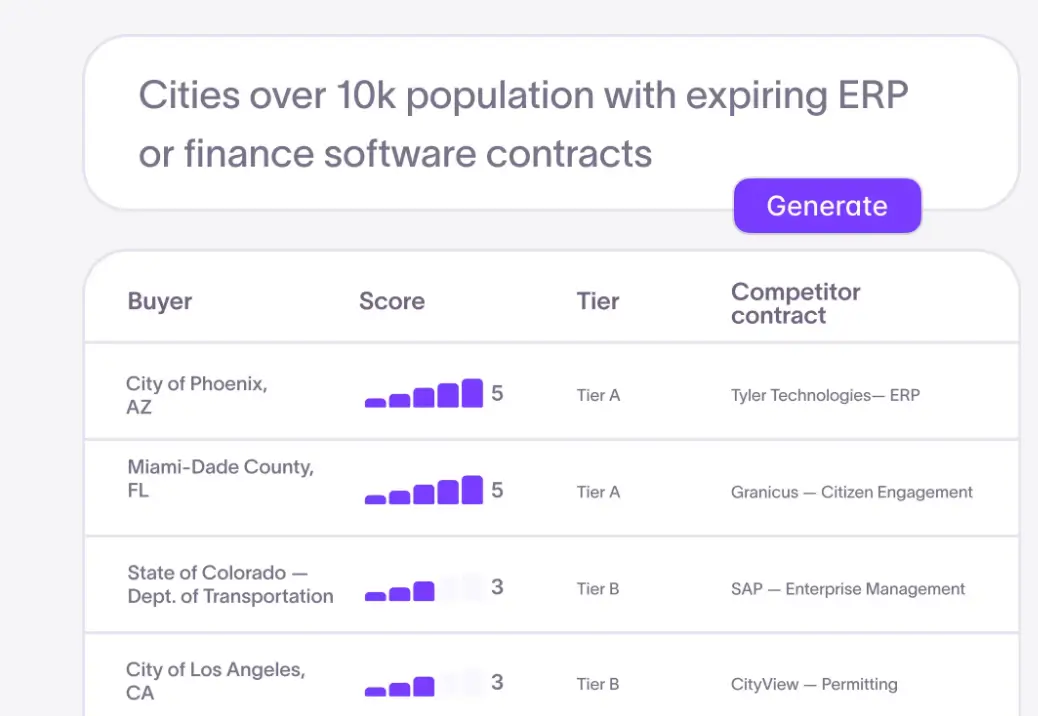
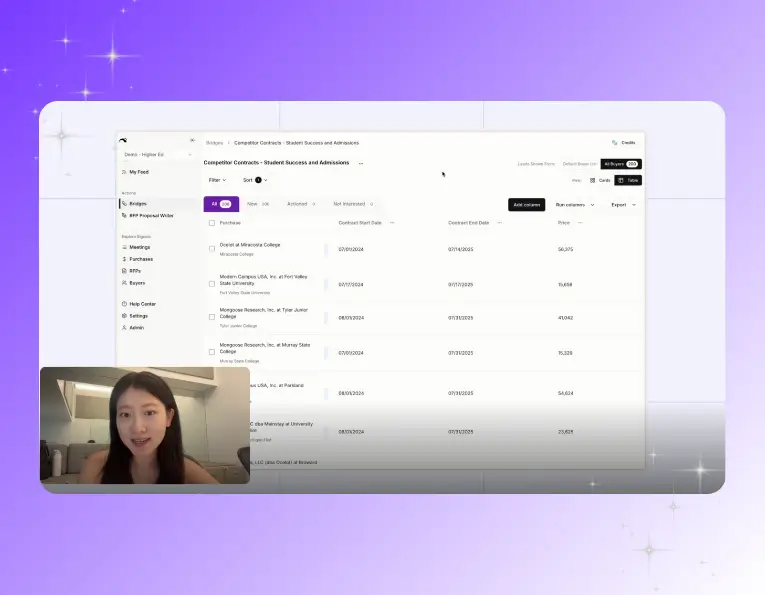
Walking into a discovery call without knowing what a prospect pays the incumbent, or when that contract expires, puts reps at a disadvantage. Public Spend Intelligence runs FOIA automation at scale to surface full competitor contracts, including annual revenue, raw vendor proposals, opt-out clauses, implementation fees, and expiration dates. Out of the box, Starbridge has purchase order data covering 77% of local government, K-12, and higher education institutions.
Spend records cross-reference against the full buying signal dataset, so reps arrive at every call with competitive context already in hand. InquirED generated $200K in new pipeline within their first quarter by pairing Starbridge spend intelligence with signal-driven outreach.
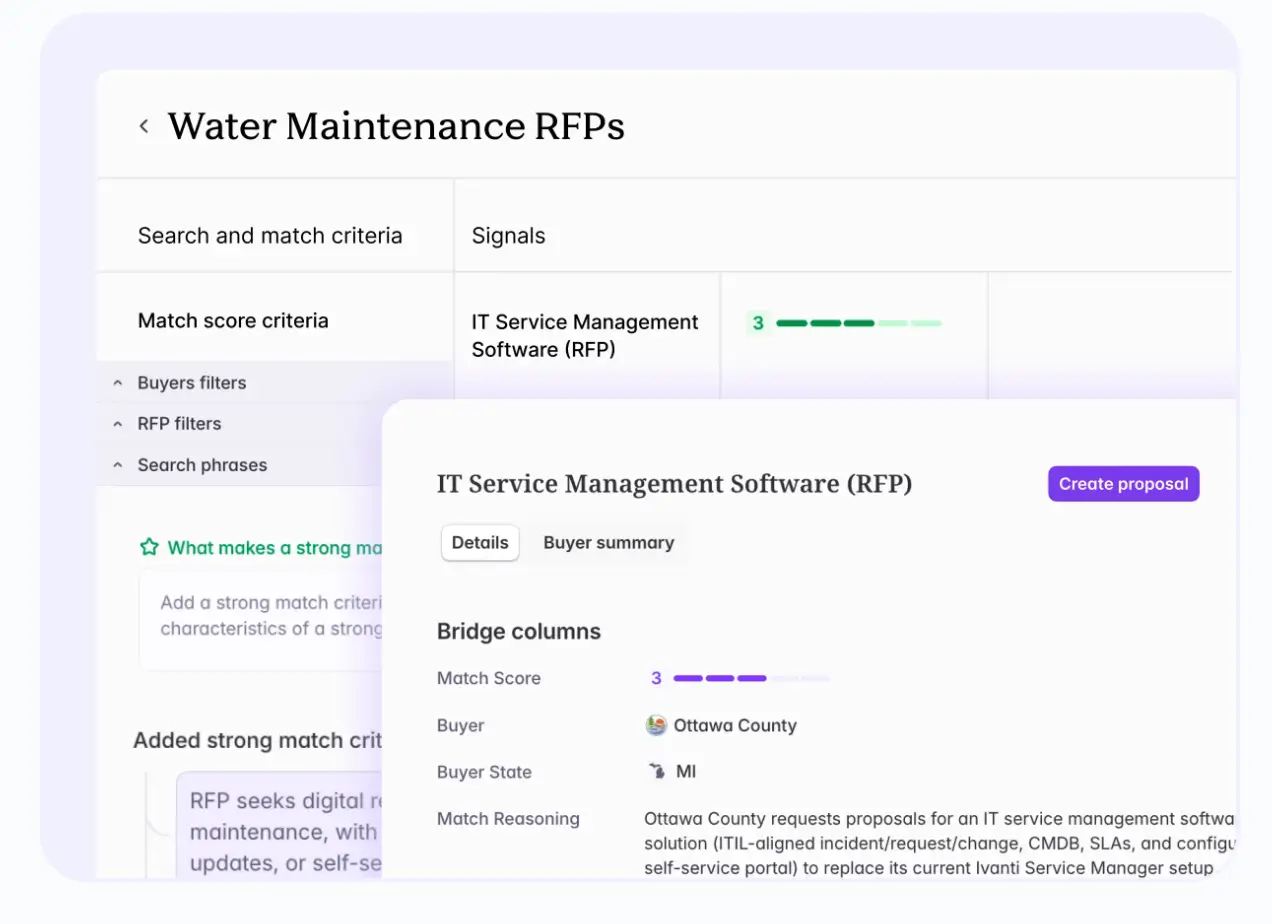
For teams that do respond to formal bids, AI RFP Finder & Proposal Writer pulls thousands of state, local, and education bid portals into a single scored feed ranked by product fit, region, and win likelihood. The platform automatically flags RFPs that name a competitor, giving teams early visibility into displacement opportunities. A native proposal writer drafts responses from the team's own product knowledge base, with a compliance matrix builder for structured evaluation criteria, so the path from discovery to submitted proposal stays inside one tool.
The last mile of a government deal is procurement itself. Starbridge gives you a faster path to purchase by providing access to every major contract vehicle including NASPO ValuePoint, OMNIA Partners, Sourcewell, TIPS, and GSA, and it handles the compliance, paperwork, and renewals. Because the platform already knows each buyer's preferred purchasing channel, reps can route every opportunity down the fastest compliant path to a signed PO.
Where Starbridge falls short
Starbridge is purpose-built for state and local government, K-12, and higher education, which means its coverage of federal markets is not as deep. Teams with a significant federal pipeline may need a complementary tool for that segment.
The AI proposal writer accelerates drafting and handles compliance matrices well, but it’s not a full proposal management platform. Teams responding to complex, high-volume RFPs will still benefit from specialized proposal software alongside it.
Additionally, Starbridge’s pricing reflects the depth of its data and the breadth of its workflow capabilities, which puts it at a higher price point than lighter-weight alternatives. Teams with smaller budgets or those without an established government and education revenue motion may find the investment harder to justify until pipeline volume supports it.
Best for
Revenue teams running outbound into state and local government, K-12, and higher education who need one platform that covers the full motion from buying signal to closed deal. Starbridge is the strongest fit for teams that want buying signal monitoring, verified contacts, spend intelligence, RFP response, and contract vehicle access all working together in a single system with native CRM integration.
2. GovSpend
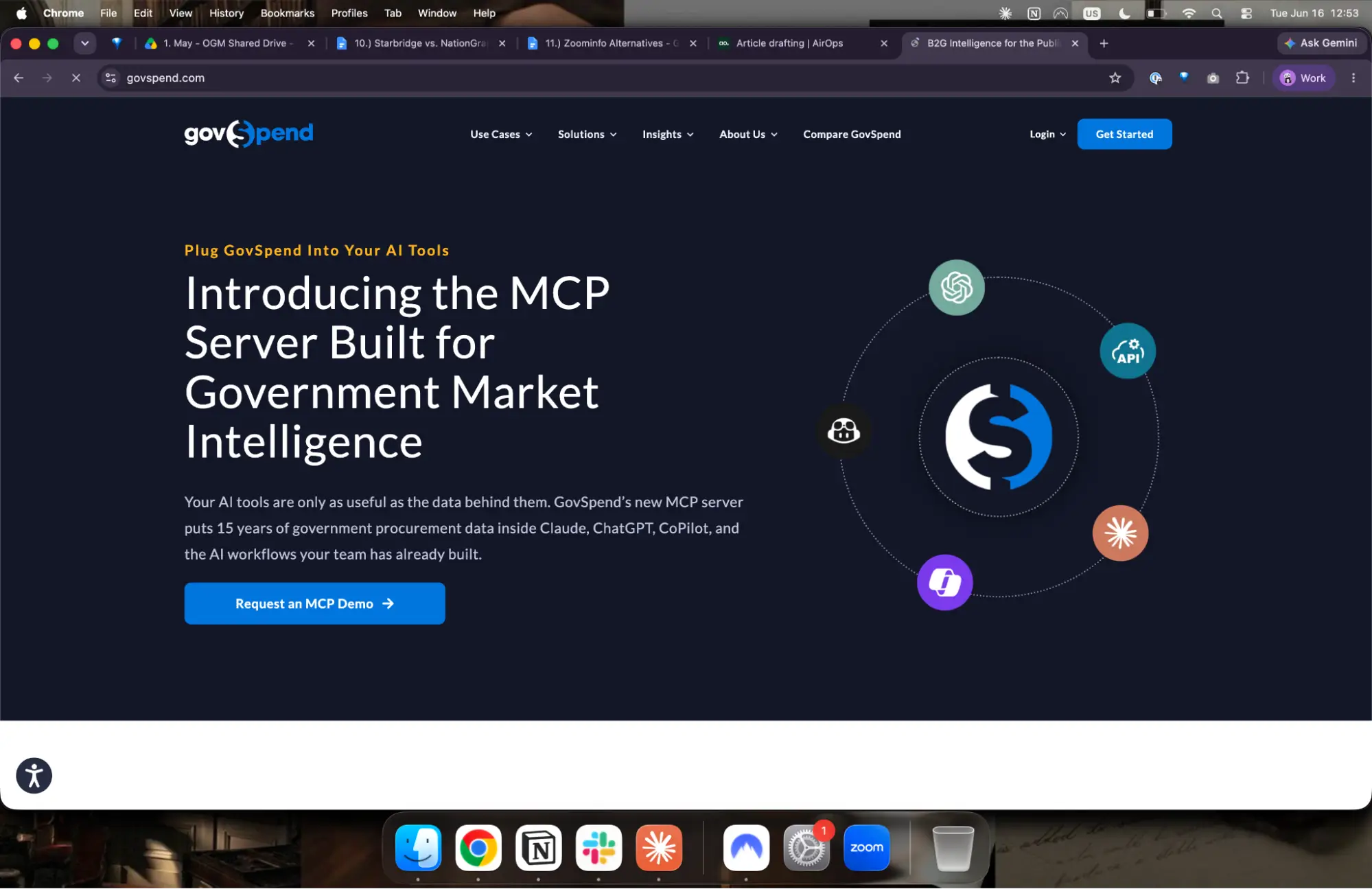
GovSpend is a procurement intelligence platform that gives government sales teams visibility into how agencies spend their budgets. The platform’s capabilities include historical purchase order data, meeting intelligence, and bid tracking, serving teams who sell into both state and local government and federal markets through its Fedmine brand.
What GovSpend does well
GovSpend is well-known for its depth of vendor spend and procurement data. The platform provides line-item purchase order records showing who is buying what, from whom, and at what price across government markets. With hundreds of thousands of active contracts and historical pricing data, teams can build competitive positioning strategies, identify pricing benchmarks, and spot accounts where an incumbent contract is approaching expiration.
GovSpend's newer modules, including AI-transcribed Meeting Intelligence and an AI-ranked Opportunities module, sit on top of that same purchase order foundation. Both depend on activity that has already entered the public record, so they extend the historical database rather than adding a forward-looking signal layer.
The platform provides millions of government contacts searchable by role, agency, and location, with native Salesforce and HubSpot integrations that keep CRM records updated through scheduled syncs.
Where GovSpend falls short
GovSpend's strength is also its constraint. Purchase orders, meeting alerts, and Opportunities module scores all describe activity that has already entered the public record. A rep using GovSpend likely learns about an opportunity at the same moment as everyone else watching that record, after a competitor has often already influenced the decision.
The volume of data in GovSpend may also require manual effort to filter and prioritize. One G2 reviewer noted that "it's hard to get some of the things that are not pertinent to my business filtered out, just the way that the filtering system works." Teams with broad territories may spend considerable time narrowing results to find the most actionable opportunities.
Data freshness varies depending on state and agency reporting cadences. As one G2 reviewer described, "sometimes data is missing or not entered correctly or is out of date." Because the platform sources contact data through agency relationships and document requests, data freshness can vary by agency and region, which may affect time-sensitive outreach.
As of this writing, GovSpend partners with Iris for drafting responses. Teams that respond to a high volume of RFPs may find the additional step of moving to a partner tool adds friction to the proposal workflow.
Purchase order data also shows which past deals ran through vehicles like Sourcewell or OMNIA Partners. Visibility into that activity is different from being able to sell through those vehicles, and contract vehicle sell-through is not a stated GovSpend capability as of July 2026.
Best for
Teams that need deep historical procurement data and spend visibility for competitive positioning and pricing strategy in government markets. GovSpend is a strong fit for organizations where understanding what agencies have purchased historically is the primary use case, and where the team has the bandwidth to invest in filtering and manual research workflows.
3. ZoomInfo
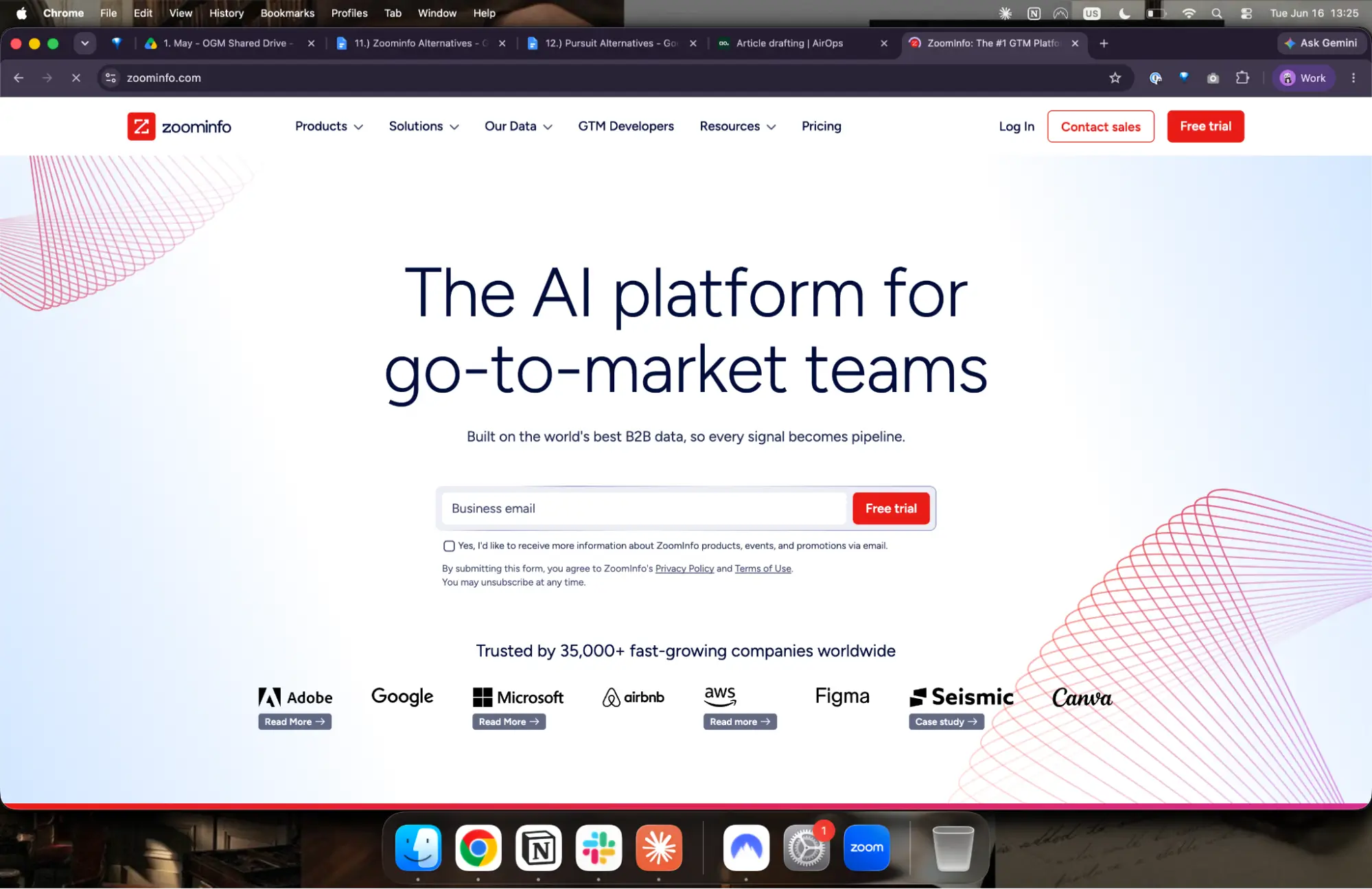
ZoomInfo is a horizontal B2B intelligence meant for commercial sales teams across industries. The platform delivers commercial intent data by tracking surges in content consumption activity across publisher networks, and it maintains one of the largest B2B contact databases available, meant primarily for commercial B2B markets.
What ZoomInfo does well
With hundreds of filtering attributes spanning tech stack, funding status, firmographics, and technographics, ZoomInfo's commercial B2B contact database empowers businesses to build highly targeted prospecting lists.
The platform's intent data engine tracks hundreds of millions of IP-to-organization pairings and keyword-to-device pairings monthly to identify accounts showing spikes in research activity around relevant topics. Guided Intent, a proprietary feature, prioritizes trending topics that are proven to drive outcomes. Higher-tier Copilot subscriptions add account prioritization, champion tracking, and real-time alerts.
ZoomInfo offers one of the broadest integration ecosystems in the category, connecting natively with Salesforce, HubSpot, Marketo, Outreach, Salesloft, and dozens of other tools. Built-in multi-touch cadences, a phone dialer, and email engagement features mean some teams can run their entire outbound motion without leaving the platform.
Where ZoomInfo falls short
ZoomInfo's intent data is optimized for commercial B2B content consumption patterns. Government and education purchasing follows a different pattern, with buying signals emerging from board meetings, budget line items, grant awards, and contract expirations rather than article reads and topic searches. Teams where state and local government, K-12, or higher education is the primary market may find that commercial intent signals don’t translate into the same pipeline results.
The same commercial-data foundation makes contact freshness a challenge in this market. ZoomInfo's contact database is traditionally used for broad commercial B2B coverage, which creates coverage gaps in government and education. Superintendents, procurement directors, grants managers, and department heads at state agencies rarely maintain active LinkedIn profiles, and platforms that depend heavily on commercial web sources may not reach them consistently or keep their records current. As one G2 reviewer shared, "some of the contact information can occasionally be outdated or inaccurate, which requires additional verification." Teams selling to state and local government, K-12, and higher education may find that bounce rates of 15-25% erode outreach performance and deliverability scores.
There is also no path to purchase built into the platform. In government and education, deals above a sole-source threshold often route through a cooperative purchasing vehicle like NASPO ValuePoint, OMNIA Partners, or Sourcewell, and contract vehicle access is not part of ZoomInfo's offering as of July 2026.
Best for
Commercial B2B sales teams needing broad contact data with intent indicators across industries. ZoomInfo is strongest when government and education selling is a secondary or emerging part of the GTM motion, and the team's primary pipeline comes from commercial accounts where broad B2B contact data and content consumption intent are reliable indicators.
4. Govly
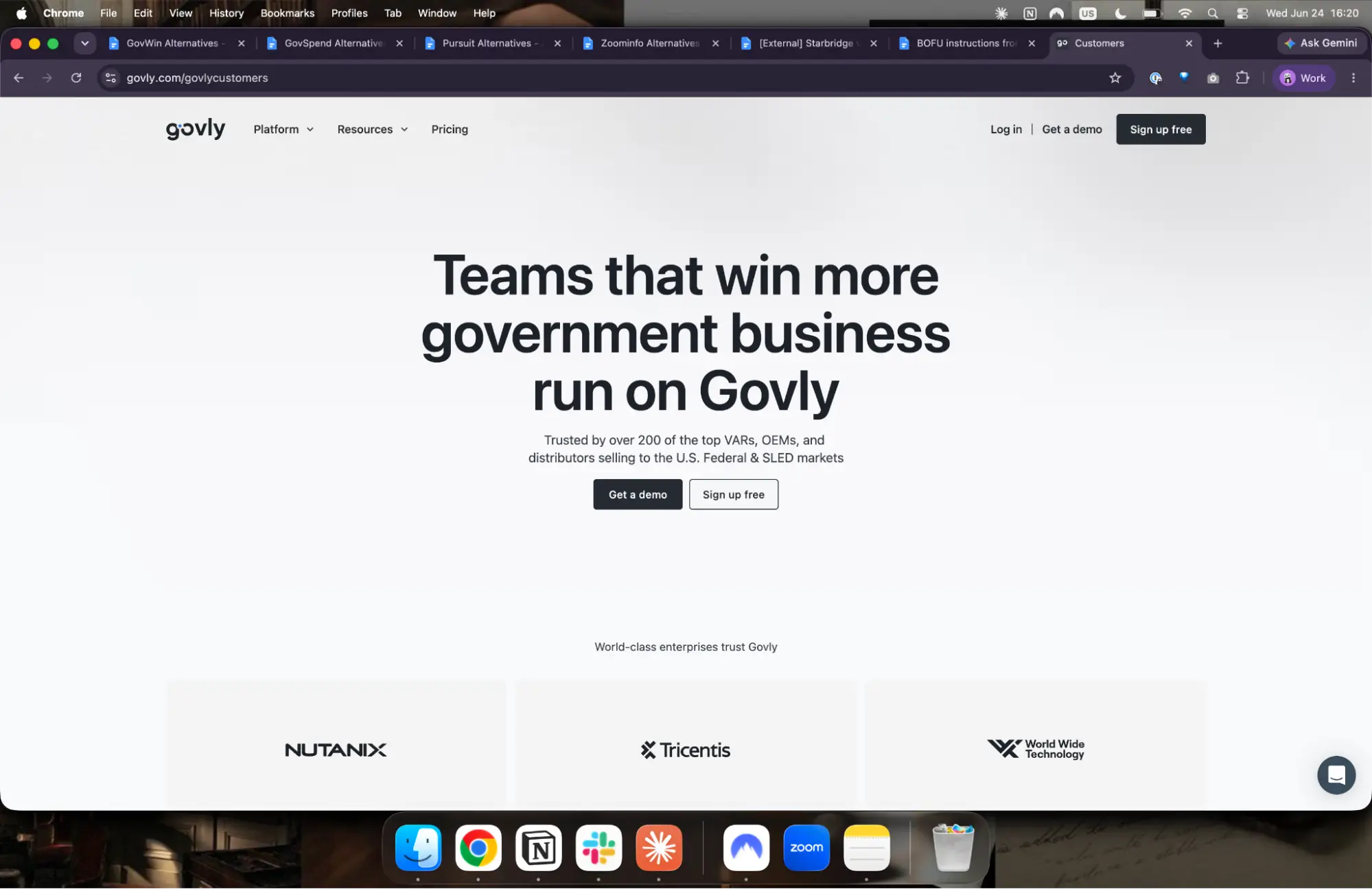
Govly is a government procurement market network for federal contractors, OEMs, VARs, and distributors. It has government and education solicitation as a secondary capability layered on top of that federal foundation.
What Govly does well
Govly's core strength is federal contract vehicle visibility. The platform gives prime contractors and partners a network for collaborating on opportunities that move through vehicles like SEWP and ITES, positioning itself as a market network that takes teams from intelligence to execution on the federal side.
OEMs, VARs, and distributors working through GWACs and IDIQs need visibility into who else is active on a given vehicle and a way to hand off or collaborate on opportunities as they move through the contracting process. Govly exists around that workflow, which is a different problem than account discovery.
For teams that need to track GWAC and IDIQ activity or coordinate with distribution partners, that network model is the point. Govly's government and education solicitation aggregation adds reactive coverage of local government, K–12, and higher education bids on top of that federal base, pulling from thousands of sources, so federal-heavy teams that also touch government and education can use one platform to watch both markets.
Where Govly falls short
Govly's local government and education capability is a secondary layer on a federal-first product, and the gap shows up in how it surfaces opportunities. Govly tells a rep an RFP has been posted. By then, a competitor has already built the relationship long before the solicitation went public.
The platform doesn't track the earlier signals that reveal buying intent before procurement starts. Board meeting discussions, budget line items, and strategic plan language, the indicators that show a district or agency is months away from issuing an RFP, aren't part of what Govly monitors. Teams relying on Govly for government and education pipeline are working from the same reactive alert model as other bid databases, just with a smaller, secondary dataset behind it.
Govly's network model is also created around partner and distributor collaboration for OEMs and prime contractors, not account-based field sales. Reps selling directly into local government, K–12, and higher education accounts won't find a workflow around how they actually prospect. CRM integration is limited, and there's no automated proposal drafting, so teams still need separate tools to turn a solicitation into a tracked, working deal.
Govly's contract vehicle strength is visibility and coordination on the federal side, where vehicles like SEWP and ITES define the workflow. State and local government and education purchases more often route through cooperative vehicles like NASPO ValuePoint, OMNIA Partners, or Sourcewell, and getting a vendor onto those vehicles is not a stated part of Govly's offering as of July 2026.
Best for
Federal contractors, OEMs, VARs, and distributors that need GWAC and IDIQ contract vehicle visibility and partner collaboration workflows, with secondary government and education solicitation tracking as a bonus.
Which GovWin alternative is right for you?
Deep historical procurement data and spend visibility is GovSpend's core strength. The platform gives teams strong visibility into what government agencies have purchased in the past, and its meeting intelligence module adds a layer of early-stage buying indicators from public discussions. Teams that need line-item purchase order records and vendor pricing benchmarks will find a solid starting point here.
Commercial B2B teams where government or education is a secondary segment will get the most from ZoomInfo's broad contact database and content consumption intent signals. The platform serves the commercial side of your pipeline well. However, teams where state and local government, K-12, and higher education is a core revenue driver may find the platform's coverage gaps in those markets limit outreach performance.
Govly provides strong federal contract vehicle visibility for teams working through GWACs and IDIQs, with a partner network for OEMs, VARs, and distributors collaborating on the same opportunities. Teams selling through federal contract vehicles will find a solid coordination layer here. Government and education solicitation tracking is included as a secondary capability, but it carries the same reactive limitations as the other bid databases on this list.
If your team sells technology or services to state and local government, K-12, and higher education and needs a platform that covers the full motion from buying signal to closed deal, Starbridge was created specifically for that workflow. The platform brings buying signal monitoring, verified contacts, spend intelligence, and RFP discovery and response together in one system with native CRM integration. It also hands buyers a purchasing pathway they already trust, with pre-approved access to every major contract vehicle.
Book a demo to see how Starbridge helps your team win more deals in the markets where you sell.
Frequently asked questions
Starbridge is the best GovWin alternative for teams whose pipeline runs through state and local government, K–12, and higher education, because it surfaces buying intent months before a solicitation posts and turns it into outreach. GovSpend is best for teams that want deep historical line-item purchase order data and vendor pricing benchmarks. ZoomInfo is best when government and education is a secondary segment inside a broader commercial motion, and its contact database and content-consumption intent are helpful for commercial accounts. Match the tool to the markets your pipeline depends on.
Yes. Starbridge is a strong GovWin alternative for teams selling to state and local government, K–12, and higher education, because it was built for that motion. Where GovWin is known for analyst-curated market research and federal bid notifications, Starbridge reads board meeting minutes, budget releases, grant awards, and contract expirations across more than 320,000 entities to surface buying intent early. GovWin surfaces macro market trends; Starbridge surfaces the micro buying signals that build pipeline. Each buying signal arrives with a verified contact and suggested outreach. GovWell booked five meetings from buying signals in their first week and now sources 15% of total qualified pipeline through Starbridge.
Look for a platform that shows not just what an agency spent, but the full contract terms behind it. GovWin is known for government spending analysis and contract award tracking, with its depth strongest at the federal level. Starbridge takes a different approach for state and local government, K–12, and higher education: its Public Spend Intelligence runs FOIA automation at scale to surface full competitor contracts, raw vendor proposals, implementation fees, opt-out clauses, and expiration dates. If spend visibility is the deciding question, Starbridge can validate coverage through a bakeoff on your target accounts. A rep can enter a discovery call knowing what a prospect pays an incumbent and when that contract expires. Frontline Education cut research time by 90% with Starbridge.
Prioritize a platform that flags buying intent before the solicitation posts, not one that notifies you after. GovWin is known for its federal bid database and solicitation tracking, which alerts teams once an opportunity is already public. Starbridge is built to surface intent earlier for state and local government, K–12, and higher education: it reads board discussions, strategic plans, budget language, and contract expirations to spot a district or agency months before an RFP appears. That head start lets reps build the relationship and help shape requirements while the window is still open, instead of responding to a spec an incumbent already influenced.
Starbridge helps most before a bid is published; GovSpend and ZoomInfo are useful once a record or intent signal already exists. Starbridge is built to work before the RFP, reading board minutes, budgets, and contract expirations to surface buying intent months ahead of a solicitation for state and local government, K–12, and higher education. GovSpend is known for deep historical purchase order data, particularly for reconstructing what agencies bought and from whom. ZoomInfo is known for broad commercial B2B contact data and content-consumption intent. Choose by the timing your motion depends on.
Starbridge is strongest for state and local government, K–12, and higher education, and its federal coverage is not as deep, so a federal-heavy team may keep a complementary tool for that segment. GovWin, a Deltek product, is known for its analyst-curated federal bid database, a genuine strength for federal-centric pipelines. The more useful question when replacing or supplementing it is where your next quarter of pipeline comes from. If that answer is state and local agencies, school districts, or universities, Starbridge is purpose-built for those markets, where buying intent shows up in board minutes, budget cycles, and grant activity long before it reaches a federal procurement system.
Explore our use case library
Ready to give your SLED team real leverage?
Let’s talk about how Starbridge can build a qualified pipeline for your current team — without adding headcount.