.svg)

How to Find Government RFPs Before They're Published

Sales reps that compete for a published RFP are already behind. The relationships that shape the deal were built months earlier.
This guide explains which public records show a government RFP forming and when you can legally talk to the buyer. It also covers how early to start and what has to change inside your sales team.
How Do You Find Government RFPs Before They're Published?
You find them in the paper trail that precedes them.
Capital plans, adopted budgets, and board agendas name purchases while they are still being decided. Expiring contracts do the same, since every one has to be renewed or rebid.
Reading those records puts you in the conversation while the budget is still being written.
Public Records That Show a Government RFP Is Coming
A government purchase leaves a documentary trail long before a solicitation exists, because the decisions behind the purchase happen in public.
Capital improvement plans are the longest-range record. Florida requires local governments to adopt a comprehensive-plan element containing "a schedule of capital improvements which includes any publicly funded projects of federal, state, or local government," and that element "must be reviewed by the local government on an annual basis" under Fla. Stat. § 163.3177. The schedule runs five years out. Where a state codifies capital planning that way, a vendor can read next year's projects, and the year after that, in a document adopted today.
Adopted budgets and budget amendments come next. A budgeted line item is a decision that already survived internal argument, which makes it a stronger indicator of buying readiness than any expression of interest.
Board and council agendas are the shortest-range record and the most specific. California requires that "at least 72 hours before a regular meeting, the legislative body of the local agency, or its designee, shall post an agenda" including "a brief general description of each item of business to be transacted or discussed," published on the agency's website under Cal. Gov. Code § 54954.2. The item is public before the vote happens, so a vendor can read the discussion topic ahead of the discussion.
Contract expirations force a timeline. Every contract a district or city signs carries an end date, and that date forces a renewal, a rebid, or a replacement. An expiring contract sits alongside board discussions and budget lines in any useful ranking of government buying indicators.
None of these records is a solicitation. Each is evidence that one is being assembled.
Why Sources Sought Notices and RFIs Arrive Too Late for State and Local Buyers
Sources sought notices and requests for information are the standard early-discovery advice, and they come out of federal practice. The Federal Acquisition Regulations System exists "for the codification and publication of uniform policies and procedures for acquisition by all executive agencies" under FAR 1.101.
State governments, counties, cities, and school districts sit outside that system. Nothing requires them to publish an early notice at all, and many never do.
Even inside federal contracting, the head start is short. A presolicitation notice "must be published at least 15 days before issuance of a solicitation" under FAR 5.203(a). Fifteen days is enough time to prepare a bid. It is not enough time to build a relationship or shape the requirements the bid will be scored against.
That’s why you should be looking for other hints that an RFP is coming. If advance notice isn’t a reliable indicator, the only alternative is continuously reading any records that do get published in your TAM.
Starbridge is the AI GTM platform for companies selling to the government, K-12, and higher education, helping teams prioritize the right accounts, engage the right people earlier, and identify high-intent opportunities before the competition. The Buying Signal Monitor reads board meeting minutes, strategic plans, and budget documents across 320,000+ government and education entities around the clock. Each warm lead arrives with who to contact and why the timing is right.
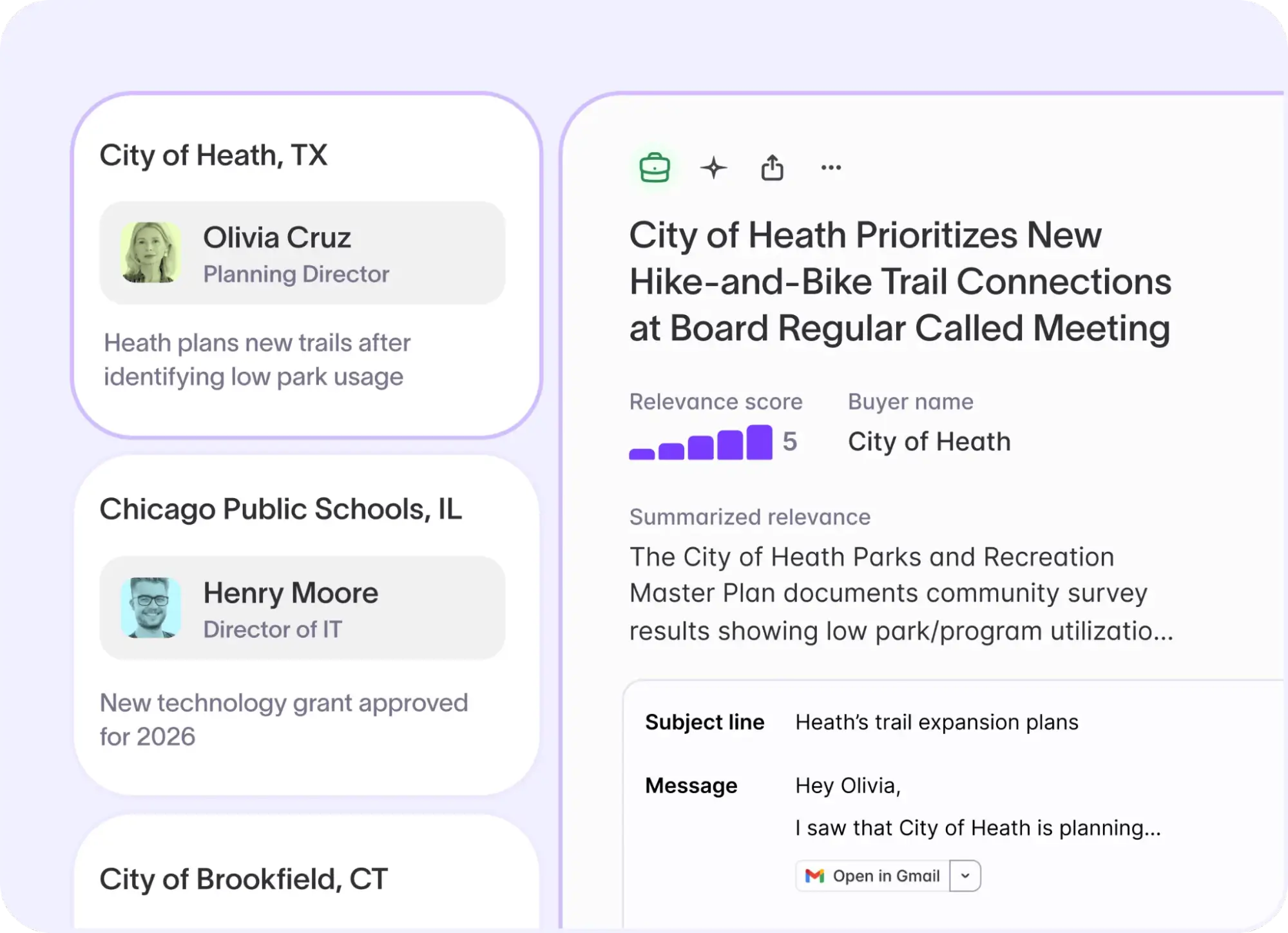
Zencity sources 50% of its cold meetings from Starbridge, with enterprise reps pulling city priorities from recent council meetings before the first discovery call.
Your reps stop waiting on a notice that may never come and start working accounts already moving toward a purchase, early enough to shape the deal they eventually close.
When You Can Legally Contact a Government Buyer Before the RFP
Talking to a government buyer before a solicitation exists is normal procurement practice, and the rules say so directly.
Federal acquisition rules state that "exchanges of information among all interested parties, from the earliest identification of a requirement through receipt of proposals, are encouraged" under FAR 15.201. The same rules list one-on-one meetings with potential offerors, requests for information, and draft RFPs among the accepted techniques. Those rules bind federal executive agencies rather than states, counties, or school districts. What they establish is that early vendor contact is a designed feature of how public buying works.
The boundary is the solicitation itself. Once a solicitation is released, most jurisdictions shut down informal contact. Florida's version is explicit. Respondents "may not contact, between the release of the solicitation and the end of the 72-hour period following the agency posting the notice of intended award, excluding Saturdays, Sundays, and state holidays, any employee or officer of the executive or legislative branch concerning any aspect of this solicitation, except in writing to the procurement officer" under Fla. Stat. § 287.057(25).
Vendors know this as the cone of silence or the blackout period.
Read that timeline the way a seller should. Everything useful happens before the release date, and the release date is not yours to control.
The restriction varies by state and sometimes by agency, so check two documents for every account. Read the designated-contact clause inside any live solicitation, which names who may be contacted and how. Then read your state's procurement code to see when its restriction starts, because some states begin the clock at solicitation release and others at a defined pre-award point.
None of this requires a private conversation. Requesting an informational meeting, responding to a published request for information, and attending a public board meeting are all documented, on-the-record activities.
How Early Should You Engage a Government Buyer?
Earlier than most teams think, and with different behavior at each stage. Each phase rewards a different kind of contact.
- Discovery runs roughly 12 to 18 months before a solicitation.
The buyer is describing a problem internally, and meeting minutes or a strategic plan reference the issue with no money attached yet.
Useful contact here is educational. Send a relevant peer case study, a policy analysis, or a short read on how a comparable district solved the same problem. A product pitch at this stage typically gets ignored.
- Planning runs roughly 6 to 12 months out.
Budget conversations begin, draft line items appear, and job postings hint at new capacity. This is when discovery conversations work. Ask what the evaluation will look like, who is involved, and what timeline the buyer has in mind.
- Procurement is the final six months.
Requirements are being written, and a vendor outside that conversation is reading the outcome rather than influencing it. Lead with competitive positioning, references from comparable entities, and a concrete purchasing path.
A cooperative contract or a purchase below the sole-source threshold can move a decided buyer without a full solicitation.
One caution about those time ranges. The phases describe a typical runway rather than a fixed schedule. A grant award or a leadership change for example can compress an 18 month timeline into two.
Buying signal coverage problem is a headcount problem
Reading budget documents and board agendas works well for ten accounts. A territory of several thousand districts, cities, and counties turns the same reading into a research function you have to staff, and the records publish continuously whether anyone is reading them or not.
Starbridge covers that reading for you.
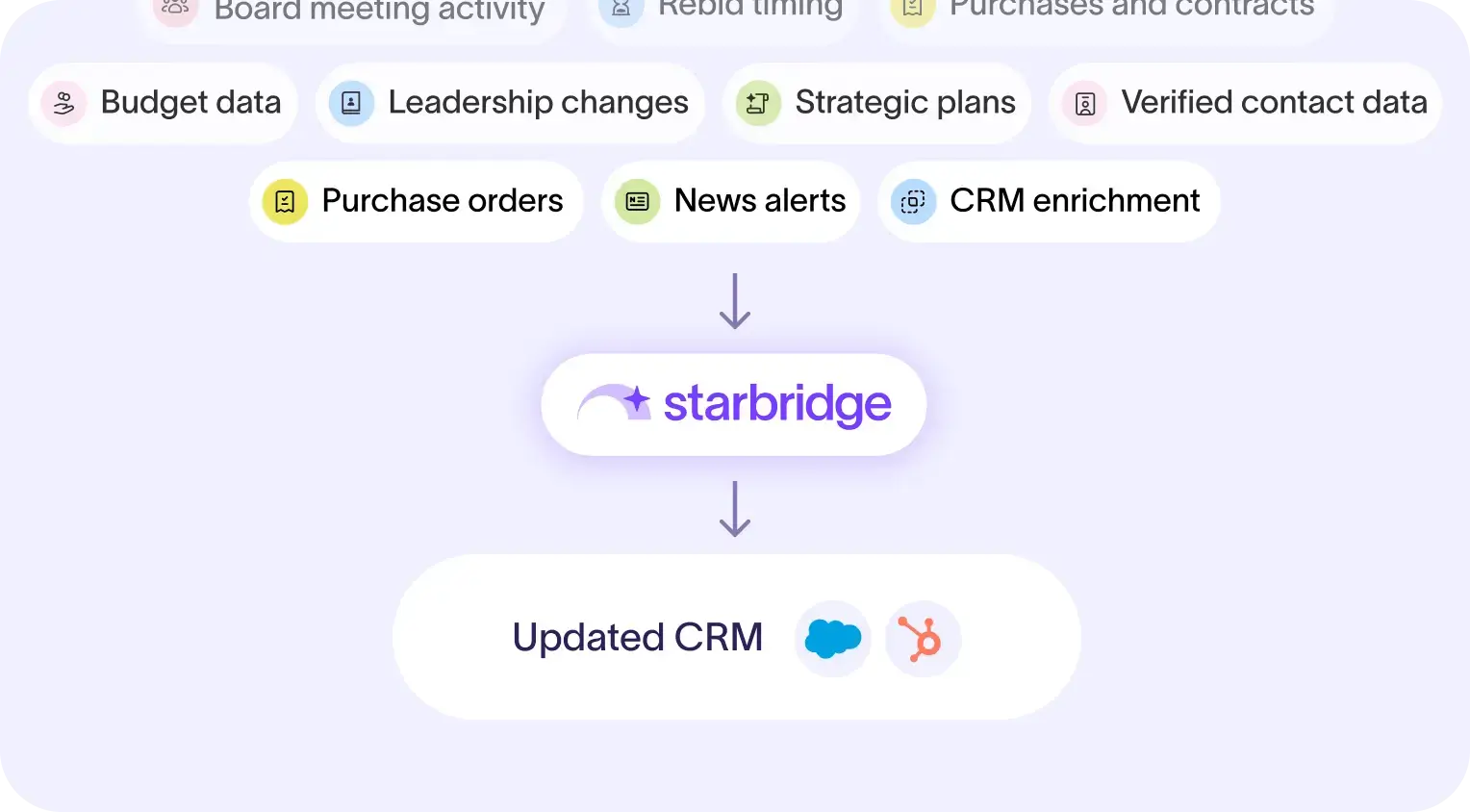
GovWell sources 15% of its total qualified pipeline from Starbridge and booked five meetings in its first week.
Your team gets a channel it can forecast, and enough runway to shape the requirements of the deals it closes.
The Deals Worth Winning Are Decided Early
A solicitation is a record of decisions already made. The budget was approved, the requirements were discussed, and in many cases a vendor was in the room while both happened. Everything that determines the outcome is published somewhere first, in a capital plan, a budget line, or a board agenda.
Reading that trail is legal, it is expected, and it stops working the day the solicitation posts. What it takes is coverage your team can sustain and a pipeline model that gives an early-stage account somewhere honest to live.
Book a demo to see which accounts in your territory are moving right now, and which deals you can shape instead of bid on.
Frequently asked questions
Yes, but selectively. By the time an RFP is published, the requirements are already set and some opportunities may favor an incumbent or preferred vendor. Look for signs that the competition is genuinely open.
Also make sure you can meet the full scope, and that you have a meaningful advantage in product fit, price, compliance, relationships, or account intelligence. If the RFP appears written around another vendor and you have no reason to believe you can displace them, skip it.
Yes, in most jurisdictions. Pre-solicitation contact is standard practice and is encouraged in federal acquisition rules. Restrictions begin when the solicitation is released, after which contact is usually limited to a designated procurement officer, in writing. Check your state's code and the solicitation's designated-contact clause.
Explore our use case library
Ready to give your SLED team real leverage?
Let’s talk about how Starbridge can build a qualified pipeline for your current team — without adding headcount.