.svg)

A playbook for finding pre-RFP opportunities in government and education

Government and education buyers aren't procurement experts in every category they purchase. They rely on vendors to educate them, and the vendor who shows up during that phase ends up influencing the evaluation criteria. By the time an RFP appears, the spec often already reflects whoever got there first.
That's what makes timing the real competitive variable in this market. Responding to an RFP you didn't know was coming rarely results in a win. The teams that consistently close government and education deals aren't better at responding to RFPs. They're better at identifying accounts moving toward one and engaging them before procurement formally begins.
This playbook gives you a step-by-step process for doing that repeatably, from spotting buying intent before an RFP to turning a signal into a booked meeting.
Step 1. Learn where buying intent surfaces before an RFP
Procurement portals, bid-aggregation platforms, SAM.gov, and bid notification sign-ups have their place, but they're post-publication tools. Once a listing appears on a bid board, the influence window has already closed.
The real opportunities live upstream, in the public record, weeks or months before a formal solicitation appears. You need to look for buying signals, which are early indicators that a government or educational entity plans to spend. These are trackable, public, and far more valuable than a published RFP.
Here is the taxonomy of pre-RFP buying signals specific to state and local government, K–12, and higher education, and what each one reveals about timing and intent:
- Board meeting discussions and agendas that reference a new initiative, a pain point with a current tool, or vendor dissatisfaction. When a school board discusses "modernizing student information systems" or a city council reviews cybersecurity posture, that's an early demand signal.
- Strategic plan priorities that name a capability or category the buyer plans to invest in over the next fiscal year. Districts and agencies publish multi-year plans that signal future purchases.
- Budget allocations and line items earmarked for a specific category, confirming that money is already set aside. A specific budget line for your solution category means the decision to buy has already been made internally.
- Grant awards that create new funding with a spending deadline, generating both budget and urgency. A district that just received a School Safety Grant has the money and the mandate to buy.
- Contract expirations that force the buyer to renew or evaluate alternatives, creating a natural opening. When an incumbent's contract is ending, the agency is legally required to evaluate alternatives.
- Leadership changes (new superintendent, CIO, city manager) that reset vendor relationships and trigger fresh buying cycles. These transitions often prompt new vendor evaluations.
- Job postings that signal a new initiative or an expanding program aligned to the vendor's product category. For instance, a "fleet manager" posting that lists "EV experience preferred" tells you a city is moving toward electrification.
Small business and diversity contracting programs (e.g., Small Business Enterprise, Minority Business Enterprise, Women Business Enterprise) are another avenue for opportunity identification worth exploring, but they're separate from the pre-RFP signal detection process covered here.
Step 2. Build a system to monitor buying signals at scale
Knowing which buying signals matter is only useful if you can monitor them across your total addressable market (TAM). The problem is scale. A typical government and education territory includes thousands of entities, each producing board meeting minutes, budget documents, strategic plans, grant records, and job postings throughout the year.
Manually tracking buying indicators across even a fraction of that requires hours of research per account. Most signals go undetected entirely. Teams that rely on manual monitoring tend to focus only on their largest accounts, overlooking mid-market districts and agencies that are actively moving toward a purchase.
What replaces that is a system that continuously scans the public record across every account in a rep's territory and surfaces only the buying signals relevant to their product and target segments. That's the difference between one-at-a-time portal searches and proactive, territory-wide signal detection.

Starbridge unveils the most relevant buying signals across state and local government, K–12, and higher education entities
Starbridge, an AI sales intelligence platform built exclusively for companies selling to the government and education sectors, delivers this with its Buying Signal Monitor.
The platform tracks over 320k state and local government, K–12, and higher education entities around the clock, surfacing buying indicators from board meeting minutes, strategic plans, budget data, grants, job postings, contract expirations, and bids. Each buying signal arrives paired with context on why the timing is right.
Signal-driven prospecting consistently delivers results for Starbridge customers. Frontline Education, for example, cut research time by 90%. Their reps now walk into meetings already knowing what the buyer cares about. GovWell generated 15% of the total qualified pipeline from Starbridge by acting on pre-RFP buying indicators before competitors knew an opportunity existed.
Step 3. Score and prioritize accounts by buying readiness
Most teams default to firmographic data for prioritization. They sort by enrollment, population, or operating budget and work their way down the list. The problem is that firmographic data describes account size rather than purchase readiness.
A large district isn't necessarily an active buyer. A city with a big operating budget might be in a spending freeze, whereas a smaller agency that just received grant funding for exactly what you sell is a far better target.
Buying-readiness indicators should drive prioritization, with firmographic data as supporting context. Here's a scoring framework that ranks accounts across three dimensions:
Starbridge automates this scoring across a team's full addressable market. It aggregates buying-readiness indicators into a single scored view, using 100+ buying signals spanning spend, leadership, contracts, and more.
That intelligence syncs, cleans, and enriches data directly in Salesforce or HubSpot through Starbridge's bi-directional CRM integration. Every rep gets a prioritized book of business grounded in real activity rather than static firmographic data.
Through Starbridge, an SDR at InquirED detected a district board discussion about forming a teacher committee. They reached out immediately and learned the district had not yet written its evaluation rubric. InquirED offered to provide one, positioning themselves to influence the process before any competitor knew the opportunity existed, and thus won $200K in new pipeline.
Step 4. Find verified contacts for the right decision-makers
Once a team has identified a high-priority account showing buying signals, the next step is reaching the right person. In state and local government, K–12, and higher education, this is one of the hardest parts. Generic B2B databases weren’t built for this market.
Tools like ZoomInfo scrape LinkedIn, which barely covers roles like superintendent, city manager, and procurement director. These titles are underrepresented or entirely missing from commercial databases. User-reported bounce rates for ZoomInfo run 15 to 25% for government contacts. In a finite market, wasted rep time on bounced emails lowers deliverability scores and reduces sequence performance.
Accurate government and education contact sourcing looks different. Contacts need to be pulled directly from official .gov and .edu websites, district staff directories, agency organizational charts, and board minutes, then continuously bounce-checked so reps never send to dead inboxes.
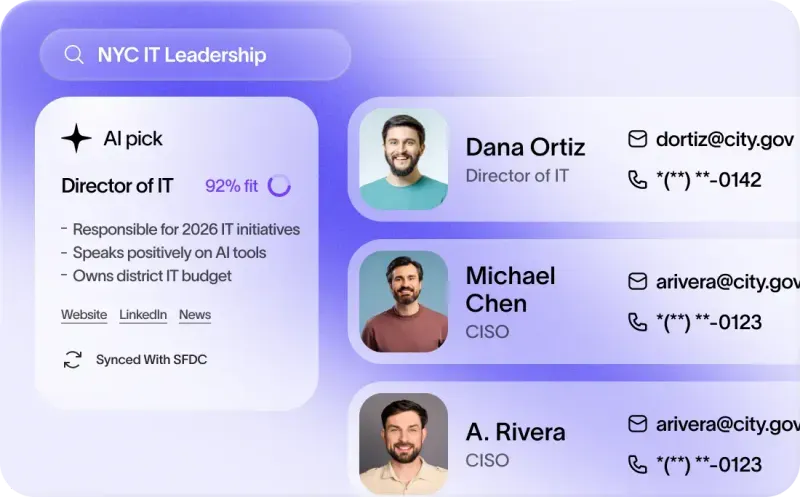
Starbridge gives you access to clean, accurate contact data
Starbridge's Contacts & Company Data was designed with this use case in mind. It uses proprietary web-agent technology to crawl government and school websites, then waterfall-enriches and continuously bounce-checks every contact. The result is a 98% email accuracy rate, validated by a 14,000-email test, and a 2% bounce rate, compared to the 15 to 25% industry standard referenced above.
Just days after connecting to Starbridge, Storage Scholars had a fully enriched TAM database, replacing thousands of hours of SDR time. The platform identified over 350 active school housing renovations and generated personalized outreach campaigns for each one.
Step 5. Turn a buying signal into outreach and a booked meeting
The gap between spotting a signal and booking a meeting is where most pre-RFP processes break down. Reps identify an opportunity, then have to manually translate it into a message, find the right contact, and get it into a sequencer. By the time outreach goes out, the timing advantage is gone.
Effective pre-RFP outreach has three components:
- A specific reference to the signal in the opening line, so the buyer knows immediately this isn't a generic pitch.
- A connection to a relevant proof point from a peer institution, which carries more weight in this market than any feature claim.
- A low-friction ask, such as a 20-minute conversation about what similar districts or agencies have done, rather than a demo request.
Starbridge runs this end-to-end. Every buying indicator surfaces with a verified contact, a suggested reason for outreach, and AI-generated messaging ready to send, pushing directly into Salesforce, HubSpot, Apollo, and Outreach.
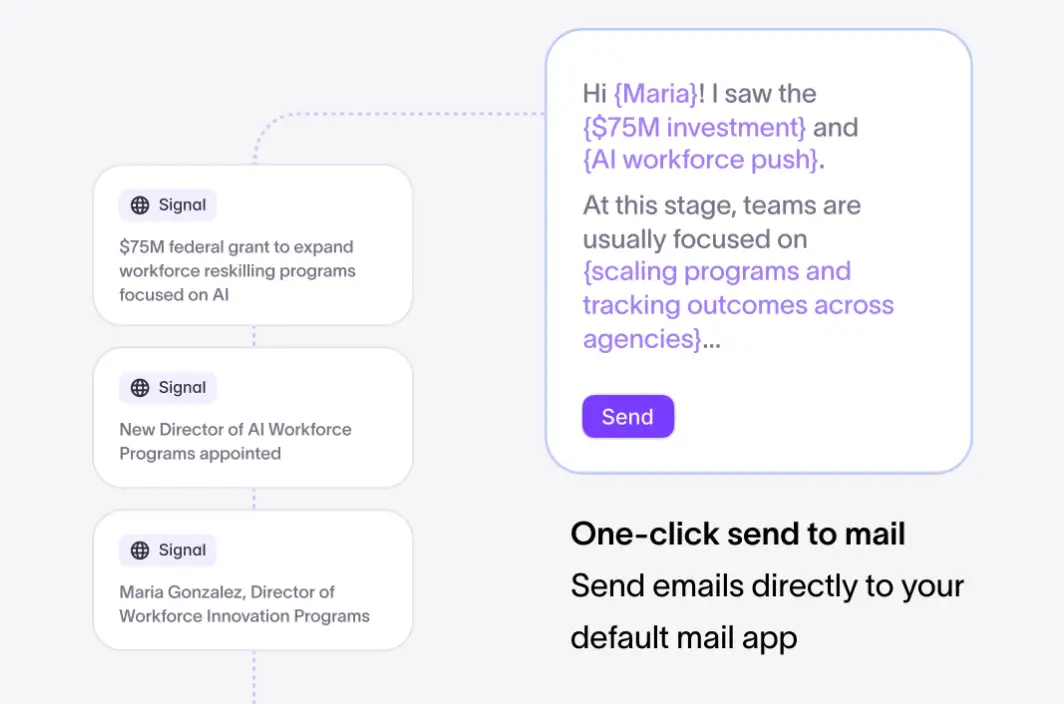
Starbridge helps you create tailored outbound emails based on intent and activity
Hapara, for example, tailored outreach to reference the specific pain points surfaced in board discussions and saw 20% higher response rates. Kaizen Labs saw a 10-20% lift in quota attainment after buying signals were delivered to Slack, giving reps context to reference board meeting details in outreach. Zencity's reps use Ask Starbridge to pull city priorities from recent council meetings before every call, and 50% of cold meetings now come from the platform.
The teams that shape deals are the ones that show up first
Companies that build a systematic process for detecting pre-RFP buying signals, prioritizing the right accounts, and reaching verified decision-makers don't just compete for deals. They shape them before procurement begins.
Starbridge is purpose-built for this motion. It aggregates buying signals from across your entire addressable market, connects them to verified decision-makers, and pushes prioritized opportunities directly into the tools your reps already use. If your team sells to state and local government, K–12, or higher education and is tired of chasing RFPs, book a demo to see what signal-driven pipeline can do for your business.
Frequently asked questions
A pre-RFP opportunity is a potential deal identified before a formal solicitation (RFP, RFQ, or IFB) is published. It surfaces through early buying signals such as board meeting discussions, budget allocations, grant awards, and contract expirations, indicating that a government or education entity is planning to spend.
Buying intent can surface 6 to 18 months before a formal solicitation appears. Board meeting discussions and strategic plan priorities often signal a purchase in the discovery phase (12-18 months out), while budget line items and job postings typically appear in the planning phase (6-12 months out).
Government and education buyers consult vendors early to learn what is possible before writing solicitation requirements. The vendor who educates the buyer during this phase influences the evaluation criteria, the language of requirements, and budget expectations. By the time the RFP is published, it often reflects the solution of whoever got there first.
Generic B2B databases scrape LinkedIn, which barely covers government and education roles. Accurate contacts need to be sourced from official .gov and .edu websites, district staff directories, and agency organizational charts, then continuously bounce-checked. Starbridge's Contacts & Company Data delivers a 98% email accuracy rate compared to 15 to 25% bounce rates from generic providers.
The strongest buying signals include board meeting discussions referencing your product category, strategic plan priorities naming a capability you deliver, budget line items earmarked for your category, grant awards creating new funding, contract expirations with incumbent vendors, and leadership changes that reset vendor relationships.
Explore our use case library
Ready to give your SLED team real leverage?
Let’s talk about how Starbridge can build a qualified pipeline for your current team — without adding headcount.