.svg)

Public Sector Email Marketing: A Guide for Marketers New to Government and Education

The first time trying public sector email marketing is not always fruitful. You export a list of school district and city contacts, load it into your sequencer, and bounce notifications arrive before the first reply. The addresses that do land reach people with no budget this quarter and no reason to respond.
This guide explains how to really send emails to the public sector. What changes when your buyer works for a government agency or a school district, and what the law allows you to send. It also explains where accurate addresses come from and how to time and write the message.
What Is Public Sector Email Marketing?
Public sector email marketing can mean two different things:Government agencies email constituents with service and program updates, or it is marketing for companies who sell to government and education. This guide covers how vendors selling to the public sector can use email marketing to better sell to government and education.
Government and Education Email Marketing vs. Commercial B2B Email
Commercial B2B email assumes a private conversation with a buyer who can move on their own timeline. Government and education buyers differ on a few key elements:
- Your message is not private.
An email you send about agency business becomes part of that agency's records, and it can be released to anyone who requests it under state public records law. That changes what you put in writing, because a price concession you would make privately in a commercial deal can later surface in someone else's records request.
- The purchase decision rarely rests with one person.
Boards, committees, and cabinets rely on documents they publish before they decide, which means the reasoning behind a purchase is often visible in advance. A superintendent who likes your product still needs a board vote, and the agenda packet for that vote is usually posted days before the meeting.
- Spending is tied to a budget year rather than a quarter.
Money is appropriated on a calendar basis, and any request that arrives outside that calendar must wait, no matter how strong the fit is. A district that has not adopted its budget cannot commit to anything, and a district that has already spent its allocation will not revisit the decision until the next year.
Federal buying follows its own rules, its own fiscal year, and its own registration requirements. This guide uses the term federal where the definition requires it.
From here on, the guide focuses on state and local government, K-12 school districts, and higher education institutions, where most companies selling into this market spend their time.
Where to Get Accurate Government and Education Email Addresses
Government and education contact lists decay faster than commercial ones. Roles turn over on election cycles and school board calendars, titles do not map cleanly across entities, and the same job has a different name in every district.
General B2B databases scrape LinkedIn, which doesn’t really work in the public sector because contact records go stale quickly.
There are a few ways to get accurate government and education email addresses:
- Entity websites and staff directories: They are authoritative and free, but they are slow because someone has to visit thousands of sites by hand.
- Purchased commercial lists: They are fast, but they arrive with contacts that are wrong, outdated, or just straight up bounce.
- FOIA requests:They return real documents with real names attached, but they take weeks.
Whichever route you choose, verify before you send. A hard bounce is a permanent delivery failure, and a series of them damages the sender reputation that every future campaign depends on.
If you want to automate the manual lead research process, consider Starbridge.
Starbridge is the AI GTM platform for companies selling to the government, K-12, and higher education, helping teams prioritize the right accounts, engage the right people earlier, and identify high-intent opportunities before the competition.
Starbridge’s contact and account data reached 98% email accuracy across a test of 14,000 emails because the addresses are built from official entity records rather than scraped LinkedIn profiles, and customers run a 2% bounce rate against the 15 to 25% typical of general B2B enrichment.
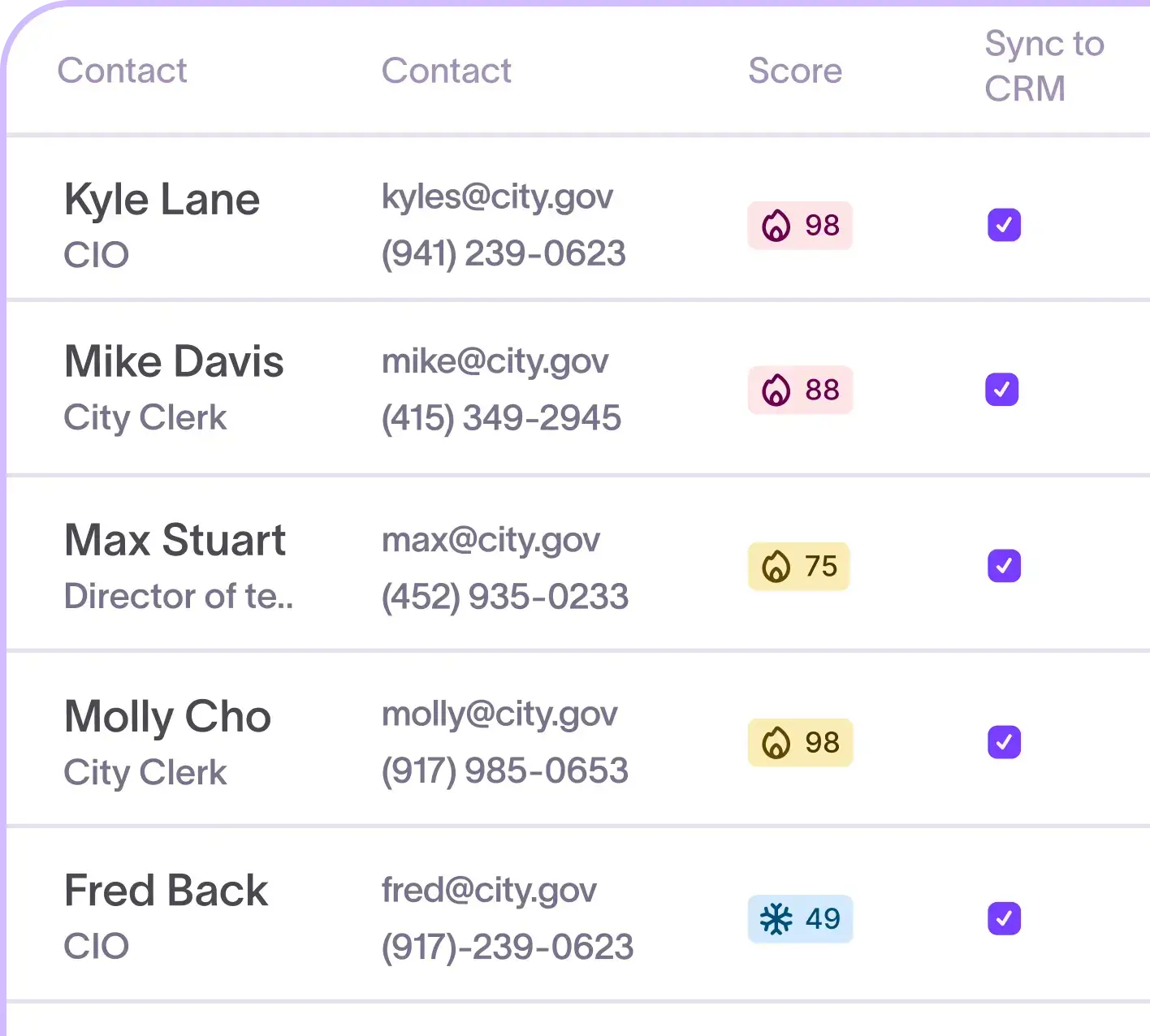
TAM to Target, a growth services firm that builds pipeline in government and education markets, reports Starbridge contact data is 3 to 4 times more valid than other vendors' data, and its team no longer verifies data points by hand before running campaigns.
When to Email Government and Education Buyers
Timing determines whether a good email matters. On July 1, 46 states and most of the nation's local governments start a new fiscal year, as Governing reported in July 2026.
Budget planning for that year usually begins the previous January, which puts the useful conversations six months ahead of the money.
Two windows matter most in the email outreach:
- October through March: New initiatives are shaped and funded for the following year, so relationship building belongs there.
- April through June: The end-of-year surge, when agencies and districts with unspent allocations have to commit them or lose them.
Buyers in that window are not starting a long 90-day procurement, so lead with a cooperative contract they can buy from fast, or a price under their sole-source threshold (which doesn’t require a long procurement).
There are a few exceptions to this rule: K-12 budget cycles break the July 1 rule often enough to check.
In Texas, a district or charter school chooses between a July 1 and a September 1 fiscal year, and the local board makes that call without state approval. Confirm the fiscal year in the district's own budget documents before building a send calendar around it.
Write Each Email From a Document the Agency or District Already Published
Generic personalization does not work with the public sector audience.
Using a first name and a company mention feels like spray and pray to someone who receives twenty of these messages a week.
What earns a reply is clear evidence that you read something the buyer wrote.
Luckily, the documents that contain that evidence are public, and they rank by usefulness. To name a few:
- A board discussion of your problem area is the strongest source, because decision-makers have already said the words out loud in a public meeting.
- A budget line item for your category comes next, because funding has been explicitly allocated.
- A grant award tells you funding arrived with an expiration date attached.
- A contract expiration tells you an incumbent has to be renewed or replaced.
- A strategic plan gives you multi-year language you can quote back.
- A leadership change resets vendor relationships, and a job posting confirms an initiative is real.
Reference one of those documents specifically. Name the meeting date, the line item, or the plan objective, then connect it to the outcome the buyer said they wanted.
A published RFP is the weakest place to start, because by then the requirements are already written and another company has usually helped write them.
If this is too cumbersome, you can work from published documents without reading every board packet in your territory.
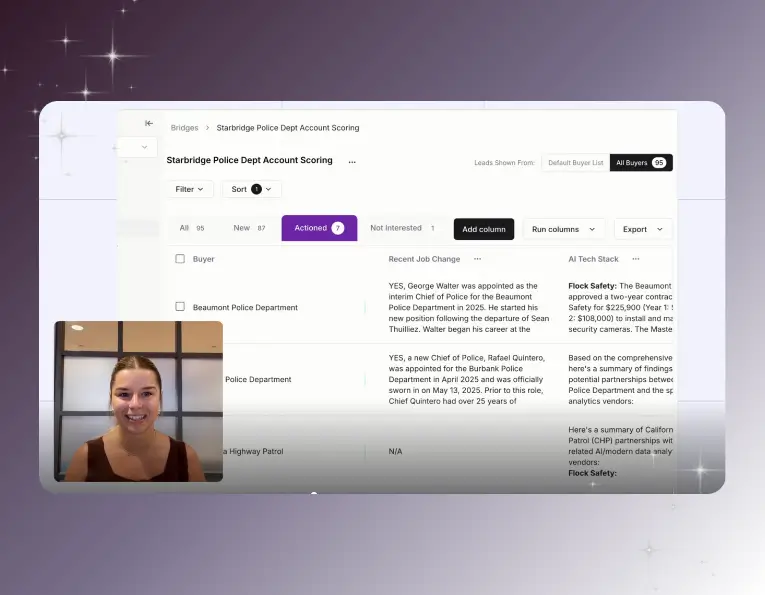
Starbridge monitors 320K+ government and education entities and surfaces the specific buying indicator behind each warm lead. A rep can open with the relevant board discussion, budget line, or expiring contract, then contact the right person.

ClearGov generated $300,000 in pipeline from a single email campaign built on Starbridge intelligence.
Writing based on published evidence is what turns a send list into closed deals rather than bounce reports.
Running Your First Government and Education Campaign
Start with the list. Verify addresses against official records before writing any copy, because deliverability determines whether anything else you do matters.
Then build the calendar. Map the fiscal year for every target entity, schedule relationship-building from October through March, and keep a fast procurement path ready for April through June.
Then write based on evidence. Pull the board discussion, budget line, or expiring contract that applies to each account, and make it the first line of the email.
Starbridge gives government and education sellers verified contact details, buying indicators, and timing in one place, from the first sign of demand through to a signed contract. Book a demo to see what the accounts in your territory published this month.
Frequently asked questions
Expect numbers in the same range as any B2B campaign for a considered purchase. Watch the bounce rate first, because government and education contact data fails more often than commercial data. Reply quality matters more than open rate, since a single board-level reply can start a multi-year contract.
Typically, you may communicate only through the designated contact named in the solicitation. New York's restricted period, for example, runs from the earliest posting to the final award, and a knowing violation can cost you the award. Read the solicitation document for its contact rules before sending anything to that entity.
No. Registration governs bidding rather than outreach. Nevada requires vendors to create an account to access procurement opportunities and receive automated notifications for matching solicitations. Register anyway, because registration is how bid notices reach you.
Yes. A government or school email address is a work address, and commercial email sent to it falls under the same federal law that governs all other commercial email you send.
That law is CAN-SPAM, and 15 U.S.C. § 7704 contains no carve-out for business-to-business messages. The statute requires you to identify the message as an advertisement or solicitation and to include a valid physical postal address. It also requires a working opt-out mechanism that stays live for at least 30 days and gives you 10 business days to honor an opt-out request.
Explore our use case library
Ready to give your SLED team real leverage?
Let’s talk about how Starbridge can build a qualified pipeline for your current team — without adding headcount.