.svg)

Lead Generation for the Public Sector: A Guide for Marketers New to Government and Education

Public sector lead generation works differently from traditional B2B. Government and education buyers rarely move through a neat funnel from ad click to gated download to sales call. They research quietly, buy on long timelines, and often leave their strongest intent signals somewhere other than your website.
This guide explains how to generate demand from government and education buyers, which channels actually work, and how to identify interest before a prospect ever fills out a form.
What Is Lead Generation for the Public Sector?
Lead generation for the public sector is the process of finding and qualifying buyers within government and education institutions. In this context, a lead is an account showing budgeted intent plus a named person with the authority to buy.
Those buyers include federal and state agencies, counties and cities, and K-12 and higher ed institutions.
Public Sector Lead Generation vs. Commercial B2B Lead Generation
There are a few key differences:
Public sector buyers typically don’t identify themselves.
- Commercial demand generation assumes the buyer will identify themselves: Someone downloads a report, visits a pricing page, or requests a trial, and that behavior becomes the lead.
- Government and education buyers rarely do any of that.
The public sector TAM (Total Addressable Market) itself is finite.
- A commercial territory is a guess at who might exist, with a list that feels infinite.
- A government and education territory is a list you can finish reading.
In the public sector, the budget often comes before interest.
- In a commercial deal, someone wants the product and then finds the money.
- An agency cannot buy what was never funded, and the funding decision often happens in a public budget process before anyone evaluates a vendor (although experienced vendors often influence the budgeting process as well).
The decision is made by a committee rather than a single person.
- In a commercial deal, one single champion may approve the purchase alone.
- In the public sector, formal solicitations are scored by a cross-functional group, and no single champion can approve the purchase alone.
Where To Actually Find Public Sector Leads
Government and education buyers do not raise a hand, but they are required by law to deliberate in public.
Agencies must give advance notice of when and where a meeting will occur and what is on the agenda. Agencies also must compile minutes or transcripts, and must take formal action in a public session.
This is good news for marketers:
- A school board debating an aging student information system is publishing its own problem statement.
- A city council approving a capital improvement plan is publishing next year's purchase list.
The richest documents are board meeting minutes, strategic plans, and capital improvement plans. Adopted budgets, grant award announcements, and executed contracts fill in what the meeting records leave out.
Buying Signals That Mark an Account Entering a Buying Cycle
Not every public document indicates that an account is buying. The indicators below reliably predict a purchase, roughly ordered by predictive strength:
- A board or council discussion of the problem you solve
- A new budget line item in your category
- A grant award with a spending deadline attached
- An incumbent contract approaching expiration
- A leadership change in a role that controls your budget
- Strategic plan language committing to a multi-year initiative
- Job postings for a role that exists only if the work is funded
- A published RFP, which ranks last because the requirements are already written
Why Procurement Portals Arrive Too Late
Procurement portals list solicitations that are already written. By the time one appears, the requirements reflect whichever vendor helped shape them.
Euna Solutions analyzed more than 6,000 public sector solicitations run through its procurement platform and found an average of 57 days from posting to award, with K-12 and higher education averaging 51 days.
That analysis dates from 2019 and covers one platform's caseload, so treat the figures as directional.
The window that determines the outcome opens much earlier before the opportunity surfaces on procurement portals:
- A problem surfaces in public discussion 12 to 18 months before a solicitation.
- Budget conversations happen 6 to 12 months out.
- Requirements are drafted in the final 6 months.
A portal alert reaches you at the end of that sequence, and you end up competing on price against vendors who have been in the conversation since the beginning.
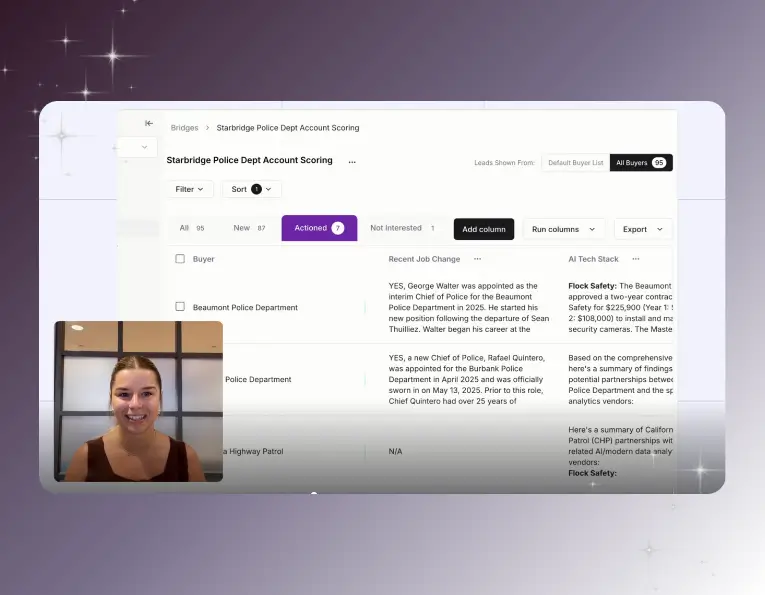
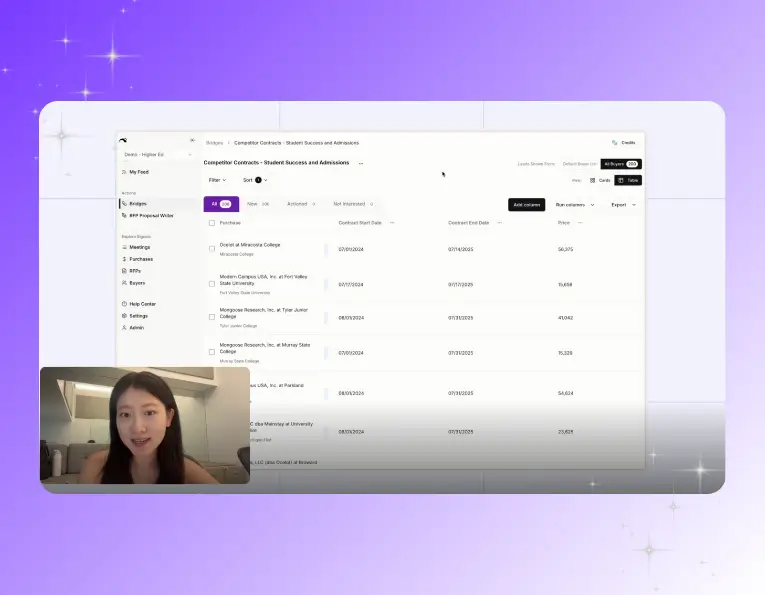
Starbridge is the AI GTM platform for companies selling to state and local government, K12 and higher education. Starbridge helps teams prioritize the right accounts, engage the right people earlier, and identify high-intent opportunities before the competition.
The Buying Signals Monitor monitors more than 320,000 government and education entities around the clock and surfaces the board discussion, budget line, or expiring contract behind each warm lead.
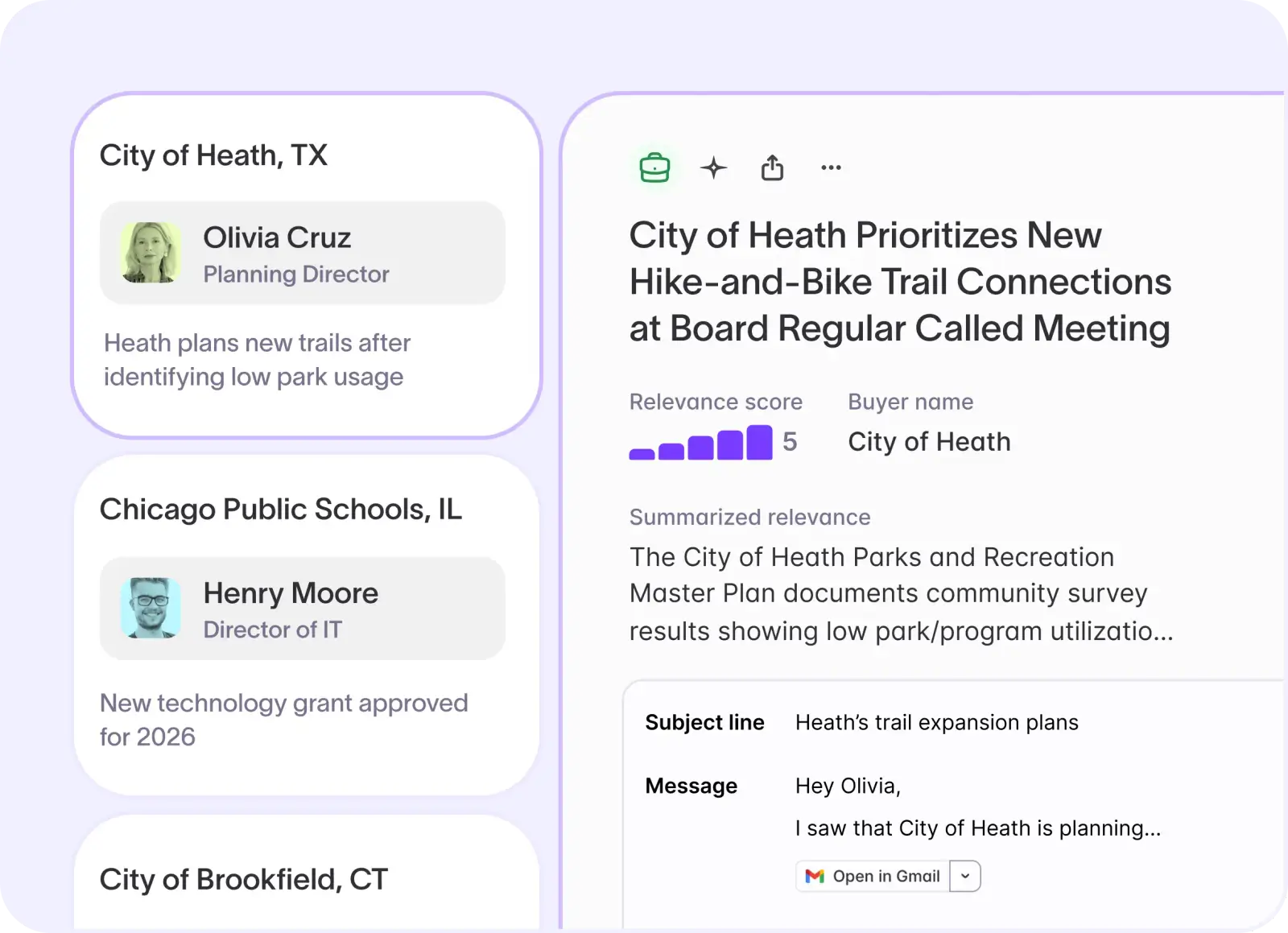
Zencity sources 50% of its cold meetings from Starbridge. Its enterprise reps pull city priorities from recent council meetings in seconds, then walk into the first discovery call already knowing the procurement path and previous contracts.
What Makes a Public Sector Lead Qualified?
A public sector lead is qualified when the money exists and they have a pain point you can solve.
Miss any one of those and you have a name, not a verified lead.
Funding source is the most important: A budget line in an adopted budget, a grant award with a stated purpose, or a bond measure that passed tells you the money is real and roughly when it has to be spent. Enthusiasm from a department head with no allocation behind it is not a strong lead.
The procurement method determines how difficult it is to win the deal. Sole-source thresholds run from roughly $5,000 to $150,000, depending on the state, municipality, or district.
If the price is below the threshold, the buyer can issue a purchase order without a competitive solicitation.
If the price is above it, an RFP is triggered, which adds months to the process and invites vendors who were never part of the conversation. Access to a cooperative purchasing vehicle can eliminate the solicitation entirely.
How to Score Public Sector Leads Until the Buying Window Opens
A lead sourced 12 months before a solicitation might not convert this quarter, and it should not be expected to.
Plan on an account sitting in your funnel across at least one full budget cycle before a purchase is possible.
A sequence built for a 30-day commercial cycle will burn the contact long before the budget exists.
Your early job is to warm up that lead and build the relationship before any solicitation, which means sending something the buyer can use rather than asking for a meeting.
Relevant policy analysis works, as does a peer district's approach or a straightforward answer to a question raised in the buyer's own board discussion.
Retire a lead when the evidence goes cold, not when the sequence ends. A board discussion with no follow-up a year later, a grant that expires unspent, or a contract that renews with the incumbent means the account has gone back to the top of the funnel.
Put the account back into monitoring and stop spending rep time on it.
Conclusion
The shift from commercial demand generation is smaller than it appears. You still need a named account, a reason to call, and a decision-maker who can say yes. What changes is the source.
Instead of waiting for a lead to fill out a form, you read what the buyer has already published about the problem, the budget, and the timeline.
Doing that across your entire TAM by hand is very time consuming.
That’s one of the reasons we created Starbridge.
Starbridge surfaces the buying indicator behind every warm lead and carries the account through to a signed contract with cooperative purchasing access built in.
Book a demo to see what your territory looks like when every government and education account arrives already scored and ready to work.
Frequently asked questions
The cost of public sector lead generation depends on how much of the lead sourcing work you do in-house rather than purchase, and on how many accounts you need covered. Compare any quote to the rep hours it replaces rather than to commercial cost-per-lead figures.
The contact record do expire fast. Government and education staff change roles often, so verify before every send. The account-level evidence expires on its own schedule. A grant with a spending deadline lapses when the deadline passes, and a board discussion with no follow-up a year later is no longer a lead.
Explore our use case library
Ready to give your SLED team real leverage?
Let’s talk about how Starbridge can build a qualified pipeline for your current team — without adding headcount.