.svg)

Starbridge vs Burbio: Which platform actually wins deals in K-12?

Starbridge vs. Burbio is a fair comparison if you sell to K-12 and want a single tool to find accounts, reach the right people early, and win the deal. In short:
- Burbio is a K-12 education intelligence and document-monitoring service.
- Starbridge is an AI GTM platform built for the full government and education market, carrying a deal from an early buying signal through outreach and procurement to a signed contract.
This comparison weighs the two on the capabilities GTM teams actually care about, from early buying signals and contact data to contract vehicle access.
Spotting early buying opportunities from data sources
A buying signal is an early sign that a district or agency is planning to spend, such as a new grant, a fresh budget line, or a contract about to expire. These surface long before an RFP appears.
The data sources a platform reads and the way it delivers what it finds determine whether a rep engages early or arrives after a competitor has already shaped the deal.
Starbridge surfaces buying indicators across board meetings, budgets, grants, contract expirations, and leadership changes
The Buying Signal Monitor watches 320K+ government and education entities around the clock, reading board minutes, strategic plans, budgets, grants, job postings, contract expirations, and more.
Bids and RFPs should be a last resort, because by the time one is posted, the buying decision is usually well underway. The point is to catch buying intent from a buyer while a rep can still influence it.
Every buying signal arrives ready to act on. It fires with a verified contact, a clear reason to reach out, and AI-generated outreach copy, then pushes directly into Apollo, Outreach, Salesforce, and HubSpot.
As a result, sales reps open their morning feed to a ranked next action, not a pile of documents to sort through.
In addition, buying signals can be searched semantically, so a signal like a looming budget shortfall surfaces even when those precise words never appear in the document. This allows you to uncover relevant opportunities that keyword-based searches miss because the buyer expressed the need in unexpected language.
Buying intent coverage spans K-12, higher education, and state and local government in a single feed, and helps companies like Zencity source 50% of its cold meetings from Starbridge.
Burbio tracks K-12 board documents through custom keyword monitoring
Burbio monitors K-12 school board meeting minutes, strategic plans, budgets, bonds, and superintendent turnover, with custom keyword and competitor trackers a team sets at the district or state level. The delivery is report-based, arriving through trackers and monthly alert reports.
Burbio also offers a District Research Agent that summarizes board minutes, budgets, and bonds for account planning.
The bottom line
Burbio helps a researcher find what a K-12 district is discussing, but puts the interpretation work on the rep. Starbridge pairs signal detection with a verified contact and ready-to-send outreach in the same motion, so a rep sees the ranked next step.
Contact and account enrichment that stays current
In a finite TAM, a single email to someone who left the role a year ago can cost a relationship you were counting on. Freshness and accuracy, not raw record count, are what separate a contact database you can trust from one that quietly ages.
Starbridge delivers 98% email accuracy through continuous web-agent crawling
Contacts & Company Data is built for how government and education staffing actually works. Proprietary web-agent technology continuously crawls government and school sites, district portals, and board minutes, then waterfall enriches the results and bounce-checks them on an ongoing basis. The database stays current because the crawling never stops.
The accuracy shows up in the numbers. A test of 14,000 emails returned 98% accuracy, with a 2% bounce rate, compared to the 15 to 25% commonly seen with generic databases. TAM to Target reports Starbridge contact data is 3 to 4x more valid than other vendors they had used, so their team stopped manually verifying records before every campaign.
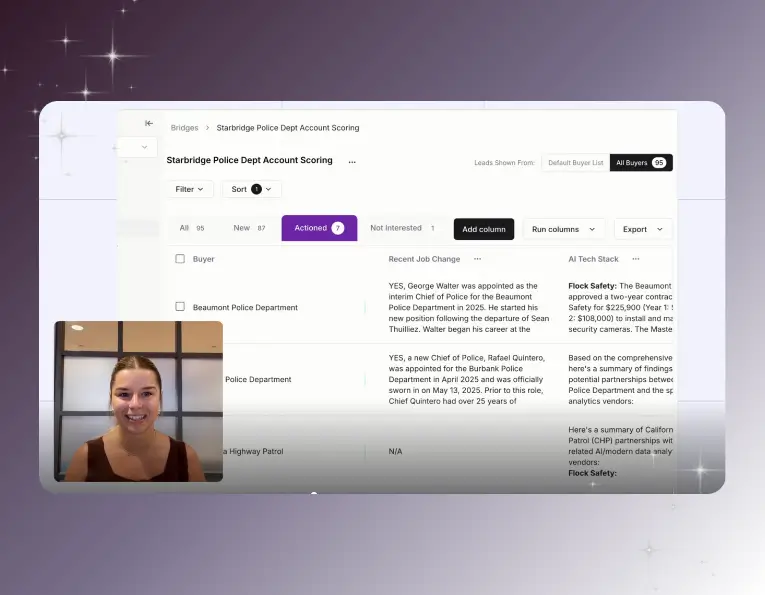
Beyond the contact itself, dynamic account scoring surfaces the warmest accounts with the context behind the ranking, and AI-generated positioning briefs connect specific product features to a buyer's stated pain.
Bi-directional native Salesforce and HubSpot integrations sync, clean, and enrich CRM records automatically, so the freshest data lives where reps already work rather than in a separate export.
Burbio offers a K-12 school district contacts dataset
Burbio provides a School District Contacts dataset with decision-maker names, titles, emails, and phone numbers, sortable by responsibility area and district, delivered alongside its K-12 data. Teams move that data into a CRM through Quick Links and an API.
Because the contacts are packaged as a K-12 dataset verified at a point in time, a rep working an account outside K-12, or returning to a district months later, may be reaching someone whose role has changed.
The bottom line
A K-12 contacts dataset gives reps a starting list. Starbridge gives them a continuously verified, scored, and enriched database pushed into the CRM with the reason each account matters right now.
Additionally, Burbio's contact coverage centers on K-12 school districts, while Starbridge covers decision-makers across K-12, higher education, and state and local government from one source.
Understanding vendor spend across government and education
Vendor spend intelligence tells you what an account already buys, from whom, and when the contract runs out.
Knowing the incumbent points reps toward displacement openings, and lets them walk into discovery well-prepared.
Platforms differ in how much detail they provide on competitive spend data.
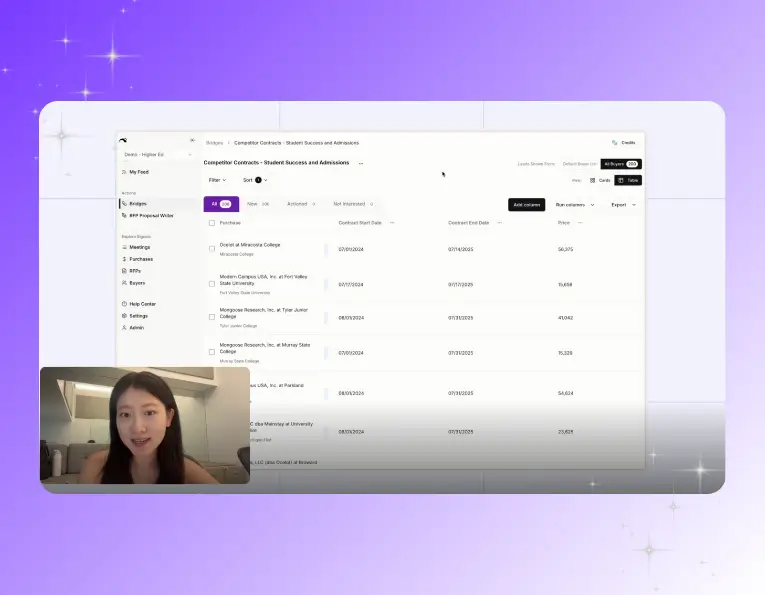
Starbridge surfaces full competitor contracts through FOIA automation
Public Spend Intelligence uses FOIA automation at scale to surface full competitor contracts and unredacted vendor proposals across government and education. A FOIA request, the formal public-records process for obtaining government documents, normally takes weeks of back-and-forth per account.
Starbridge provides 77% of purchase order data out of the box, and runs custom FOIA campaigns on the team's behalf.
What makes Starbridge especially useful is the level of detail behind each vendor relationship. A record can include annual revenue, the full proposal, opt-out clauses, implementation fees, expiration dates, and revenue by product.
A rep enters a discovery call already knowing what a prospect pays an incumbent, when that contract expires, and how to position against it. Frontline Education cut research time by 90% working this way.
Burbio maps district spending through check registers and ESSER III data
As of August 2026, Burbio surfaces K-12 spending through check registers covering thousands of districts, as well as CapEx and operating budget data, all searchable by vendor and category. For K-12 category sizing and competitor share analysis, that view is genuinely deep.
Burbio's spend data centers on what K-12 districts have recorded at the line-item and check-register level.
The bottom line
Burbio shows what a K-12 district bought. Starbridge adds the full contract terms and expiration timing behind those line items, so a rep sees not only that a contract exists but when it ends and how to displace it. Burbio's spend coverage centers on K-12, while Starbridge extends spend visibility across state and local government and higher education as well.
Finding and responding to RFPs
Finding an RFP the day it publishes usually means you are already behind. By then, a competitor has often helped shape the evaluation criteria.
The workflow that matters runs from discovering the right RFPs early to responding to them without burning a week per submission.
Starbridge scores RFPs for fit and drafts proposals with AI
The AI RFP Finder & Proposal Writer consolidates thousands of state, local, education, and university bid portals into a single personalized feed. Starbridge then scores each RFP by product fit, region, and win likelihood, so reps spend their time on the bids worth pursuing.
The AI proposal writer can draft responses from your own knowledge base, with a compliance matrix builder and a collaboration mode for review and refinement.
Burbio surfaces RFP activity within its K-12 document library
RFP and bid language appears within Burbio's keyword-searchable K-12 document library, and its Construction Tracker flags emerging K-12 building projects from board and facility discussions before they reach the RFP stage. For a team focused on getting ahead of K-12 procurement through document monitoring, that’s a useful early read.
The bottom line
Burbio helps a K-12 team spot RFP activity in the documents it tracks. Starbridge finds best-fit RFPs across the market, scores which are worth pursuing, and helps draft the response.
Contract vehicle access that removes procurement friction
Contract vehicle access is the path from vendor of choice to a signed, compliant purchase order.
When a public sector buyer already wants your product, the right cooperative vehicle lets them purchase it without running a full RFP, which can shave months off a deal that is already won.
Starbridge provides contract vehicle access as part of the platform
Starbridge provides direct access to all major contract vehicles and handles compliance, paperwork, and renewals itself, rather than routing a team through a reseller.
A team onboards once, for free, and then uses the right vehicle on every deal. For K-12 sellers, that means leading with TIPS, then reaching NASPO ValuePoint, OMNIA Partners, Sourcewell, and others as the motion widens.
In addition, Starbridge’s ‘Navigate procurement’ feature surfaces the exact vehicle each buyer uses, right on the buyer's page, so your rep isn’t guessing which pathway to propose.
As a result, a won deal becomes a signed, compliant purchase order in weeks rather than months.
Burbio centers on K-12 research and document intelligence
As of August 2026, contract vehicle access isn’t part of Burbio's offering. Burbio centers on K-12 research, spend, and document intelligence, so moving a won deal onto a cooperative vehicle happens outside the platform, through whatever process a team assembles on its own.
The bottom line
Burbio helps a team research the K-12 market. Starbridge carries a won K-12 or government deal through procurement to a signed contract inside one platform.
Which platform gets you to a closed deal?
Burbio is best for teams whose entire market is K-12, that need board and spend document research, and whose reps prefer to work from keyword reports and dashboards.
Starbridge is best for teams that prefer an all-in-one platform that gets you to a closed deal. It fits GTM teams selling beyond K-12 into cities, counties, state agencies, and higher education, as well as those that want early buying indicators tied to a verified contact and ready outreach.
Starbridge is also ideal for teams that need continuously verified contact data in the CRM, full visibility into competitor contracts, scored RFPs with AI drafting, and a contract vehicle that turns a yes into a signed purchase order.
See how signal-driven selling carries an account from an early indicator to a won contract across the full market. Book a demo.
Frequently asked questions
Starbridge is the stronger fit for GTM teams that sell across K-12, higher education, and state and local government and need one platform to carry a deal from an early buying indicator to a signed contract. It surfaces scored buying signals, verified contacts, competitor contract terms, fit-scored RFPs, and contract vehicle access in a single workflow. Burbio is a good fit for a team whose entire market is K-12 and whose reps want deep document-level research on district spending, board discussions, and budgets. If your sales motion reaches beyond school districts, Starbridge covers more of the market and more of the work.
Look for five things working together rather than in isolation. First, early buying indicators that surface before an RFP, such as budget lines, grants, and contract expirations. Second, contact data that stays accurate in a market where roles turn over often. Third, visibility into what accounts already spend and with whom. Fourth, a way to find and respond to best-fit RFPs. Fifth, a compliant path to purchase once a buyer says yes. Starbridge connects all five into a single motion that integrates with tools like Salesforce, HubSpot, Apollo, and Outreach, so intelligence becomes action without manual handoffs between tools.
Starbridge is built to shorten the path from a qualified buyer to a signed contract, not only to surface opportunities. Its Contract Vehicle Access is available as part of the platform, so once a buyer wants to purchase, a team can move the deal onto a cooperative vehicle the buyer already uses and reach a compliant purchase order in weeks rather than months. Starbridge provides that access directly and handles the compliance, paperwork, and renewals itself. As of August 2026, Burbio doesn’t publicly state contract-vehicle sell-through as a capability, so moving a won K-12 deal through procurement happens outside its platform.
Starbridge keeps contact data current through proprietary web-agent technology that continuously crawls government and school sites, district portals, and board minutes, then waterfall enriches and bounce-checks the results on an ongoing basis. Because the crawling never stops, records stay fresh rather than aging between refreshes, and dynamic account scoring plus AI positioning briefs turn each verified contact into a reason to reach out. That coverage spans decision-makers across K-12, higher education, and state and local government. Burbio's School District Contacts dataset centers on K-12 decision-makers verified at a point in time, so a team selling beyond school districts or returning to an account months later receives less ongoing re-verification.
It depends on how much of your market and sales motion sits outside K-12 document research. Burbio offers genuinely deep K-12 spending and board-document data, and a team whose entire market is school districts may be well served by it. Switching to Starbridge makes sense when you sell into cities, counties, state agencies, or higher education, or when you want signals tied to a verified contact, competitor contract visibility, scored RFPs, and a contract vehicle to close, all in one platform.
Explore our use case library
Ready to give your SLED team real leverage?
Let’s talk about how Starbridge can build a qualified pipeline for your current team — without adding headcount.