.svg)

Starbridge vs. Civic IQ. Which platform helps you close more government and education deals?

If you sell to state and local government, K-12, or higher education, the wrong sales intelligence tool means a stale CRM, hours of manual research, and competitors reaching decision-makers first.
- Starbridge is an end-to-end AI GTM intelligence platform that carries a deal from buying signal to signed contract.
- Civic IQ is a pre-RFP buying signal feed that monitors board meetings and budgets across agencies.
This Starbridge vs. Civic IQ comparison covers five solution areas where the platforms diverge.
Spotting early buying opportunities from data sources
A buying signal is an early indicator that a school district, university, or state or local agency is planning to spend. Examples include a new grant, a budget line item, a contract about to expire, or a leadership change tied to purchasing authority. The data sources your platform monitors determine whether you engage early or arrive after a competitor.
Starbridge surfaces buying indicators from board meetings, grants, leadership changes, and more
Starbridge built its Buying Signal Monitor to give GTM teams that early-mover advantage in state and local government, K-12, and higher education. The platform monitors 320K+ entities around the clock, pulling buying indicators from board meeting minutes, strategic plans, budget releases, grants, job postings, contract expirations, news alerts, and RFPs.
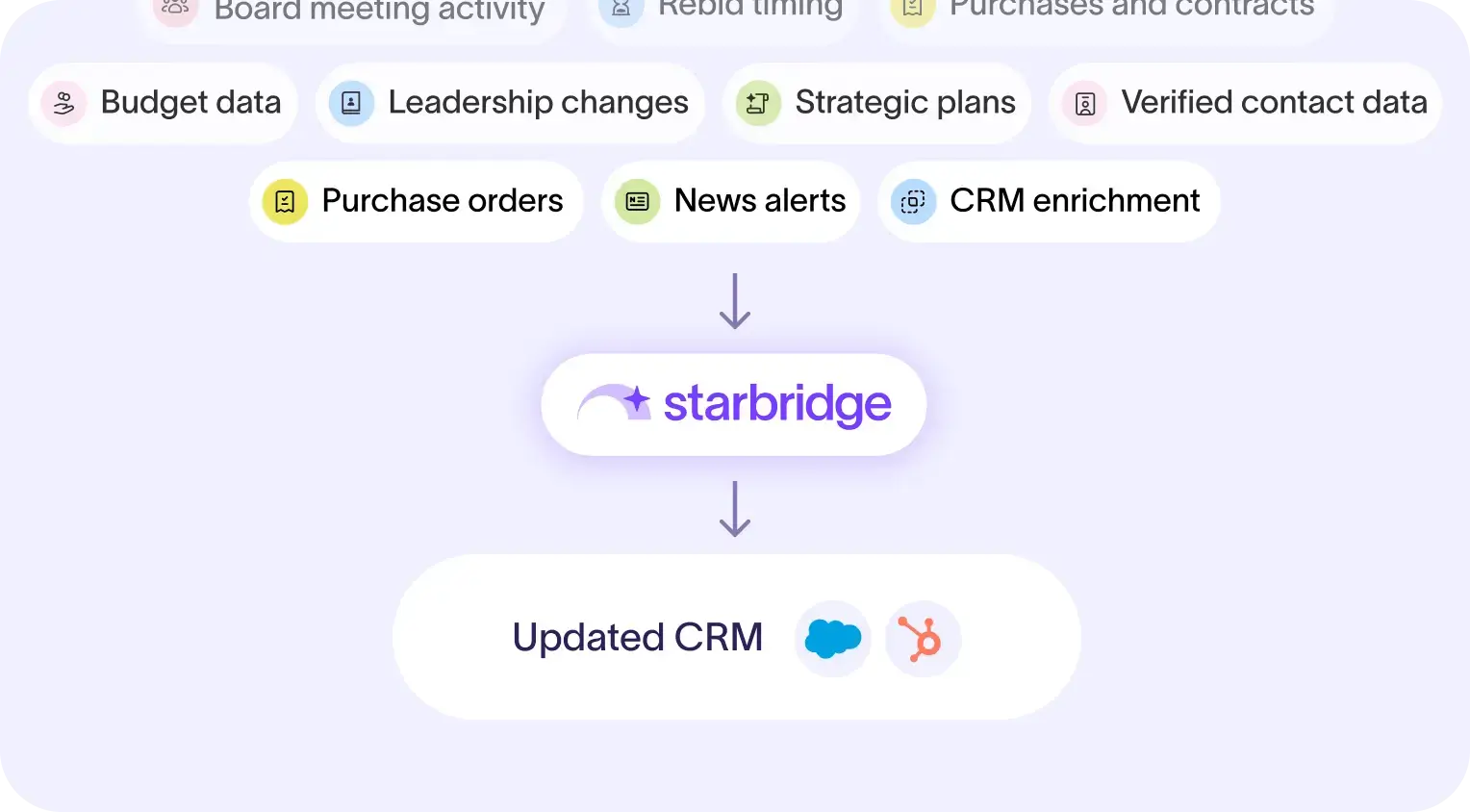
When a buying signal fires, Starbridge delivers more than an alert. Reps get a verified contact, a reason to reach out, and AI-drafted outreach copy they can send directly from the platform or push into Apollo, Outreach, Salesforce, or HubSpot.
The depth of account-level scoring is what sets this apart. Rather than forcing reps to triage dozens of individual alerts, Starbridge aggregates multiple buying indicators into a single account score that surfaces which prospects have the strongest combined intent. Your reps walk into a discovery call already knowing that a district discussed your category in a board meeting, received a related grant last quarter, and has a competitor contract expiring in six months.
At SimpliGov, the top-performing AE sources 90% of pipeline from Starbridge buying signals. That kind of signal-first motion means reps spend more time in conversations that convert and less time on manual research that leads nowhere.
How Civic IQ approaches early buying signals
Civic IQ monitors board meeting minutes, agendas, budget documents, and video transcripts across thousands of agencies. Its AI Mode scores each signal by relevance and surfaces the most urgent opportunities first. The platform attaches verified decision-maker contacts to each signal and drafts a personalized three-step email sequence for each one.
Based on publicly available information, Civic IQ scores at the signal level rather than the account level. Prospects evaluating the platform may find that aggregating multiple signals into an overall account score requires additional manual work.
The bottom line
Civic IQ delivers pre-RFP signal coverage. Starbridge adds account-level scoring, AI-drafted outreach, and a customer base that validates production-scale reliability.
Another core differentiator between these platforms is proven scale and results. Starbridge serves 450+ customers, including enterprise organizations like Abnormal AI and Airtable. As of August 2026, Civic IQ may be less proven, featuring only two case studies on its website, with both customers surfacing a handful of opportunities.
Contact and account enrichment that stays current
Generic B2B enrichment tools draw heavily from LinkedIn and commercial sources. Those sources barely reach government and education buyers, and records go stale fast. Freshness and accuracy are the differentiators in this market.
Starbridge delivers 98% email accuracy through continuous .gov and .edu crawls
Starbridge designed its Contacts & Company Data capability by going directly to the source. Instead of drawing from LinkedIn and commercial databases that barely reach government and education buyers, the platform runs continuous web crawls across government department sites, school district portals, university websites, and board minutes.
Every record then passes through waterfall enrichment and ongoing bounce-checking, so reps get verified names, emails, and phone numbers for decision-makers that stay accurate as roles change.
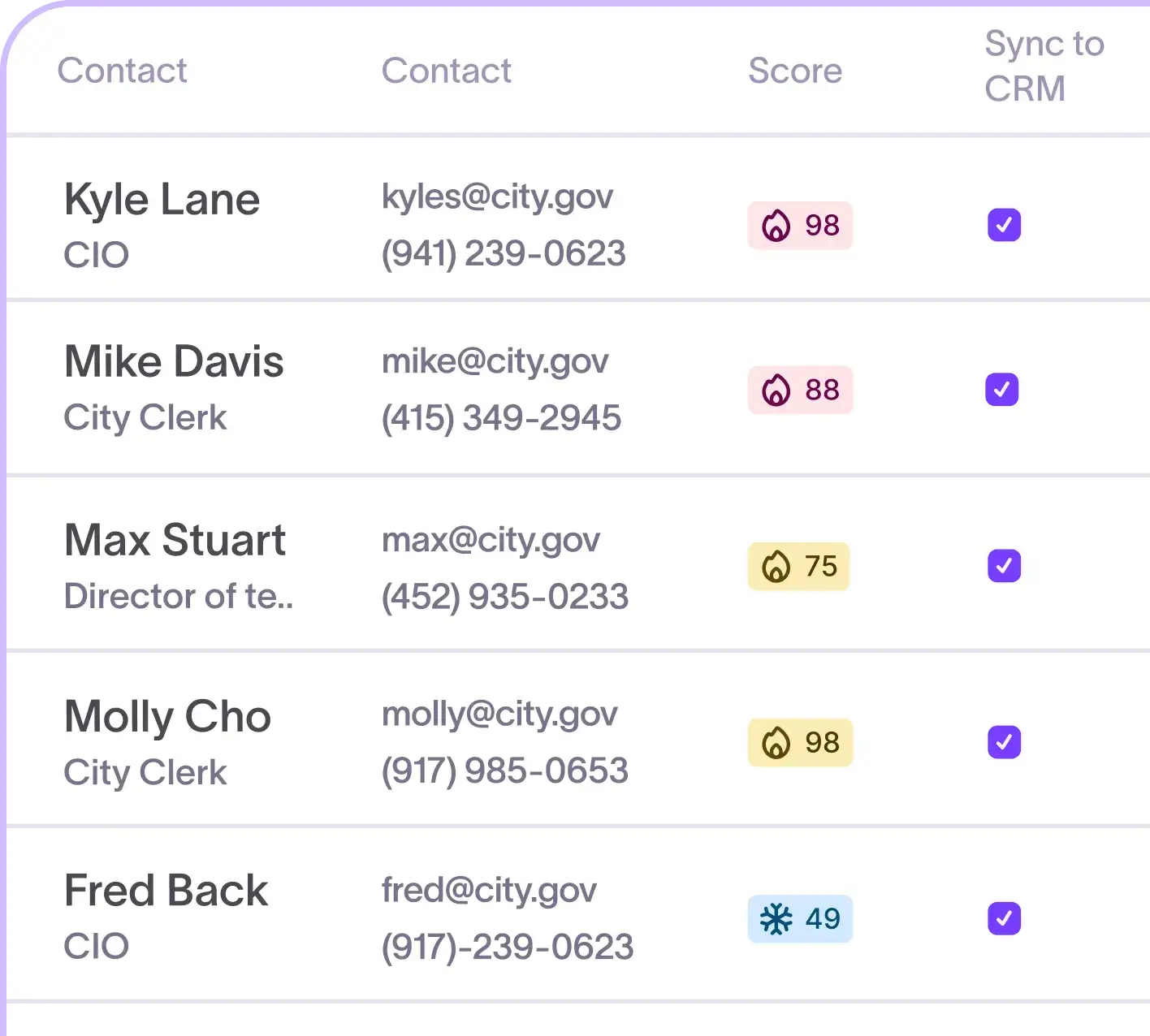
The accuracy gap is measurable. In a test of 14,000 emails, Starbridge achieved a 98% accuracy rate with a 2% bounce rate, compared to the 15% to 25% bounce that is standard among general B2B enrichment providers. That difference translates directly into fewer dead-ends, more conversations that connect, and less time wasted chasing bad data.
Beyond raw contact accuracy, the platform layers on dynamic account scores and AI-powered positioning briefs. Your reps see which accounts are warmest and get talking points that connect product features to real buyer pain. Bi-directional native integrations with Salesforce and HubSpot clean and enrich CRM data automatically, so the records reps rely on stay current without manual upkeep.
Mantra Health gained 3x enrichment coverage after switching to Starbridge. Their team found verified contacts they couldn’t surface anywhere else, in a market where generic B2B tools consistently fall short.
How Civic IQ approaches contact enrichment
Civic IQ attaches verified decision-maker contacts to each buying signal. Its List Builder tool lets reps create decision-maker lists filtered by persona or contract-expiry lists filtered by competitor. Lists export directly to CRM.
Per publicly available information, Civic IQ bundles contact data into its signal and list-building workflows rather than offering a standalone continuously verified contact database. Prospects may find that coverage varies depending on how many signals fire for a given account.
Civic IQ offers native integrations with HubSpot, Salesforce, Pipedrive, Zoho, and Attio for syncing signal data. Prospects evaluating both platforms may want to compare the depth of bi-directional CRM sync and ongoing bounce-checking capabilities.
The bottom line
Civic IQ attaches contacts to signals. Starbridge offers a continuously verified, scored, and enriched contact database pushed into your CRM with context on why each account matters now.
Understanding vendor spend across government and education
Knowing what accounts spend on competitors changes every discovery call. You can size the market, identify incumbents, time outreach around contract expirations, and position against specific pricing. Vendor spend intelligence turns research into revenue.
Starbridge runs FOIA automation to surface full competitor contracts
Starbridge’s Public Spend Intelligence gives GTM teams that unfair advantage in competitive displacement. The platform uses FOIA automation at scale to surface full competitor contracts and unredacted vendor proposals from state and local government, K-12, and higher education accounts.
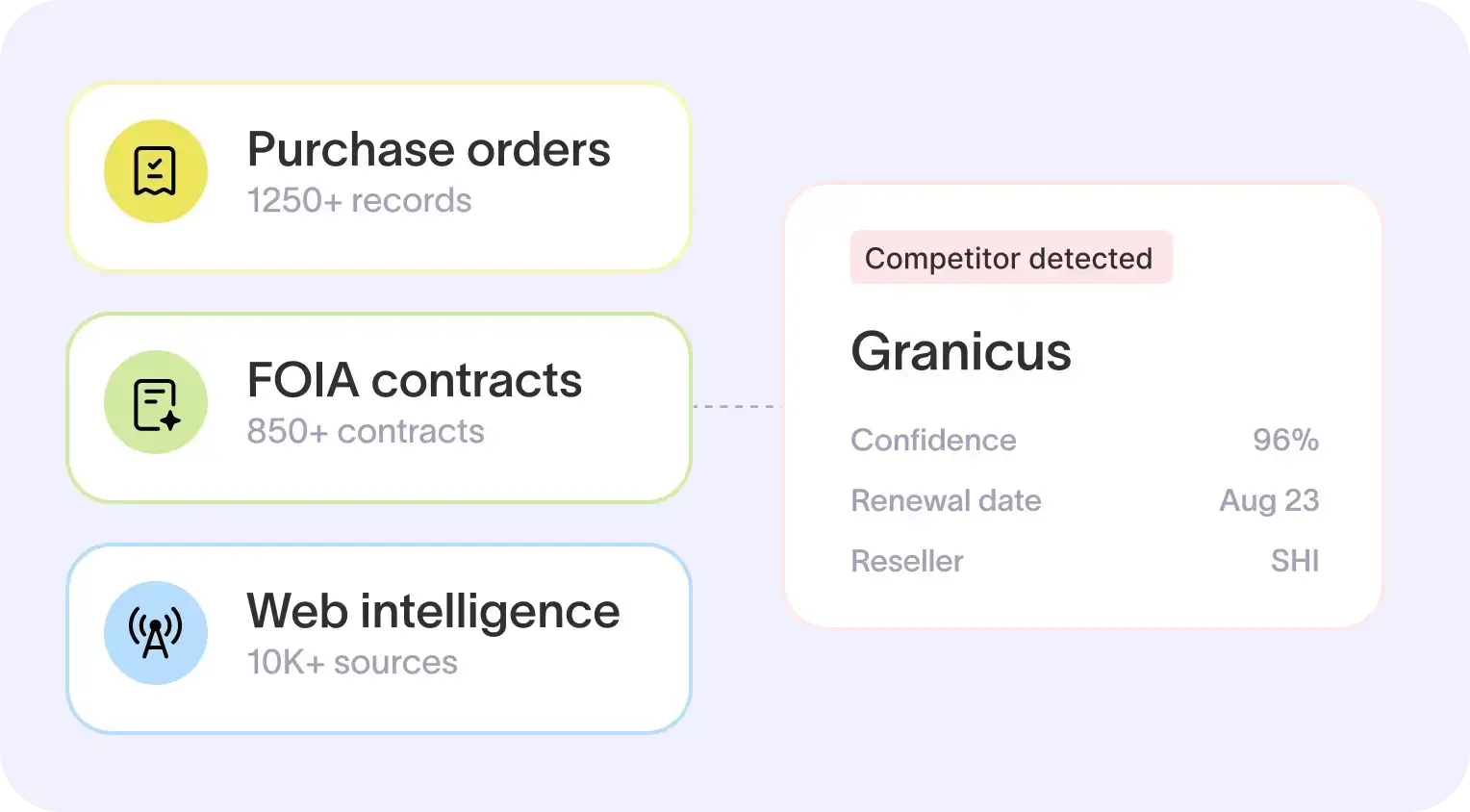
FOIA requests are how vendors obtain public records from government agencies, but filing them manually takes months of follow-up for a single account. Starbridge automates the process across an entire target market and delivers contract depth that purchase order data cannot match. Reps see annual revenue, full proposal text, opt-out clauses, implementation fees, expiration dates, and revenue by product line. Starbridge also cross-references purchase order data against its buying signal dataset, so competitor presence and account activity appear in one place. Your reps walk into a discovery call already knowing what the prospect is paying a competitor, when that contract expires, and exactly how to position against the incumbent's pricing structure.
Frontline Education, for example, cut research time by 90% after deploying Public Spend Intelligence.
At Abnormal AI, reps reclaimed 10 hours per week that previously went to manual account and procurement research. That time goes back into selling.
How Civic IQ approaches vendor spend
Civic IQ tracks signed contracts and awarded purchase orders across thousands of agencies. Its For Government research tool provides pricing benchmarks, vendor history research, and incumbent identification drawn from tracked spend.
The bottom line
Civic IQ shows that a contract exists. Starbridge differentiates on depth. Its automated FOIA workflows run continuously across an entire target market to surface the full contract and proposal, so prospects may find they can compare complete contract terms rather than the award summary alone.
Finding and responding to RFPs
By the time an RFP publishes, a competitor has often shaped the requirements. The best-positioned vendors engage accounts months earlier. Still, RFP response matters. Winning teams find the right bids, score them for fit, and respond fast.
Starbridge scores RFPs for fit and drafts proposals with AI
Starbridge’s AI RFP Finder & Proposal Writer turns RFP response from a bottleneck into a competitive advantage. The platform aggregates thousands of state, local, education, and university bid portals into a single personalized feed, then scores every RFP by product fit, region, and win likelihood, so reps focus on opportunities worth pursuing rather than wading through noise.
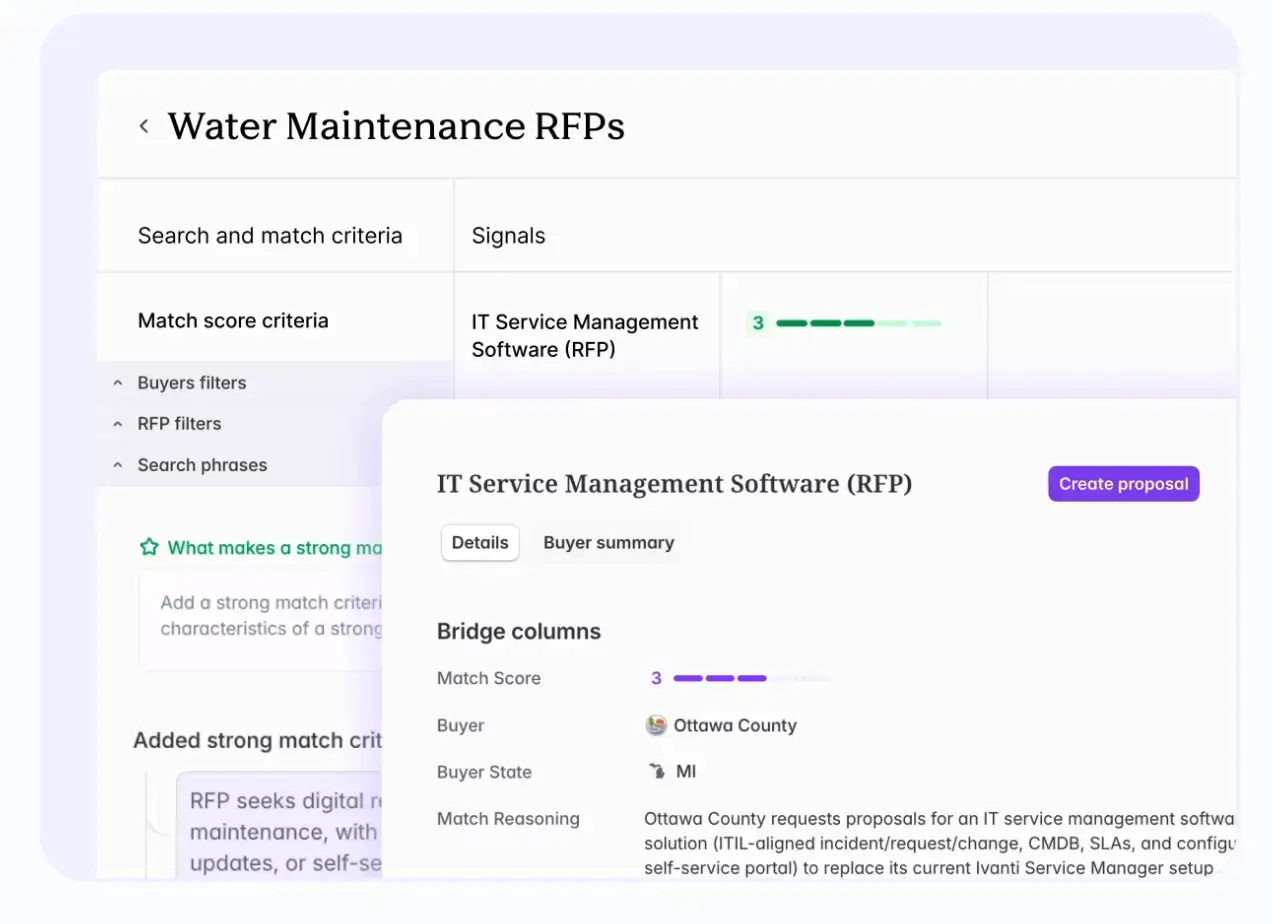
When it's time to respond, the AI proposal writer drafts directly from your knowledge base. Starbridge also generates compliance matrices and offers a collaboration mode for comments and refinement. Reps spend less time on document assembly and more time on deal strategy, positioning, and relationship building.
How Civic IQ approaches RFPs
Civic IQ surfaces live and historical RFPs, bids, and awards inside its signal feed. Reps can track active solicitations alongside other pre-RFP buying indicators.
The bottom line
Where Civic IQ centers on surfacing solicitations, Starbridge extends into the response itself with an AI proposal writer that drafts from the customer's knowledge base, a compliance matrix builder, and a collaboration mode for refinement.
Starbridge also differentiates by scoring each RFP for product fit, region, and win likelihood, so that fit assessment is built into the workflow rather than handled as a separate step.
Contract vehicle access that removes procurement friction
A contract vehicle is a pre-negotiated purchasing agreement that lets government and education buyers skip a full RFP process. Cooperative contracts like NASPO ValuePoint and TIPS allow agencies to purchase from approved vendors without running a competitive solicitation. For vendors, getting on these vehicles means a won opportunity can become a signed purchase order in weeks instead of months.
Starbridge provides contract vehicle access as part of the platform
Starbridge built Contract Vehicle Access to solve the last-mile problem that stalls deals after a buyer says yes.
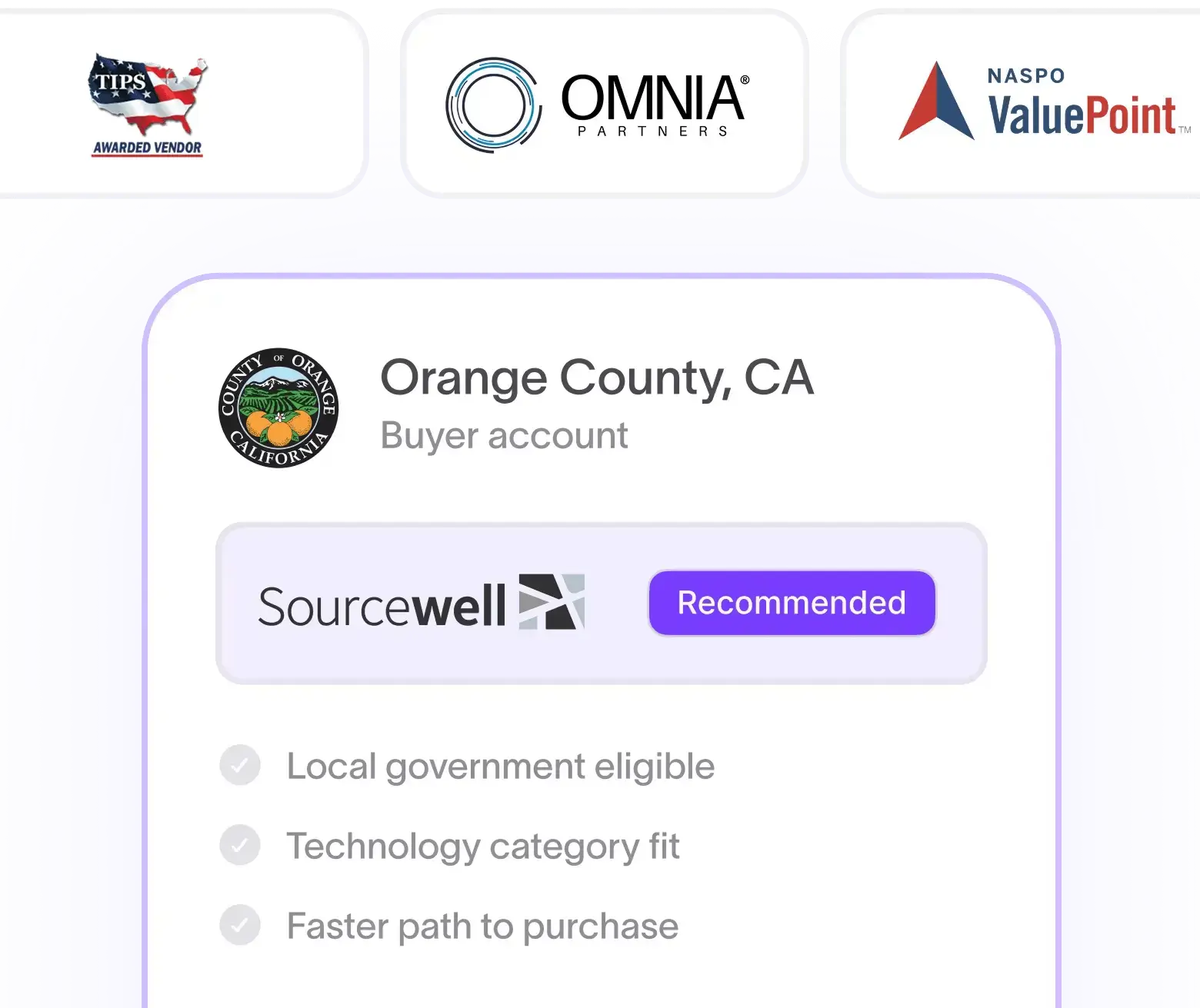
Gaining direct access to cooperative vehicles independently can take years of applications and compliance work. Starbridge removes that barrier as part of the platform. Vendors onboard once, then gain access to NASPO ValuePoint, OMNIA Partners, Sourcewell, TIPS, and more. Starbridge handles compliance, paperwork, and renewals, so teams don’t need to apply separately to each vehicle or manage ongoing administrative overhead.
Navigate Procurement surfaces the exact contract vehicle each buyer uses directly on the buyer's profile page. Your reps see which cooperative the agency purchases through and move from won deal to signed PO without triggering a full RFP. A qualified opportunity becomes a compliant, signed purchase order in weeks rather than months.
The depth of procurement support is what sets this apart. Instead of researching vehicle eligibility and chasing paperwork, reps hand off the administrative burden and focus on closing the next deal. The path from buyer interest to revenue shortens, and deals that once stalled in procurement move forward.
How Civic IQ approaches contract vehicle access
As of August 2026, Civic IQ maps procurement paths and cooperative vehicles at the agency level. Account executive profiles show which vehicles each agency can use, such as TIPS Cooperative or Texas DIR. This capability centers on research and navigation.
The bottom line
Civic IQ maps which vehicles each agency uses. Starbridge differentiates by providing the vehicle access itself and running the compliance and paperwork, so a won deal moves onto a cooperative contract the buyer already uses without a separate onboarding process for each vehicle.
For teams already on multiple cooperative contracts, Civic IQ's procurement mapping adds value. For teams without existing vehicle access, Starbridge vs. Civic IQ represents the difference between research and execution.
Which platform helps close more deals?
Civic IQ may be enough for teams that need only a weekly pre-RFP signal feed. The platform offers genuine value for monitoring board meetings and budgets across thousands of agencies. Its pricing intelligence from awarded contracts supports competitive research.
The platform starts by scoring buying activity at the account level, so reps know which prospects are warmest. It delivers continuously verified contact data that stays accurate as roles change. When it's time to displace a competitor, it surfaces full contracts through FOIA automation. As RFPs publish, it scores them for fit and drafts responses with AI, then turns won deals into signed purchase orders through built-in contract vehicle access.
All five capabilities push intelligence into Salesforce, HubSpot, Apollo, and Outreach. One platform carries a deal from buying signal to signed contract.
For GTM leaders who want to close government and education deals without adding headcount, Starbridge delivers the coverage, accuracy, and workflow automation. Book a demo to see how your team can start sourcing pipeline from buying signals, verified contacts, and competitor intelligence in one platform.
Frequently asked questions
Starbridge is the stronger fit for most teams selling to state and local government, K-12, and higher education, because it carries a deal from the first buying indicator to a signed contract. CivicIQ is a reasonable choice for a team that wants a focused pre-RFP signal feed to start conversations and little beyond that. Starbridge adds a continuously verified contact database, full competitor contract visibility, on-platform RFP drafting, and direct contract vehicle access, and it proves that motion across 400+ customers. If your reps need to close deals rather than only find them, Starbridge routes the whole workflow through one platform.
Look for a platform that reads the public record early, scores whole accounts rather than isolated signals, keeps contact data verified, exposes real competitor contracts, and provides a compliant path to purchase. Civic IQ covers the early-signal end of that list well. Starbridge connects all five as one workflow, moving from a buying indicator through outreach, spend research, RFP response, and a signed contract, then pushing that intelligence into Salesforce and HubSpot. The connective tissue between those stages is what saves reps hours and keeps a deal moving toward close.
Starbridge uses FOIA automation to surface the full competitor contract and the unredacted proposal, including opt-out clauses, implementation fees, and expiration dates. That depth tells a rep not only the price but the terms and timing needed to displace an incumbent. Civic IQ centers its research on awarded-contract values and pricing benchmarks drawn from purchase orders, which suits benchmarking and spotting the incumbent vendor. A rep planning a displacement, rather than benchmarking a price, gets more from the full-document view that Starbridge provides.
For most government and education teams, yes, though it depends on what the team needs. Civic IQ delivers a capable pre-RFP signal feed, and a team that only wants weekly signals may be well served by it. Teams that also need verified contacts, full contract visibility, on-platform RFP drafting, and a direct path to a signed contract get all of that from Starbridge in one platform. Because Starbridge covers the full workflow from buying signal to signed contract and syncs into Salesforce, HubSpot, Apollo, and Outreach, switching tends to consolidate several point tools into one and shorten the path to close.
Explore our use case library
Ready to give your SLED team real leverage?
Let’s talk about how Starbridge can build a qualified pipeline for your current team — without adding headcount.