.svg)

Starbridge vs. ZoomInfo: A head-to-head comparison across five areas

ZoomInfo is a horizontal B2B intelligence platform known for commercial contact data and web intent signals. Starbridge is the AI sales intelligence platform built specifically for companies selling to government and education.
This comparison breaks down the five areas that separate the two platforms for government and education sales teams. Here is a quick glance before we go deep.
Starbridge offers head-to-head contact data bakeoffs against ZoomInfo to prove superior data quality in the public-sector.
Available as part of the platform with no minimum deal size. Free to start.
Contact and account enrichment that stays current
Accurate contact data is the foundation of every outbound motion. In government and education, it is also one of the hardest things to maintain. Superintendents, procurement directors, IT leaders, and grants managers rarely keep active LinkedIn profiles. Many do not use the platform at all. Roles turn over with election cycles, budget years, and board decisions.
Starbridge delivers 98% email accuracy through purpose-built web-agent technology
Starbridge built its Contacts & Company Data capability by going directly to the source. Using proprietary web-agent technology, the platform continuously crawls government department websites, school district portals, university staff directories, and board meeting minutes to find and verify contacts. Waterfall enrichment layers multiple sources, and continuous bounce-checking ensures that stale records get flagged and refreshed before they reach a rep's outbox.
Starbridge delivers 98% email accuracy, validated across a 14,000-email test, with a 2% bounce rate. For comparison, the industry standard bounce rate for general B2B databases is 15 to 25%.
Beyond raw contact data, the platform scores accounts based on buying-readiness indicators, including competitor usage, contract expirations, budget trends, and grant funding. Firmographic data like enrollment and operating budget provides supporting context, but it is not the primary scoring driver.
Bi-directional native integrations with Salesforce and HubSpot sync, clean, and enrich CRM data automatically. Records update continuously as Starbridge's web agents discover new contacts, verify existing ones, and flag roles that have changed. Reps stop manually importing CSV files into a CRM that goes stale the moment the upload finishes.
Within days of Starbridge setup, Storage Scholars fully automated its contact enrichment process. The platform identified 350+ active school housing renovations and generated fully personalized outreach campaigns.
ZoomInfo's B2B database may not reach government and education roles with the same depth
ZoomInfo maintains one of the largest B2B contact databases in the market, partly drawn from LinkedIn profiles, contributed business card data, and commercial web sources. For commercial roles at private companies, ZoomInfo's coverage is strong. Other companies like Prospeo report accuracy may be closer to 75 to 85%.
Government and education contacts present a different challenge. Superintendents, procurement directors, grants managers, and department heads at state agencies rarely maintain active LinkedIn profiles. Many have never created one. The most reliable source for these contacts is official government and school websites, district staff directories, and board meeting records. Starbridge crawls these sources continuously. ZoomInfo's strength is its breadth across commercial B2B roles.
One G2 reviewer noted that "data quality is around 80% in my opinion" and that "updates to contact and company information is often slow." Another reviewer adds that "Sometimes contact information is outdated; it takes almost a year to update when a prospect leaves the organization, leading to incorrect data." In government and education, where roles turn over with election cycles and budget years, a year-old record is often a departed contact. When reps cannot trust the contact record in front of them, outreach attempts carry the risk of a bounce or a dead end.
Starbridge goes further by scoring accounts based on government buying behavior and generating AI-powered positioning briefs grounded in procurement activity, giving reps context that goes beyond a name and email address.
The bottom line
For commercial B2B roles, ZoomInfo delivers strong contact coverage. When the target market is government and education, Starbridge's approach to sourcing and verifying contacts is built for the way these buyers actually operate. The data comes from official government and school websites, not from professional networking platforms, and it stays current through continuous crawling and bounce-checking.
Spotting early buying opportunities from data sources
In government and education sales, the organizations that buy your product signal their intent through public actions long before a formal procurement begins. A school board discusses a new literacy initiative in a recorded meeting. A county publishes a grant award for cybersecurity infrastructure. A university posts a job opening for a procurement director. These buying signals tell your team which accounts are actively planning to spend, and they appear weeks or months before the RFP that most sales teams treat as the starting gun.
Starbridge surfaces buying indicators from board meetings, grants, leadership changes, and more
Starbridge built its Buying Signal Monitor to continuously track these public actions across 320k+ public sector entities. The platform monitors board meeting minutes, strategic plans, budget data, grants, job postings, contract expirations, news alerts, and bids/RFPs.

Bids appear last in that list for a reason. In government procurement, an RFP represents the end of the buying cycle, not the beginning. By the time a formal solicitation posts, a competitor has likely been in the room for months, helping shape specifications and building trust with decision-makers. The real opportunity lives earlier, in the discussions, funding decisions, and leadership changes that precede formal procurement.
Every buying signal the platform surfaces fires with three components that move a rep from awareness to action. A verified contact shows who to reach, a reason for outreach shows why the timing is right, and AI-generated personalized copy gives them what to say. Buying signals push directly into Apollo, Outreach, Salesforce, and HubSpot, so reps act from the tools they already use instead of toggling between platforms.
The underlying architecture matters here, too. Starbridge uses a vector database that understands context rather than matching exact keywords. If a school board discusses "budget shortfalls" without ever using the phrase "spending reduction," the platform still surfaces it as a relevant buying indicator. Traditional keyword-based approaches miss these entirely.
Within its first week on the platform, GovWell booked five meetings sourced from Starbridge buying signals, with 15% of its qualified pipeline traced back to the platform.
ZoomInfo's approach to buying intent
ZoomInfo's intent data draws on IP-to-organization mappings and publisher networks that track B2B content consumption. The system identifies companies researching topics based on web browsing and content engagement patterns, such as article reads, downloads, and topic searches across thousands of commercial publishers and websites.
This methodology serves commercial B2B selling. It detects when a company's employees are consuming content about a topic in aggregate, which can indicate buying interest for products sold to businesses.
Government and education purchasing decisions follow a different pattern. A school district planning to replace its student information system signals that intent through a board meeting discussion, a budget line item, or a grant award. These buying indicators live in the public procurement record. Starbridge was built to monitor exactly these sources. ZoomInfo's intent methodology partly tracks the commercial B2B web, where content consumption spikes more reliably indicate buying interest.
The bottom line
Starbridge monitors the public procurement record to surface what is about to happen in government and education accounts. ZoomInfo monitors commercial web activity to surface what B2B companies are researching right now. For teams selling to state and local government, K–12, and higher education, the buying indicators that matter most live in board minutes, budgets, and contract records, and Starbridge is purpose-built to find them.
Understanding vendor spend across government and education
Knowing what a government or education account is spending today, with whom, and when that contract expires changes every aspect of a sales conversation. It determines which accounts your team prioritizes, how reps position against incumbents, and what they say in the first 60 seconds of a discovery call.
In government procurement, spending data is public record. Vendor contracts, purchase orders, and proposals can be obtained through Freedom of Information Act (FOIA) requests. But filing those requests manually, tracking responses, and extracting actionable intelligence from the documents is time-consuming work that most sales teams simply cannot do at scale.
Starbridge runs FOIA automation to surface full competitor contracts, not just line items
Starbridge built Public Spend Intelligence to automate this entire process. The platform continuously files custom FOIA requests at scale across government and education entities. Each FOIA response delivers the full picture of what a government account is actually spending.
- Annual contract revenue and pricing
- Complete, unredacted vendor proposals
- Opt-out clauses and implementation fees
- Contract expiration dates
- Revenue breakdown by product
This depth transforms how reps prepare for conversations. Instead of asking a prospect what they use today and hoping for an honest answer, a rep walks into a discovery call already knowing what the account pays a competitor, when that contract expires, what the implementation looked like, and where the pricing has room to be challenged.
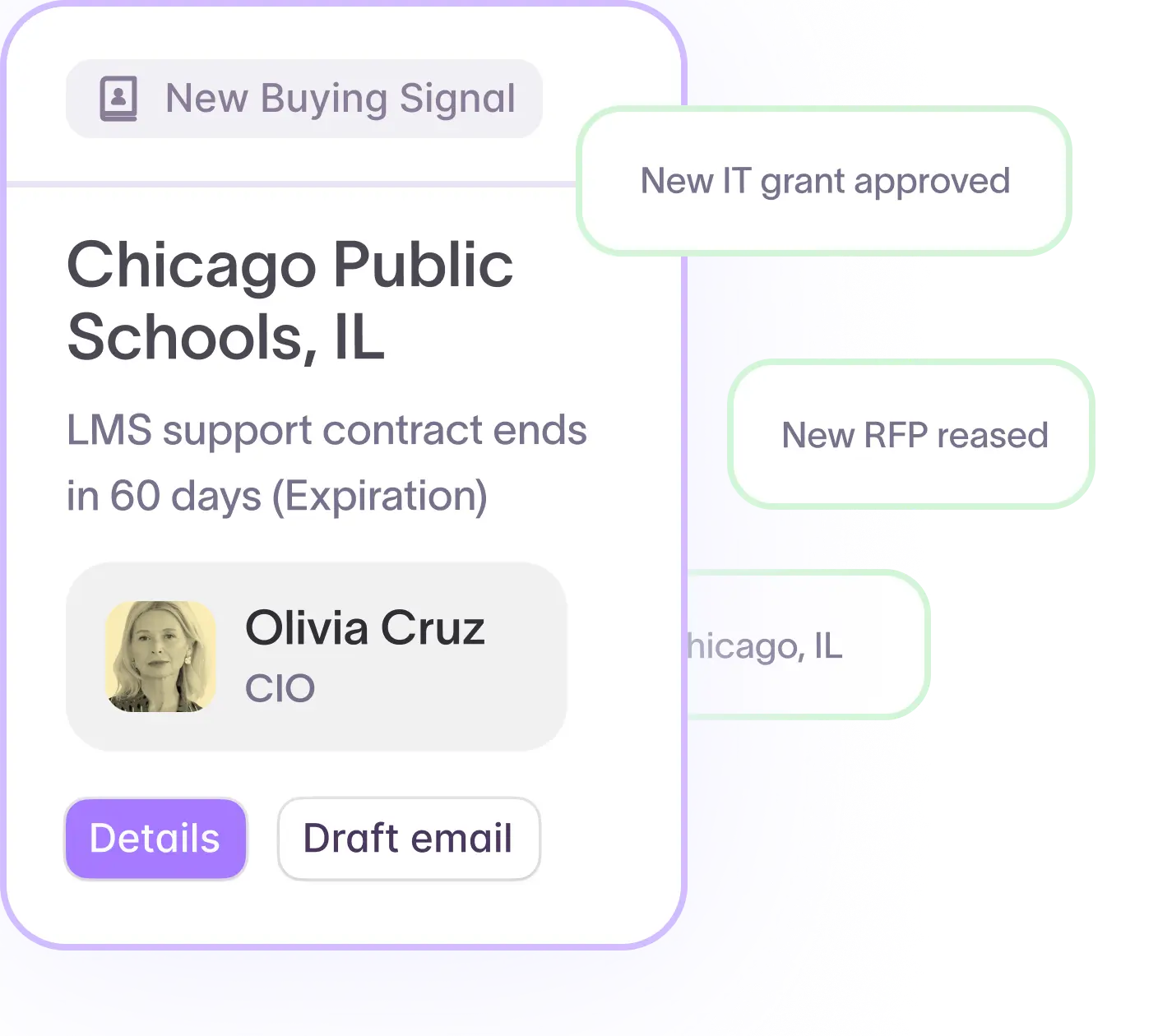
The timing dimension matters just as much as the data itself. Government contracts typically include renewal windows and opt-out deadlines. Understanding how government sales work makes these timing windows actionable. Missing a contract expiration by a month can mean waiting another full procurement cycle, sometimes years, for the next opportunity. Starbridge surfaces these dates so teams can time outreach to arrive when decision-makers are actively evaluating whether to renew or switch.
A 90% reduction in research time is what Frontline Education achieved after implementing Starbridge, with reps now walking into meetings already knowing what the buyer cares about. At Abnormal AI, replacing manual account research with Starbridge's automated spend intelligence saves 10+ hours per rep per week.
Where ZoomInfo's data layer focuses
ZoomInfo's data layer covers firmographics, technographics, and commercial intent signals. It can tell you a company's tech stack, employee count, and revenue range. These are valuable inputs for commercial B2B prospecting.
Government and education sales require a different kind of competitive context. Reps need to know what the account is spending today, who the incumbent vendor is, when that contract expires, and what the full proposal looked like. That intelligence lives in government procurement records and FOIA responses. Starbridge automates the process of surfacing it. Without that automation, teams typically file FOIA requests individually, wait weeks for responses, read through PDF documents to extract pricing and contract terms, and track expiration dates in a spreadsheet. That is the workflow Starbridge was built to replace.
The bottom line
A tech stack and firmographic profile tell a rep who to call. Knowing what a school district pays your competitor, when that contract expires, and what the full proposal looked like tells a rep how to win. Starbridge surfaces that level of detail for every government and education account.
Closing deals through contract vehicles
In government and education, a won evaluation still has to clear procurement. Above the buyer's sole-source threshold, a purchase normally triggers a full competitive solicitation, and a new solicitation stretches the sales cycle by months. A contract vehicle is how a vendor skips that process. The buyer purchases off a cooperative contract that has already been competitively bid.
Starbridge helps close deals faster with pre-approved contract vehicle access
Starbridge doesn't stop once the opportunity is sourced. When a buyer is ready to move, Starbridge offers pre-approved access to every major contract vehicle, like NASPO ValuePoint, OMNIA Partners, Sourcewell, TIPS, and GSA. Deals close through a purchasing pathway the buyer already trusts, and Starbridge manages the compliance, paperwork, and renewals.
One onboarding covers the major vehicles, and the access is free to start with no minimum deal size. Because Starbridge already knows the exact vehicle each buyer purchases through, reps can route every opportunity down the fastest compliant path from first signal to signed contract.
Where ZoomInfo fits in the procurement workflow
ZoomInfo's platform surfaces commercial contact data and web intent signals. Contract vehicle sell-through is not a stated ZoomInfo capability as of July 2026. Cooperative purchasing is a government and education construct, and Starbridge builds that pathway into the same platform that surfaced the signal and the contact, so the motion runs from first indicator to signed contract without leaving the workflow.
The bottom line
A contract vehicle lets a ready public sector buyer purchase without running a solicitation. Starbridge gives vendors that pathway, handles the compliance and paperwork behind it, and turns the last mile of procurement into a routine transaction.
Finding and responding to RFPs
In government and education, RFPs represent real budgets tied to a defined procurement timeline. However, the RFP itself is often the last step in a process that started months earlier when a decision-maker identified a need, evaluated options informally, and sometimes worked with a vendor to shape the requirements.
If your team only finds RFPs after they post on a bid board, you are starting the race late. A competitor who engaged early may have helped draft the specifications, established trust with the evaluation committee, and positioned their solution as the default.
Starbridge scores RFPs for fit and drafts proposals with AI
Starbridge built its AI RFP Finder & Proposal Writer to solve both sides of the RFP problem, finding the right opportunities and responding to them fast enough to win. The platform centralizes thousands of state, local, education, and university bid portals into a single personalized feed. Instead of monitoring dozens of websites individually, a rep sees every relevant opportunity in one place.
Each RFP is scored by product fit, region, and win likelihood, so teams spend time on bids they can actually win instead of chasing every posting. The platform also flags RFPs that name an incumbent competitor, giving reps critical context about the competitive landscape before they decide whether to pursue.
When the team decides to respond, Starbridge's AI proposal writer drafts responses using the customer's own product knowledge base. A compliance matrix builder maps RFP requirements to response sections. Collaboration mode supports comments, tagging, and real-time refinement across team members. The result is faster, more consistent proposals that align with what the buyer asked for.
RFPs should be the last buying signal in a team's workflow, not the first. Starbridge's buying signal capabilities ensure teams are already engaged with an account, already known to decision-makers, and already positioned before the RFP drops. That is how GovWell booked five meetings in its first week on the platform, and it now sources 15% of total qualified pipeline from Starbridge. The AI RFP Finder & Proposal Writer then helps close what the earlier engagement started.
Where ZoomInfo fits in the RFP workflow
ZoomInfo is known for contact discovery and commercial intent signals. Its strength is identifying who to reach and when they are researching solutions. For teams that also need to find, score, and respond to government RFPs, Starbridge offers a purpose-built workflow that handles the entire process natively.
Teams selling to government and education often monitor bid boards separately, across dozens of portals with different formats and alert systems. They respond using a combination of word processors, spreadsheets, and shared drives. Starbridge consolidates that entire workflow into a single platform with AI-powered scoring, compliance matrix automation, and proposal drafting that pulls from a centralized product knowledge base. Moving from a buying signal to a submitted proposal happens without switching tools.
The bottom line
Starbridge finds RFPs across thousands of bid portals, scores them for fit, flags incumbents, and helps draft a winning response, all from the same platform where buying signals and contacts already live. For teams selling to government and education, where formal procurement drives a substantial share of deals, having this workflow in one place directly affects how fast deals close.
Which platform helps you close more deals?
ZoomInfo is a strong platform for commercial B2B selling. If government and education selling is a small part of your motion, ZoomInfo's broad contact database and commercial intent signals may cover your needs.
But if selling to state and local government, K–12, and higher education is a core part of how your team generates revenue, Starbridge is the clear choice. Starbridge connects early buying signals from the public procurement record, continuously verified contact data from official government and education sources, and FOIA-sourced competitor contracts and spend intelligence. It adds AI-powered RFP discovery and proposal writing, plus pre-approved contract vehicle access that closes deals through purchasing pathways buyers already trust. All five capabilities work together in a single platform that pushes intelligence directly into Salesforce, HubSpot, Apollo, and Outreach.
Book a demo to see how Starbridge helps teams selling to government and education win more deals.
Frequently asked questions
ZoomInfo is known for one of the largest commercial B2B contact databases, sourced largely from LinkedIn and commercial web data, which works well for private-company roles. Government and education decision-makers such as superintendents and procurement directors rarely keep active LinkedIn profiles, so that sourcing thins out in the market you sell to. Starbridge sources contacts in real time through proprietary web-agent crawls of verified .gov and .edu domains, then layers waterfall enrichment and continuous bounce-checking on top. In a test of 14,000 emails it reached 98% accuracy with a 2% bounce rate, compared with the 15 to 25% typical of general B2B databases. Starbridge is also happy to run a direct contact data accuracy bakeoff against ZoomInfo using your own list, so you can verify the difference before you commit.
That focus is the advantage. The records that decide these deals (board minutes, budgets, grants, procurement records, and official .gov and .edu directories) are not on the commercial web, which is where a horizontal contact database is strongest. Starbridge is purpose-built for state and local government, K–12, and higher education, so its data, buying signals, and workflows are shaped around how these buyers actually operate, from how an opportunity first surfaces in a board agenda to how a contract comes up for renewal. For a team whose pipeline is government and education, that depth is what turns coverage into booked meetings.
Raw database size is a commercial-B2B strength that does not translate directly to government and education coverage. A large, LinkedIn-sourced database still thins out for the superintendents, city managers, and procurement officials who rarely maintain profiles. Starbridge measures coverage differently: verified contacts across more than 320,000 state and local government, K–12, and higher education entities, sourced from the official records where these decision-makers actually appear, and continuously bounce-checked. What matters is not how many contacts a database holds overall, but how many it has, accurately, for the accounts you are trying to reach.
Starbridge is the AI sales intelligence platform built for companies selling to state and local government, K–12, and higher education. It is not a data feed: it connects verified contacts, buying signals, spend and contract intelligence, RFP discovery, and AI-drafted proposals into one workflow, scores accounts by buying readiness, and pushes prioritized leads into your CRM and sequencers. For a team running a government and education go-to-market motion, that makes Starbridge the system that runs the motion end to end, from the first buying indicator to a submitted proposal, rather than a source you query on the side. Where ZoomInfo brings horizontal coverage for commercial B2B, Starbridge brings that same end-to-end breadth to government and education selling, with data and workflows designed for it.
ZoomInfo's intent data draws on commercial web activity, inferring interest from browsing and content consumption across publisher networks. Government and education buyers signal intent through public actions instead: a board discussion, a budget line item, a grant award, or a contract nearing expiration. Starbridge monitors those sources across more than 320,000 state and local government, K–12, and higher education entities and delivers each buying signal as a warm lead with a verified contact, the reason the timing is right, and AI-generated outreach copy ready to send. Rather than a stream of aggregate web activity to interpret, reps get the specific accounts that are about to spend, and why. GovWell booked five meetings from Starbridge buying signals in its first week on the platform.
Many teams standardize on ZoomInfo for commercial prospecting, and it does that job well. For the government and education motion specifically, Starbridge connects the stages reps work through into one workflow: verified contacts, buying signals, spend and contract intelligence, RFP discovery, and AI-drafted proposals, with accounts scored by buying readiness. It delivers buying signal alerts via Slack and email, and pushes leads into Apollo, Outreach, Salesforce, and HubSpot, and its native Salesforce and HubSpot integrations are bi-directional and sync, clean, and enrich records automatically. Teams keep ZoomInfo for their commercial accounts and add Starbridge where the government and education procurement record, not the commercial web, is where deals begin.
Explore our use case library
Ready to give your SLED team real leverage?
Let’s talk about how Starbridge can build a qualified pipeline for your current team — without adding headcount.