.svg)

How to Use Government Strategic Plans and Board Minutes for Buying Signals

By the time the RFP drops, the deal is already decided. The meeting that defined its requirements was captured months earlier in a public document.
This guide explains which sections of a government strategic plan predict a purchase, which items in board minutes show one coming, and how to date the buying window from both, months before the RFP drops.
How Do You Use Government Strategic Plans and Board Minutes to Find Buying Signals?
A strategic plan names what an agency intends to buy, a capital improvement plan attaches dollars and a target year, and board agendas and minutes show the purchase moving through approval. Match that language to your product category, then prioritize the accounts where funding and timing already exist.
Each document answers a different question. The strategic plan answers what the buyer wants. The capital improvement plan answers whether money exists. The agenda answers when the decision lands. An account that appears in all three is further along than an account that appears in only one, and that difference is the entire basis for prioritizing outreach.
This account research scales two ways. A rep can research manually for a short list of named accounts, or a platform can run it across every entity in a territory. This guide teaches how to manually research first, because understanding what the documents say is what makes any automated alert useful.
Strategic Plans, Capital Improvement Plans, and Board Minutes: What Each Document Proves
Treating strategic plans, capital improvement plans, and board minutes as one undifferentiated pile of paperwork is what makes document research feel unreliable. Each document answers a different question, looks a different distance ahead, and calls for a different response.
Strategic plans state the intent
A strategic plan is a governing body's public statement of priorities, usually covering the next three to five years. A city might name economic resilience, a county might name service modernization, and a school district might name improved assessment outcomes. There are rarely dollar figures attached and never a procurement date.
What the plan gives you is direction and vocabulary. If a district's plan names expanding career and technical education and you sell CTE curriculum, you now know the priority exists and the exact words the buyer uses to describe it. Outreach that repeats the plan's own language back to the buyer comes across as informed rather than cold.
Capital improvement plans prove the money
A capital improvement plan, usually shortened to CIP, is the funding document. The UNC School of Government describes the CIP as a multiyear blueprint, typically spanning five to ten years, that combines proposed projects with their costs, timelines, and funding strategies.
The CIP is distinct from the annual capital budget, which funds only a single year. Projects in the CIP's first year feed directly into that annual budget, so a line item in year one or two is close to real procurement. A CIP entry has a number and a fiscal year next to it. That is the difference between a preference and a plan, and it is why the CIP is the strongest early document in the stack.
Board agendas and minutes show the approval
An item appears on a council or school board agenda because it has crossed an approval threshold. By that point, a dollar amount and a staff recommendation already exist in writing. The agenda packet is published before the meeting, typically a few days to a week before the vote, which makes it a forward-looking document.
Approved minutes point the other way. They are published after a later meeting approves them, which makes minutes a record of decisions that are already weeks old. Read agendas to get ahead of a vote. Read minutes to confirm what passed and who voted for it.
Together, the three documents cover a horizon that runs from years out in the plan and the CIP down to days out on the agenda. That range is what lets a seller choose an entry point instead of discovering every deal at the same late moment.
What to Look for in Board Meeting Agendas and Minutes
The agenda packet is the unit of reading. It bundles the agenda itself, the staff reports behind each item, and supporting attachments like contracts and fiscal notes. Two parts of the packet do most of the work for a seller.
Read the consent agenda first
The consent agenda is a grouping of routine, noncontroversial items that a board votes on collectively, without discussion. The Municipal Research and Services Center notes that routine contracts, contract renewals, and budget amendments commonly appear there. Purchases in your category can pass in a single motion that never reaches debate.
Vendor renewals on the consent agenda are competitive intelligence in plain sight. A renewal listed today is a contract expiration you can time outreach against in the next cycle. Minutes should list every consent item individually, so scanning the consent section of published minutes is the fastest way to inventory who an account already buys from.
School boards work the same way. A district routinely renews curriculum licenses, assessment platforms, and transportation contracts on consent, and each line names a vendor and a dollar amount. Ten renewals across a quarter's minutes provide a map of the installed base you are selling against.
The staff report language that moves money
Staff reports are where intent becomes a transaction. Phrases that signal a purchase taking shape include authorizing staff to issue an RFP, approve contract with, award of contract, approve purchase of, and budget amendment. The fiscal impact section names the funding account and its balance, which tells you whether the purchase is funded or aspirational.
Earlier-stage language matters just as much. A presentation, workshop, or study session on a problem means the body is still in discovery. Direction to staff to evaluate options means planning has started, and a feasibility study or pilot program means requirements are forming.
Match your outreach to the stage of the language. Discovery-stage items call for an educational touch. Planning-stage items call for a conversation about evaluation criteria. Approval-stage items are usually already spoken for, and a proposal sent at that point is often just filling out paperwork for someone else.
One reading habit covers both ends of the timeline. Scan agendas for forward motion in your category, and scan minutes for the renewals and awards that reveal the incumbents. Fifteen minutes per packet is usually enough once you know which two sections to open.
Where Strategic Plans, CIPs, and Board Minutes Live
Every one of these documents is public by law. All fifty states have open meetings and public records statutes, indexed by the National Freedom of Information Coalition, and those laws are why agendas, minutes, and plans get published at all. Washington, for example, requires public agencies to post the preliminary agenda for a regular meeting online at least 24 hours in advance, and some cities hold themselves to several days.
Board agendas and minutes live on the entity's own website, usually under the clerk, board of trustees, or city council page. Many agencies publish through agenda-portal platforms that archive full packets by meeting date. Strategic plans typically sit on the administration or superintendent's page, and CIPs are filed with budget documents in the finance or public works section. Adopted budget books often carry the full CIP project list as an appendix, searchable by keyword.
The catch is consistency. One city posts a searchable packet a week early. The neighboring district uploads a scanned PDF three weeks after the vote. The documents are public everywhere but uniform nowhere, and that inconsistency limits how many accounts one person can cover by hand.
Turn Buying Signals From Plans and Board Minutes Into a Ranked Account List
For a named-account list, the manual version of this work is straightforward. Pick the 20 or 30 accounts that matter most, add their regular board meetings to your calendar, and read each packet the day it posts. Log every hit in your CRM with the date, the item, and the stage of the language. Within a quarter you will know which accounts are talking about your category and which are already funding it.
The 2022 Census of Governments counted 90,837 local governments in the United States, and the count rose to 91,438 in the Bureau's 2025 update. Each one publishes on its own schedule in its own format. A rep can read one district's packet before a call. No team can read a thousand packets a week, every week, manually.
Stack document indicators with other buying signals
A plan mention alone is a lead. A plan mention plus a grant award, an expiring competitor contract, or a newly hired decision-maker is a deal forming. Scoring accounts by stacked buying indicators, rather than alerting on single events, turns document research into a ranked list your reps can work from top to bottom.
This is the job Starbridge was built for. Starbridge is the AI GTM platform for companies selling to the government, K-12, and higher education, helping teams prioritize the right accounts, engage the right people earlier, and identify high-intent opportunities before the competition. The Buying Signals Monitor reads board meeting minutes, strategic plans, and capital improvement plans across 320,000+ government and education entities and scores every account in a territory by buying readiness.
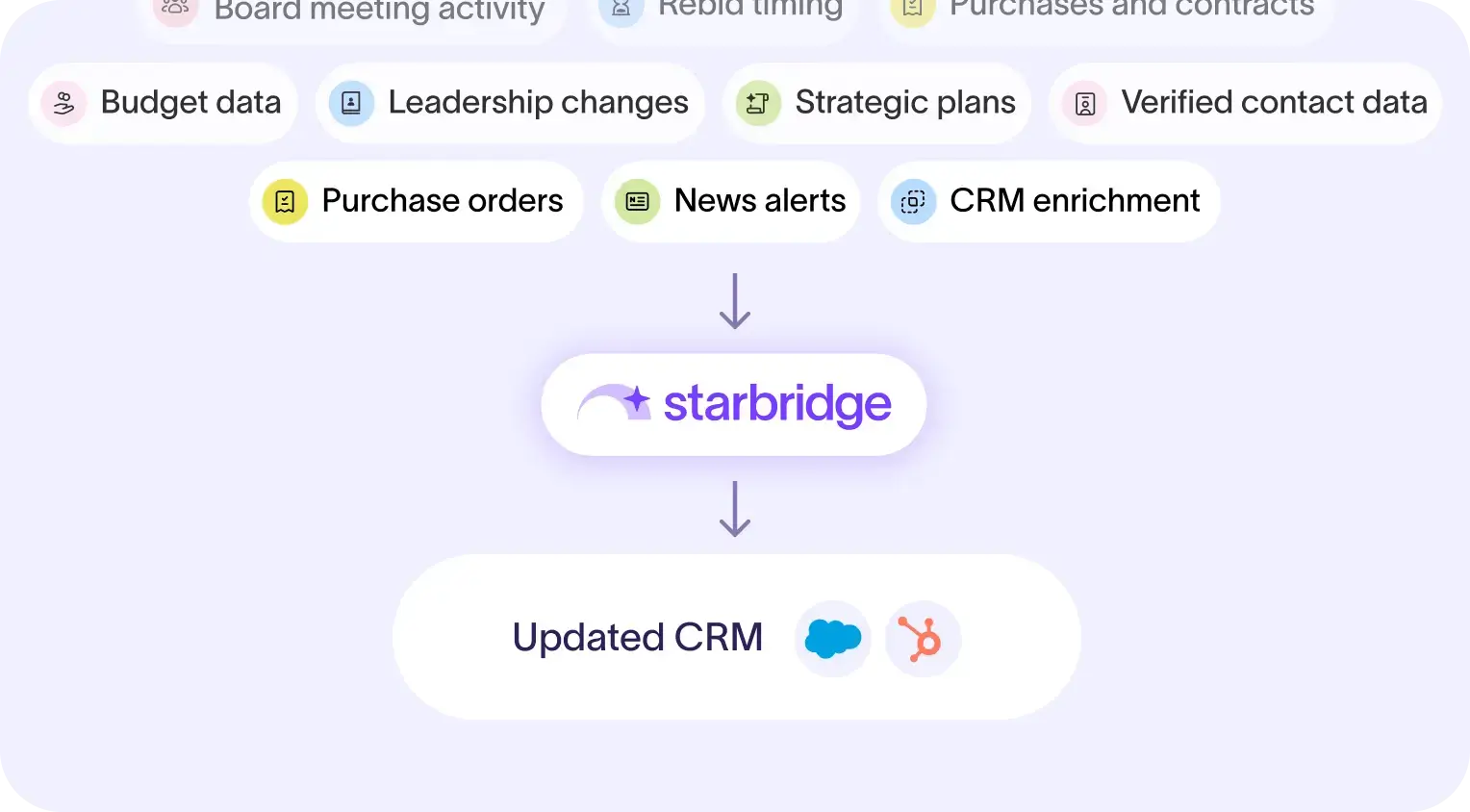
InquirED drove $200K in new pipeline in its first quarter by replacing manual board-document research with signal-driven account scoring. The manual method proves the deals are visible. Scoring at scale is how a team acts on every visible deal instead of the 30 it has time to read.
Conclusion
Strategic plans announce the priority 3 - 5 years in advance. Capital improvement plans fund it. Board agendas approve it. Sellers who read those documents in sequence stop reacting to RFPs and start choosing which deals to shape months before a solicitation exists.
The documents are free, public, and updated on a schedule you can calendar. Start with your top 25 accounts this week and read what those buyers have already told you. When you are ready to apply the same discipline across every account in your territory, book a demo to see how Starbridge turns board minutes and strategic plans into a ranked account list your reps can use to win deals.
Frequently asked questions
In the earliest documents, the timeline spans years. Capital improvement plans typically look five to ten years ahead, and strategic plans cover three to five years. Board discussion of a problem usually starts 12 to 18 months before procurement. Agenda packets are the last warning, appearing from a few days to a week before an approval vote.
A strategic plan states priorities without assigning money. A capital improvement plan assigns costs, timelines, and funding sources to specific projects over a multi-year period, and its first-year projects feed directly into the annual capital budget. The strategic plan tells you what a buyer wants. The CIP shows what the buyer funded.
Explore our use case library
Ready to give your SLED team real leverage?
Let’s talk about how Starbridge can build a qualified pipeline for your current team — without adding headcount.